


So, you’re thinking about setting up as a sole trader? The first and most important thing you need to do is tell HMRC you exist. That’s it. Registering for Self-Assessment is the one action that officially gets your business off the ground.
It's the most popular and straightforward way to start a business in the UK for a reason. Everything else, from picking a name to sorting your finances, flows from that single step.
Deciding to be your own boss is a huge milestone. Setting up as a sole trader is easily the quickest and simplest way to get there, letting you focus on what you're good at instead of drowning in paperwork.
Unlike forming a limited company, there are no registration fees with Companies House. You simply are the business, and the business is you. This direct link is one of its biggest perks—you have total control and get to keep all the profits after tax.
It’s no surprise that this model is so common. Sole traders make up the bulk of British businesses, accounting for around 74% of all UK businesses. That's about 4.15 million ventures, from freelancers and contractors to small local shops. As explained by The Company Warehouse, this simplicity is a massive draw.
When you operate as a sole trader, there's no legal curtain between you and your business. This is a double-edged sword and has two big implications you need to get your head around from day one:
This guide is your roadmap. We’ll walk through every essential step, from the official registration process to managing your money properly right from the start.
As you can see from the government's own guidance, the main job is just letting HMRC know you're now self-employed.
So, what's next? We’ll cover everything you need to feel confident and prepared. That means registering with HMRC, getting to grips with National Insurance contributions, picking a business name that doesn't get you into trouble, and setting up your finances.
A crucial part of that financial setup is getting a separate bank account. It’s not legally required, but it’s a non-negotiable for staying sane and organised. Our guide on how to set up a business bank account breaks down why this is so important and how to do it.
By the end of this guide, you’ll have a clear, actionable plan to launch and run your sole trader business without the guesswork.
Before we dive into the 'how-to', it's worth taking a moment to see how being a sole trader stacks up against the other main option: forming a limited company. This quick comparison should help clarify which path is right for you right now.
Remember, you aren't locked into being a sole trader forever. Many successful businesses start this way and then incorporate into a limited company later on as they grow and their needs change. For now, let’s focus on getting you up and running.
Right, let's get down to the single most important job on your to-do list: officially telling HMRC you exist. This isn't just a bit of admin; registering as a sole trader is what makes your business legitimate in the eyes of the taxman and gets you set up for Self-Assessment.
Getting this sorted from day one will save you a world of pain later on. Think fines, stress, and frantic calls to an accountant. The process itself is pretty straightforward, but you absolutely have to know the deadlines.
Don't worry, you're in good company. There are around 4.39 million self-employed people in the UK. It’s a hugely popular way to do business, and for good reason.
Get your calendar out, because this is the one date you really can't forget. You must register with HMRC by 5 October in your business's second tax year.
Just to be clear, the UK tax year runs from 6 April to 5 April.
So, if you started your business in July 2024 (which falls in the 2024/25 tax year), your deadline to register for Self-Assessment would be 5 October 2025. Miss it, and you’re looking at penalties. My advice? Just get it done as soon as you start trading.
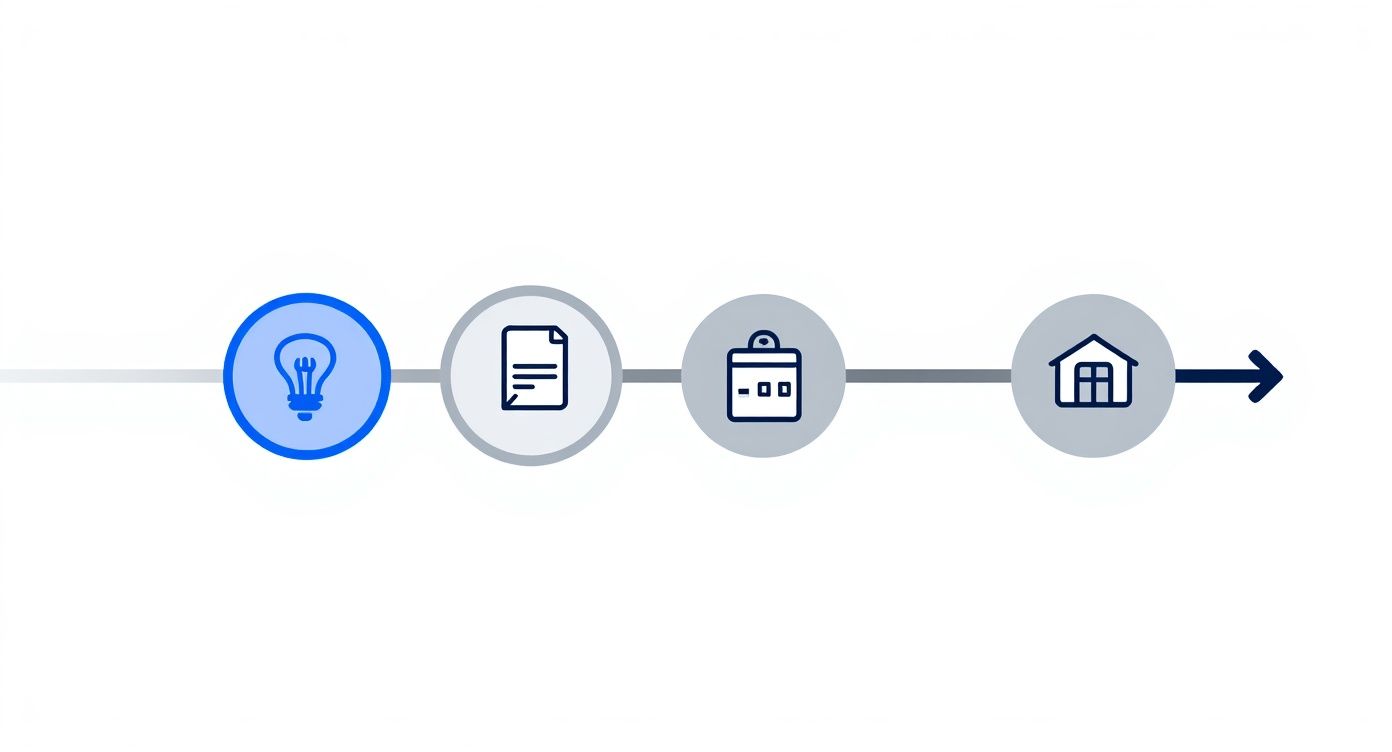
As you can see, getting registered is the central, non-negotiable step that formalises everything and lets you trade without constantly looking over your shoulder.
Once you're registered, you'll need to start thinking about National Insurance Contributions (NICs). This is what qualifies you for state benefits down the line, like the State Pension. For a sole trader, it usually boils down to two types:
The good news is you don't have to manage these separately. Both are calculated and paid through your annual Self-Assessment tax return, keeping your main tax obligations in one place.
Key Takeaway: Your Self-Assessment tax return is where it all comes together. It’s not just for Income Tax; it's also how you'll declare your earnings and pay the right amount of National Insurance based on your profits.
With the tax system moving more and more online, keeping good records is no longer just a good idea—it's essential. To see what's coming, it's worth reading up on Making Tax Digital for Self-Assessment to understand the new rules.
Start keeping meticulous records of every penny in and out from the moment you begin. Trust me, this simple habit will make filing your first tax return infinitely less painful and ensure you only pay what you owe.
Once you've registered with HMRC, the next thing on your mind will likely be your business identity. Deciding on a name isn't just a creative task; it's a crucial step that comes with a few rules you'll need to follow as a sole trader.
Your name should be professional, memorable, and, most importantly, legally compliant.
You’ve got a lot of flexibility here. Many sole traders just use their own name – think "John Smith Plumbing." Simple and effective. Or, you could go for a distinct trading name like "Pinnacle Plumbing," as long as it doesn't mislead anyone or step on an existing trademark.

The government has some clear guidelines to avoid confusion and misrepresentation. When you're brainstorming names, keep these restrictions in mind:
Before you get the business cards printed, a quick search online and on the Companies House register is a smart move. This simple check helps make sure your chosen name isn't already taken, saving you from potential confusion or legal headaches down the line.
A basic name search is a good start, but you also need to check the UK's intellectual property database for existing trademarks. Using a name that's already trademarked, even by accident, could land you in serious legal trouble for infringement.
Once you’ve settled on a name, it's worth thinking about whether trademarking your business name is necessary to protect your brand. While it's not mandatory for sole traders, trademarking is the only way to get exclusive rights to use that name for your specific goods or services. If you have big plans for your brand, this is something you should seriously consider.
Your legal duties don't stop with your business name. Depending on your industry, you might need specific permits or licences to operate legally. This is where it pays to be thorough.
Real-World Example: A freelance graphic designer working from home probably won't need any special licences. In contrast, someone starting a mobile catering business will need to register with their local council and get the right food hygiene certifications.
Think carefully about what your business actually does. Do you play music for customers in a shop or café? You'll need a music licence. Do you work with children? A DBS check will be required. These details are non-negotiable. For a more detailed look, have a read of our complete guide on how to start a business in the UK.
Finally, let's talk about business insurance. While it’s not always a legal requirement, public liability insurance is a must-have for most sole traders. It covers you if a client or member of the public is injured or their property is damaged because of your business. Don't think of it as just another expense; it's a vital safety net that protects your personal finances if the worst happens.
Getting your finances right from the very beginning isn't just good practice; it's the foundation of a healthy, sustainable business. Simple financial habits, built from day one, will save you countless hours of stress and head-scratching when it’s time to file your tax return.
The single best thing you can do when you set up as a sole trader is to open a separate business bank account. While it's not a strict legal requirement, I’ve seen enough messy accounts to know that mixing business and personal transactions is a recipe for chaos. A dedicated account creates a clear financial boundary, making it incredibly easy to track your income and expenses.
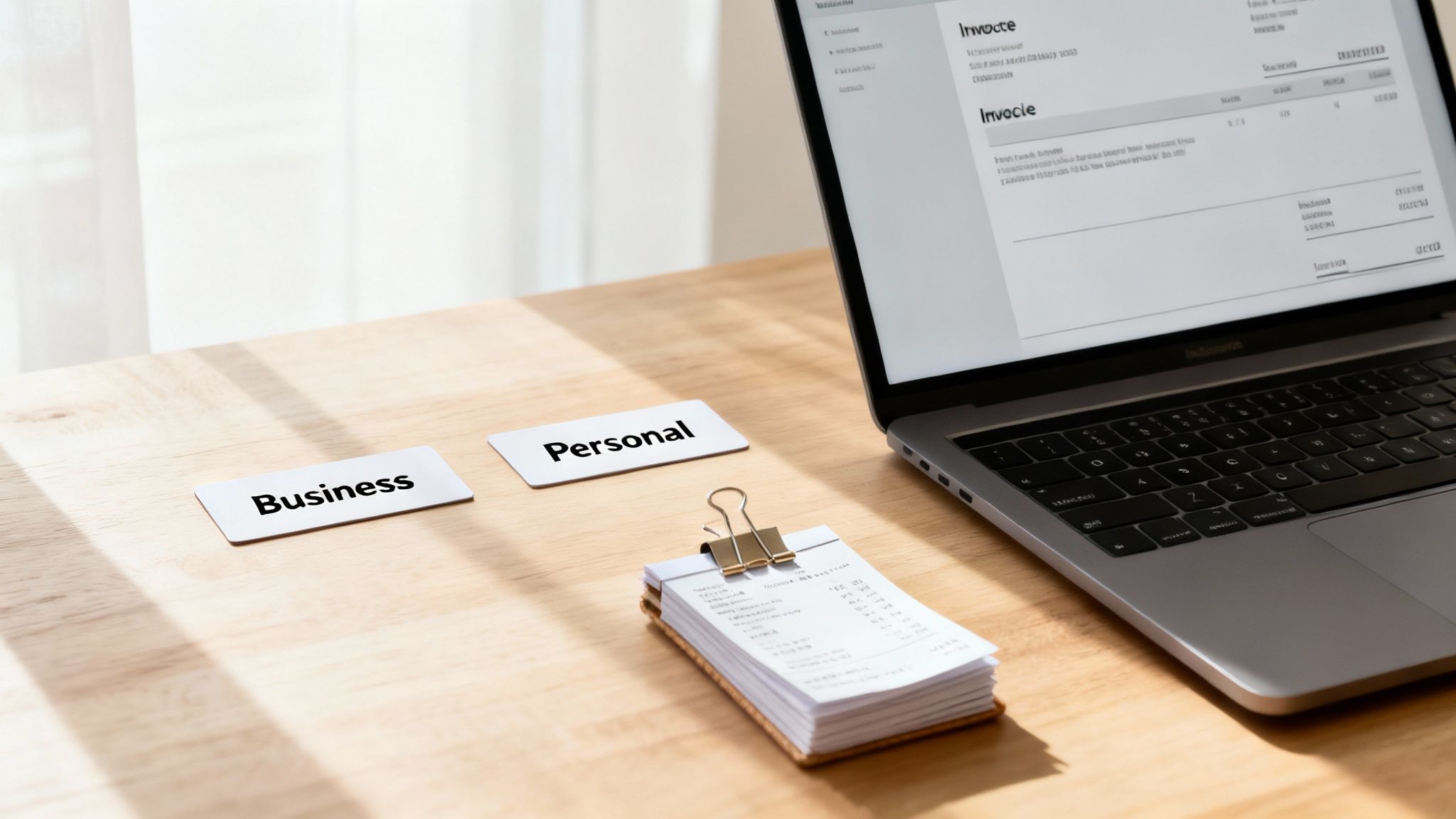
This separation isn't just for your own sanity. It provides a clean, auditable trail for HMRC and makes calculating your profit a straightforward task, rather than an archaeological dig through your personal spending.
Once your banking is sorted, your next priority is record-keeping. HMRC requires you to keep accurate records of all your business sales and expenses. This isn't optional, and failing to do so can result in some pretty hefty penalties.
So, what exactly do you need to hang on to?
Crucially, you need to hold onto these records for at least five years after the 31 January submission deadline of the relevant tax year. For example, for the 2024/25 tax year (which ends on 5 April 2025), you must keep your records until at least the end of January 2031. For some extra guidance, check out these 8 Practical Small Business Bookkeeping Tips.
Your invoice is more than just a request for payment; it’s a professional document that represents your business. A clear, complete invoice not only looks the part, but it also helps you get paid faster and keeps your records tidy.
Pro Tip: Don't be shy about clearly stating your payment terms on every invoice. Whether it's 14, 30, or 60 days, setting this expectation upfront prevents awkward conversations and helps you manage your cash flow.
A professional invoice is all about clarity and making it easy for your client to pay you. A good one will prevent any back-and-forth and ensure you have all the details you need for your own records.
Use this checklist to ensure your invoices include all the key details required for clear communication and prompt client payment.
Including these elements makes you look professional, helps your client’s accounts department, and ultimately, gets you paid on time.
Manually tracking everything in a spreadsheet works when you’re just starting out, but it can quickly become a time sink and is notoriously prone to errors. This is where accounting software becomes a game-changer.
Modern accounting tools are designed for people who aren't accountants. Platforms like FreeAgent, QuickBooks, and Xero can connect directly to your business bank account, automatically categorising transactions and making bookkeeping almost effortless. They let you create and send professional invoices, track expenses by snapping photos of receipts, and even estimate your tax bill in real-time.
Honestly, investing in one of these tools is an investment in your time and peace of mind. But if you find the whole process overwhelming, professional bookkeeping services can manage it all for you, ensuring everything is accurate and compliant right from the start. That frees you up to focus on what you do best—running your business.
Let's talk about Value Added Tax, or VAT. It's a term that tends to cause a bit of unnecessary panic for new business owners, but here’s the good news: when you first set up as a sole trader, it’s probably not something you need to lose sleep over.
Most small businesses can operate for quite a while before hitting the point where VAT registration becomes a legal must.
The key is to get your head around the VAT registration threshold. Think of it as the magic number that tells you when you must register with HMRC. For the 2024/25 tax year, that figure is £90,000 in VAT-taxable turnover.
Crucially, this isn’t measured against the tax year or your own business's financial year. It's based on a rolling 12-month period. That means at the end of every single month, you need to glance back over the previous 12 months and add up your total sales. Once that cumulative figure hits the £90,000 mark, registration becomes mandatory.
Once you cross that threshold, you don’t have a choice—you have to register. But you can also choose to register for VAT voluntarily, even if your turnover is nowhere near the limit. I know, that sounds a bit counterintuitive. Why invite more admin?
Well, there are some specific situations where it’s actually a smart move.
If you mainly sell to other VAT-registered businesses, for instance, registering lets you reclaim the VAT you pay on your own business expenses. We’re talking about things like new equipment, software subscriptions, and stock. Suddenly, you can claim that 20% back, which can seriously reduce your overheads.
Real-World Scenario: Imagine you're a freelance video editor who has just splashed out thousands on a powerful new computer and the latest editing software. By voluntarily registering for VAT, you could claim back the 20% VAT you paid on those big-ticket items. That could easily be a saving of hundreds, if not thousands, of pounds.
Deciding whether to register voluntarily is a strategic call. For a more detailed look at the numbers and how it all works, you can learn more about the current VAT registration threshold and what it really means for your business.
For most new sole traders, the simplest approach is just to keep a close eye on your turnover. As you start getting closer to that £90,000 figure, you can begin preparing to register without any last-minute rush, keeping you compliant and in full control.
The beauty of being a sole trader is its sheer simplicity, but that doesn't mean it’s the right fit for your business forever. As you find your feet and start to grow, there will come a moment when you need to step back and think strategically about what’s next.
Knowing when to make that shift is key. Often, it's a financial tipping point. When your annual profits start hitting the £30,000 to £40,000 mark, forming a limited company suddenly becomes a much more tax-efficient way to operate. This structure lets you pay Corporation Tax on profits and then draw income through a mix of salary and dividends, which can often slash your overall tax bill.
But it's not just about the numbers. Other signals might tell you it’s time for a change. Perhaps you’re taking on bigger projects and want to shield your personal assets—like your home—from business risks. A limited company gives you that protection through limited liability. Or maybe you want to project a more polished, established image to win over larger corporate clients, who often prefer (or even require) their suppliers to be incorporated.
This isn't just theory; it's a real trend. The latest figures from the Office for National Statistics showed a 4.1% drop in sole proprietorships last year, while the number of limited companies climbed by 1.8%. It’s clear that many business owners are making this exact strategic move. You can dig into the data yourself in the UK business population estimates on ONS.gov.uk.
My take: Switching to a limited company isn't just a box-ticking exercise to save a bit of tax. It’s a fundamental shift in how you protect yourself, how you're perceived, and how you build a business that can grow, attract investment, and one day, even be sold.
Yes, there's more admin involved with a limited company—you'll need to file annual accounts and a confirmation statement with Companies House. But for a growing business, the benefits of protection, credibility, and tax planning are often well worth the extra effort. Thinking about these triggers early helps you build a clear roadmap for the future.
Even the clearest plan can leave you with a few "what ifs". It's completely normal. Here are some quick answers to the most common questions we get from new sole traders, designed to clear up any confusion and get you moving.
Yes, absolutely. It’s incredibly common for people to run a business on the side while holding down a full-time job.
You simply need to declare your sole trader income on your annual Self Assessment tax return. Your employer doesn’t need to be involved at all, though you might notice HMRC adjusts your main job's tax code to make sure you're paying the right amount of tax overall.
This one’s easy: registering as a sole trader with HMRC is completely free. There are no government fees to pay.
Any initial costs you face will be for the things your business actually needs to operate – maybe some new equipment, specific insurance for your trade, or a simple website to get your name out there.
Key Insight: One of the biggest myths is that there's a hefty setup fee. The only real investment at this stage is your time and whatever resources you need to get your business off the ground, not government registration.
The official deadline to register is 5 October after the end of the tax year in which you started trading. If you miss it, HMRC can issue penalties.
These fines tend to get bigger the longer you leave it. My advice? Just get it done as soon as you start trading. It saves a world of stress and ensures you stay on the right side of the rules from day one.
Getting set up is just the first step. At GenTax Accountants, we help sole traders like you manage their finances and tax obligations right from the start, leaving you free to focus on what you do best: growing your business. Find out how we can support you at https://www.gentax.uk.
