



When it comes to contracting, the first big decision you’ll face is how to structure your business. It boils down to a classic trade-off: convenience versus control.
An umbrella company essentially hires you as an employee. They take care of all the invoicing, tax, and admin for a fee, making it a fantastic, low-hassle option for short-term gigs or for those just dipping their toes into the contracting world. On the other hand, setting up your own limited company gives you far more control over your finances and can be much more tax-efficient, but it also means you’re the one wearing the company director hat.
Choosing the right path is a critical first step for any UK contractor, as it has a direct impact on your take-home pay, how much paperwork you'll have to deal with, and your legal responsibilities. For most people, the best choice really depends on the length of their contract, their daily rate, and frankly, how much they enjoy (or despise) business admin.
Think of an umbrella company as a safety net that feels a lot like traditional employment. A limited company, however, offers the freedom and potential for higher earnings that comes with true self-employment.

To help you get your head around it, this quick comparison lays out the fundamental differences at a glance. It's designed to give you a clear, high-level overview before we dive deeper into the nuts and bolts of each option. Most contractors find that seeing these core distinctions side-by-side gives them immediate clarity on which route aligns better with their career goals.
This table gives you a straightforward summary of the key differences between operating through an umbrella company and running your own limited company.
As you can see, there’s no single "best" answer—it's all about what fits your personal circumstances and professional ambitions. The right choice for a three-month project inside IR35 will be completely different from the right choice for a seasoned contractor juggling multiple long-term clients.
Think of an umbrella company as a straightforward intermediary that acts as your employer. For a lot of contractors, this completely simplifies how they manage their contracts and finances. Instead of jumping through the hoops of setting up a business, you simply become an employee of the umbrella company. They sign the contract with your agency or client, leaving you to get on with the actual work.
This model strips away nearly all the administrative headaches that come with contracting. The process is clean and simple: you submit your timesheets, and the umbrella company takes care of everything else. They’ll invoice the client, chase the payment, and then run your payroll.

The real appeal for many is how your pay is handled. The umbrella company calculates and deducts all the necessary taxes and National Insurance contributions right from your earnings via the Pay As You Earn (PAYE) system—just like any other permanent employee. This process keeps you fully compliant with HMRC, so there are no nasty surprises or unexpected tax bills down the line.
The core purpose of an umbrella company is to offer a compliant and hassle-free employment structure. It neatly bridges the gap between traditional employment and independent contracting, making it a low-risk entry point into the contracting world.
The payslip you get will clearly break down all the deductions, so you know exactly where your money is going. This will typically include:
This level of transparency means you have a solid grasp of your take-home pay without ever needing to wrestle with business accounts. For contractors who just want a reliable and professionally managed payment system, this kind of payroll service is the heart of the umbrella model.
One advantage that often gets missed in the umbrella vs limited company debate is gaining access to statutory employment rights. By being an employee of the umbrella company, you’re legally entitled to a safety net of benefits.
These benefits usually cover the essentials:
This setup is perfect for contractors who prioritise security and predictability. It provides genuine peace of mind, knowing you have fundamental protections while still enjoying the freedom of contracting. For anyone on their first contract or working on a project that falls 'inside IR35', this simplicity is often the clincher.
For contractors chasing maximum financial control and a better bottom line, forming your own limited company is the definitive move. This isn't just about changing how you get paid; it transforms you from a contractor into a business owner, putting you in the director's seat of your own Personal Service Company (PSC). It’s a serious step up, bringing a lot more autonomy and responsibility.
The journey starts by registering your business with Companies House. This one action establishes it as a distinct legal entity, completely separate from your personal finances. This legal wall is the bedrock of a limited company, shielding your personal assets from business debts and liabilities. From there, you'll need to open a dedicated business bank account—a legal must-have—to handle all company income and expenses.

As the director, you're in complete charge. You'll be invoicing clients, managing cash flow, and strategically claiming legitimate business expenses. This level of control opens up financial optimisation that you simply don’t get under an umbrella company. You can claim for a wide range of costs, including:
Operating as a limited company director means you're not just completing a contract; you're actively running a business. This demands a proactive approach to financial management and compliance, but the rewards in both take-home pay and professional freedom can be substantial.
This structure is known for its superior tax efficiency, mainly because of how you pay yourself. Most directors take a small, tax-efficient salary combined with larger dividend payments drawn from the company's post-tax profits. Because dividends aren't subject to National Insurance contributions, this approach often leads to a significantly higher take-home pay compared to a standard PAYE salary. It's also worth understanding how a business loan can affect personal credit, as this can influence your personal financial standing.
Navigating all these responsibilities, from corporation tax returns to filing annual accounts, usually calls for professional backup. Working with specialist accountants is essential for anyone running limited companies. They make sure you stay compliant while helping you make the most of the financial perks. Think of it as a partnership—one that’s key to balancing the admin load with the significant benefits of being your own boss.
When it comes to the umbrella company vs limited company debate, nothing looms larger than IR35. Known formally as the off-payroll working rules, this bit of legislation is all about figuring out your real employment status for tax. It's designed to stop 'disguised employment' – where a contractor works through their own limited company but, for all intents and purposes, looks just like a regular employee.
For a limited company director, getting on the wrong side of an IR35 investigation is a serious risk. If HMRC decides your contract is 'inside IR35', they see you as an employee for tax purposes. This wipes out the tax advantages of your limited company and can leave you with a hefty bill for back-dated tax and National Insurance.
The game really changed a few years back when the government shifted who was responsible for making the IR35 call. For most contracts, it's now the end client, not the contractor, who has the legal duty to decide if a role falls inside or outside the rules. This has made a huge difference, as many clients are now far more cautious.
To sidestep the headache and potential financial penalties of getting it wrong, many big organisations simply insist that contractors working on 'inside IR35' roles must use a PAYE solution. This is exactly where an umbrella company becomes the go-to, compliant option.
If your client says the contract is 'inside IR35', an umbrella company is your safe harbour. You're already an employee of the umbrella company, so all your taxes are handled correctly through PAYE. This completely removes any IR35 risk for you, your recruitment agency, and your client.
Looking back, the direction of travel for IR35 is crystal clear. The rules first appeared back in 1999, were rolled out to the public sector in 2017, and then hit the private sector in April 2021. That last change was a bombshell, sparking a major move towards umbrella companies as contractors and clients looked for a simple, compliant way to work. In fact, HMRC estimated that around 70% of contractors in the private sector would be affected, forcing a rethink of their business setup. You can get a better sense of how contractors have navigated this by checking out these insights on umbrella company comparisons.
This legislative pressure means your IR35 status is the first question you need to answer:
At the end of the day, you can't make this choice in a vacuum. Your client's IR35 determination directly shapes which structure is financially viable and compliant, making a solid grasp of the rules absolutely essential.
Let's get straight to it. For most contractors, the big question in the umbrella company vs limited company debate boils down to one thing: your net earnings. While both get you contracting, the way your income is handled and taxed is worlds apart, and that directly impacts what lands in your bank account. It’s not about your day rate; it’s about what you keep.
Working through an umbrella company is straightforward. They run a standard PAYE (Pay As You Earn) system, meaning they deduct income tax, both employee's and employer's National Insurance Contributions (NICs), and their fee right from your invoice. But this simplicity has a price—all your earnings are treated as salary, which usually means keeping less of what you earn.
On the other hand, a limited company opens up a much more tax-efficient way of working, especially for contracts outside IR35. As a company director, you can pay yourself a small, tax-savvy salary and then draw the rest from the company’s post-tax profits as dividends.
The financial gap between these two routes can be pretty significant. Contractors using an umbrella company often see a hefty slice of their income go to taxes and fees. For instance, on a gross income of £50,000, a contractor might see their annual take-home pay shrink by £8,000 to £10,000, depending on the umbrella's margin.
A limited company gives you the tools for much greater financial control, especially for higher earners, though it does come with more admin. You can find more detailed breakdowns in this contractor take-home pay comparison on gorillaaccounting.com.
The real magic of a limited company’s financial setup is dividends. The crucial point here is that dividends aren't subject to National Insurance. That alone creates an immediate and substantial saving compared to a PAYE salary. By keeping your salary low (often just enough to qualify for state benefits) and taking the rest as dividends, you can seriously boost what you take home.
The tipping point usually comes when your earnings are high enough that the tax savings from the salary-and-dividend model easily cover the accountancy fees and admin time needed to run your own company.
This strategic approach lets you make the most of various tax-free allowances. It’s crucial to get the rules right, of course, and you can get up to speed with our guide to the UK dividend allowance. For contractors on long-term projects with healthy day rates, this structure is almost always the more profitable path.
Deciding between an umbrella and a limited company isn't about which one is better overall, but which is the right fit for you, right now. The best choice really hinges on a few key things: your contract's IR35 status, how long it runs, your day rate, and frankly, how much admin you're willing to put up with. There’s no one-size-fits-all answer here, just the structure that aligns with your current professional needs.
For instance, if you're a contractor just starting out on a three-month project that's been deemed 'inside IR35', an umbrella company is almost a no-brainer. The setup is practically instant, the paperwork is minimal, and you don’t have to worry about IR35 compliance because it’s all handled for you. It’s a low-risk, simple way to get into the contracting world.
This visual decision tree breaks down how your contract rate translates into take-home pay under each structure.
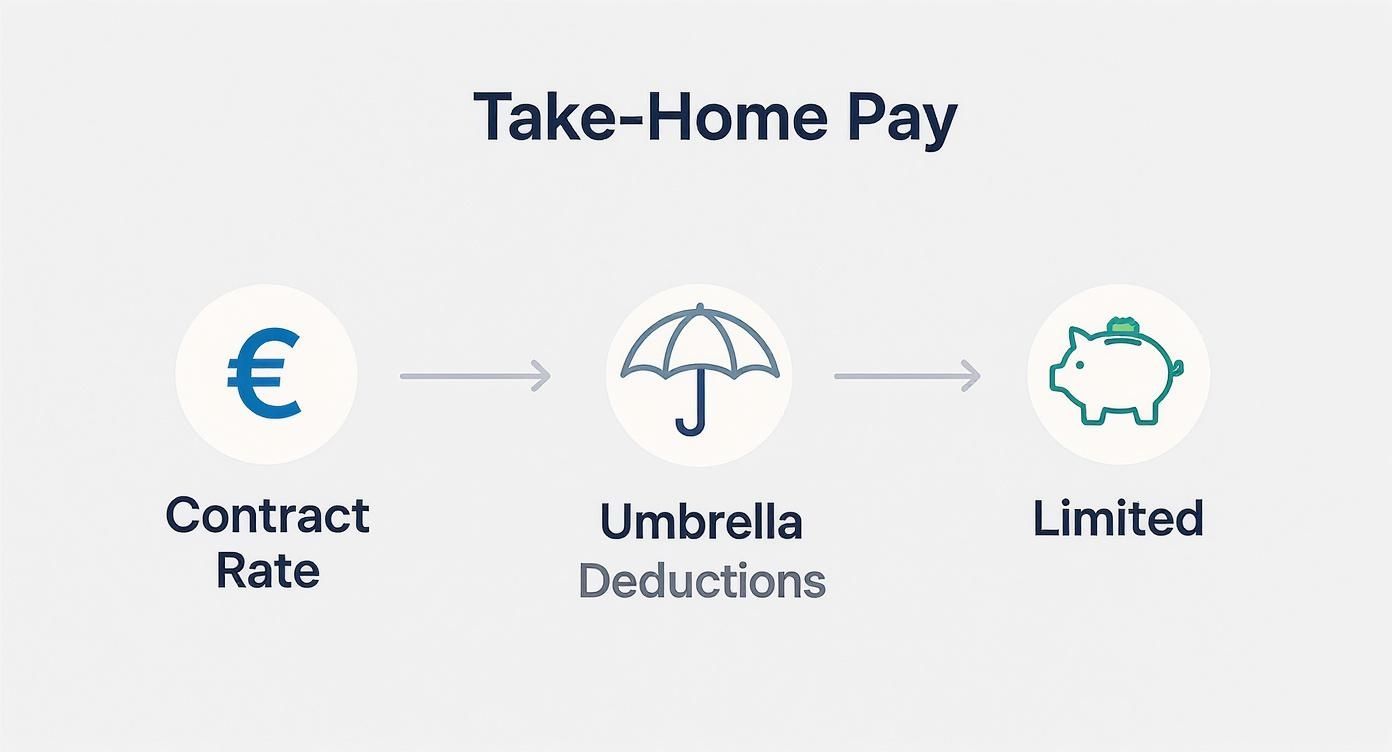
As the infographic shows, while the limited company route (the piggy bank) offers higher earning potential, the umbrella path (the deductions icon) is a more straightforward, though lower, return after all the taxes are sorted.
At the other end of the scale, think of a seasoned project manager on a £600-per-day contract that’s clearly 'outside IR35'. For them, operating through their own limited company is the most logical and financially rewarding path. Being able to manage their business expenses and draw income through a tax-efficient mix of salary and dividends means significantly more money in their pocket, making the extra admin well worth the effort.
Then you have contractors whose main goal is security and simplicity. If you value statutory benefits like holiday and sick pay, and the idea of doing zero paperwork beyond submitting a timesheet sounds like a dream, an umbrella company is the perfect choice, regardless of your contract’s length or rate.
Your choice is a direct reflection of your career priorities. If your priority is maximum take-home pay and business control on an outside-IR35 contract, choose a limited company. If it's simplicity, compliance, and security, especially for inside-IR35 roles, choose an umbrella.
The market has definitely shifted over the years, especially in response to new legislation. Before the IR35 reforms came into full effect, limited companies were the default choice for most, thanks to their tax efficiency. However, the reforms triggered a huge swing towards umbrella companies as contractors sought a compliant, hassle-free alternative. By 2021, it was estimated that hundreds of thousands of contractors had moved to umbrella arrangements, with the biggest providers servicing thousands of contractors and agencies. You can dig deeper into the growth of umbrella companies on goforma.com.
This shift just goes to show how external factors can change which structure makes the most practical sense at any given time. By analysing your specific situation against these real-world scenarios, you'll be in a much better position to make a confident and suitable decision for your contracting career.
Even with all the facts laid out, it's natural to have a few lingering questions. Deciding between an umbrella and a limited company is a big step, so let's clear up the most common queries contractors ask.
Absolutely. It’s incredibly common for contractors to move between these two structures, and the process is usually pretty straightforward.
Many contractors dip their toes in the water with an umbrella company first. It’s simple, low-admin, and a safe bet for a first contract or a role that’s definitely inside IR35.
But what happens if your situation changes? Say you land a long-term, high-value contract that's firmly outside IR35. At that point, you can easily form your own limited company. All it involves is giving your umbrella provider notice and getting an accountant on board to handle the company formation for you.
The difference is night and day, and it has a direct impact on your take-home pay.
As a director of your own limited company, you can claim a whole host of legitimate business expenses against your company's profit. This is a huge advantage, as it lowers your corporation tax bill. We're talking about costs for essential equipment, professional training, business travel, and more.
Under an umbrella company, your hands are tied. HMRC rules on Supervision, Direction, or Control (SDC) are very strict, meaning most umbrella contractors can't claim tax relief on everyday expenses like travel to work or meals. It's only possible in very specific, rare circumstances.
Each structure offers a different kind of financial security. An umbrella provides the safety net of employment rights like sick pay, while a limited company’s higher earning potential allows for self-directed security through private savings and investments.
This really depends on what "security" means to you.
An umbrella company gives you the kind of safety net you'd get in a permanent job. You get statutory employment rights like sick pay, holiday pay, and maternity or paternity leave. It's predictable and reliable.
A limited company, on the other hand, offers zero automatic benefits. You're on your own when it comes to things like pensions and income protection. However, the trade-off is the potential for much higher take-home pay, which gives you the financial firepower to build your own security through private insurance, savings, and investments.
Once you've set up your limited company, our guide on how to set up a business bank account can help you with the next essential step.
At GenTax Accountants, we specialise in guiding contractors through these crucial decisions. Contact us today to ensure your business structure is perfectly aligned with your career goals.
