


Filing a corporation tax return is a must-do for every single limited company in the UK. It doesn't matter if you've made a profit, a loss, or are completely dormant – if your company exists, you have to file. The whole process boils down to working out your taxable profit, filling in the CT600 form, and getting it over to HMRC online, usually within 12 months of your company's year-end.

Before you jump into the paperwork, it's really important to understand what HMRC expects. This isn't just a box-ticking exercise; it's a fundamental legal duty for every limited company. I've seen businesses trip up thinking that because they made a loss or stopped trading, they could just ignore it. Unfortunately, that's not how it works. The obligation is there right up until your company is officially dissolved.
Understanding this from the get-go puts you on the right track for managing your tax properly and avoiding any nasty surprises.
One of the biggest hurdles for new business owners is the gap between the profit in your company accounts and the profit HMRC actually taxes you on. They’re almost never the same number.
Your statutory accounts, the ones you prepare for Companies House, show your accounting profit. But for tax purposes, you need to calculate your chargeable profit (often called taxable profit). This means making a few key adjustments.
For example, client entertainment is a perfectly legitimate business cost in your accounts, but you can't deduct it for tax. You have to add "disallowable expenses" like this back to your profit before working out your tax bill. On the flip side, you can deduct capital allowances for things like equipment purchases, which will likely be different from the depreciation figure in your accounts. Getting your head around what is corporation tax and these adjustments is crucial for getting it right.
Your Corporation Tax accounting period is simply the stretch of time your tax return covers. For most businesses, this lines up neatly with the 12-month financial year shown in your company accounts.
But life isn't always that simple. Things can get complicated if:
A classic mistake is just assuming your accounting period is always a tidy 12 months. Always double-check the start and end dates HMRC holds for your company. Filing for the wrong period is a surefire way to get an automatic penalty.
The tax you'll actually pay depends entirely on your chargeable profits. The UK has moved on from the old single flat rate, so things are a bit more complex now.
Since April 2023, there's been a tiered system. The main rate of Corporation Tax jumped from 19% to 25% for companies with profits over £250,000. If your profits are £50,000 or less, you'll pay the small profits rate of 19%.
What if you're in between? If your profits fall somewhere between £50,000 and £250,000, you'll get 'marginal relief', which works out as a tapered rate. This new structure makes getting your profit calculation spot-on more important than ever. You can read a bit more about this change in the UK corporate taxation landscape on shorts.uk.com.
Getting your corporation tax return right starts long before you even think about filling in the CT600 form. It all comes down to one thing: the quality of your financial records. Think of it as the foundation of a house – if it’s weak, everything built on top is at risk of crumbling.
Your bookkeeping isn't just about tracking what comes in and what goes out. It’s the proof that underpins every single number you declare to HMRC. Shoddy records lead to guesswork, and guesswork leads to mistakes. That could mean you overpay tax, or worse, you underpay and find yourself facing a dreaded HMRC enquiry.
First things first, you'll need a complete set of your company’s year-end accounts. This isn't a 'nice-to-have'; you must file these statutory accounts with your CT600. The two headline documents are your Profit and Loss statement and your Balance Sheet.
These can't just be high-level summaries. A single line for "expenses" won't do. You need a proper breakdown of every cost so you can clearly see what's an allowable business expense and what isn't. Keeping on top of this throughout the year is key. If it all sounds like a headache, professional https://www.gentax.uk/services/bookkeeping can be a lifesaver, freeing you up to run your business.
This is where so many business owners trip up. The profit figure on your P&L statement is almost never the amount you actually pay tax on. You have to make a series of adjustments to get from your accounting profit to your taxable profit. This whole process is laid out in a document called a "tax computation," which shows HMRC your workings.
Essentially, it involves two key steps: adding back any expenses that HMRC doesn't allow for tax relief and then subtracting special allowances they do permit.
Key Takeaway: The single most common source of errors is failing to correctly adjust accounting profit. HMRC specifically looks for disallowed expenses like client entertainment or personal costs being claimed, so meticulous record-keeping here is non-negotiable.
Common "disallowable" expenses that you must add back to your profit include things like:
Instead of letting you claim depreciation, HMRC has its own system: capital allowances. This is how you get tax relief on big-ticket "capital" purchases like machinery, office equipment, vans, and computers. For those looking to streamline the preparation of financial data for their tax returns, consider the benefits of using AI for financial analysis to help categorise and process these transactions more efficiently.
Beyond your main accounts, there are other crucial documents you’ll need to have handy. Having this information organised and ready to go will make the whole process feel less like wading through treacle.
Here's a quick checklist of the key records you'll almost certainly need.
Let's take the director’s loan account as a prime example of why this detail matters. If a director owes the company more than £10,000 and fails to repay it within nine months and one day of the company's year-end, the company gets hit with a temporary tax charge. This charge, known as a Section 455 tax, is a whopping 33.75% of the outstanding loan.
Without a crystal-clear record of the loan account, it's impossible to know if this tax is due, let alone calculate it correctly. Getting these details right from the start is what separates a smooth tax filing from a stressful one.
Right, you’ve got your records sorted and your taxable profit calculated. Now for the final hurdle: actually submitting your corporation tax return. The days of printing out forms and popping them in the post are long gone – everything has to be filed online. How you do it really depends on how complex your business is.
For a very straightforward business, maybe a small consultancy with minimal expenses, HMRC's own free filing service might just do the trick. But for most businesses, especially those claiming capital allowances on assets, you're going to need commercial accounting software.
This isn’t just a matter of preference. Since 2011, it's been mandatory to submit both your CT600 form and your company accounts in a specific digital format called iXBRL (Inline eXtensible Business Reporting Language). Don't worry, you don't need to know what that means – most commercial software handles this conversion for you automatically, which is a massive relief.
Getting this choice right is crucial. HMRC’s online service is really only built for the simplest of returns. If you need to do anything slightly more complicated, like claiming specific tax reliefs or managing losses from a previous year, it just won't cut it.
Commercial accounting software, on the other hand, is designed to handle the full spectrum of business activities. It walks you through the process, helps you work out capital allowances, and makes sure your accounts are correctly formatted in iXBRL without you having to think about it. Popular options you've probably heard of include Xero, QuickBooks, and FreeAgent, which often plug directly into HMRC's systems.
A word from experience: Don't let the cost of software put you off. The time you'll save and the potential errors you'll avoid make it a no-brainer. A single mistake from a manual filing could easily cost you more in penalties than a year's subscription to good software.
For many company directors, the easiest and safest route is simply working with an accountant. They use professional-grade software as standard, which guarantees compliance and gives you an expert eye to review your figures. You'd be surprised how often they spot savings you might have missed. If you need that peace of mind, exploring dedicated tax return services is well worth your time.
No matter which software you use, the basic process of submitting your return follows a similar path. It all starts with getting your login details sorted and ends with that final click to send everything off to HMRC.
Here’s a quick visual breakdown of the key stages involved in getting your tax information ready.
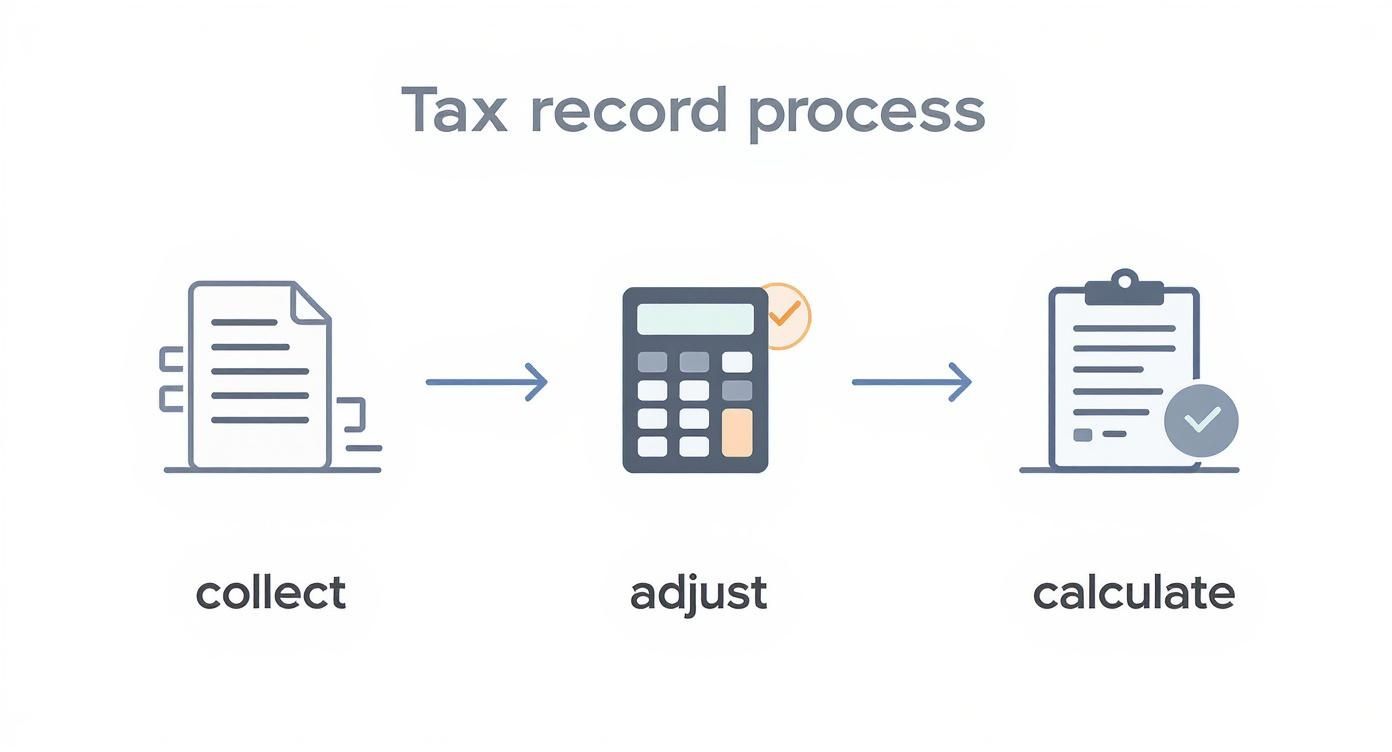
This just simplifies the journey from raw numbers to a final tax figure, showing how important each step is.
Here’s what that looks like in practice:
This is one of the most common – and costly – mistakes business owners make. The filing deadline and the payment deadline are not the same.
Let's make that real. Say your company’s year-end is 31st December 2024:
Miss the payment deadline and HMRC will start charging interest immediately. Miss the filing deadline and you'll get hit with an automatic penalty, starting at £100 for being just one day late. With around 4.87 million companies registered in the UK, HMRC's system is a well-oiled machine built to issue these penalties without exception.

Getting your CT600 filed is a huge relief, but you're not quite over the finish line. The final step—actually paying the bill—is just as important. A simple mistake here can lead to frustrating delays and HMRC chasing you for money you’ve already sent.
The most common tripwire I see is using the wrong payment reference. It’s a tiny detail that causes massive headaches.
Your Corporation Tax payment reference is a unique 17-character code, and it’s specific to the accounting period you’re paying for. This code changes every single year. If you reuse an old one, HMRC's system might not match your payment to the right bill, leaving them to think you haven't paid at all.
So, where do you find this crucial string of characters? HMRC usually includes it on the 'notice to deliver a Company Tax Return' they send out, as well as on any payment reminders.
You can also log in to your company's HMRC online account to find it. The format is always the same: it starts with your 10-digit UTR, followed by 'A001', and then two digits for the accounting period's end year (for instance, '24' for a period ending in 2024).
HMRC gives you a few different ways to settle your bill. The best choice often comes down to convenience and how close you are to the deadline.
Crucial Tip: Always double-check your bank’s processing times. Some payments can take up to three working days to clear. Paying on the deadline using a slower method is a classic mistake that can land you with late payment interest.
For the vast majority of companies, a simple bank transfer from your business account is the safest bet. If you’re just starting, getting a dedicated account is vital for keeping things clean. You can learn more about how to set up a business bank account to manage your finances from day one.
Staring at a tax bill you can't afford is incredibly stressful. The absolute worst thing you can do is bury your head in the sand. HMRC is often more reasonable than people expect, but only if you're proactive and communicate with them.
If you know you’re going to struggle to pay on time, you might be able to arrange a 'Time to Pay' agreement. This is essentially a payment plan that lets you spread the cost over several manageable instalments.
To have a chance of getting one, you need to contact HMRC's Payment Support Service as soon as you realise there's a problem. Be prepared to explain why you can't pay, what steps you've taken to find the money, and what you can realistically afford each month. Having a clear cash flow forecast ready will massively strengthen your case—they need to see you have a credible plan to get back on track.
Getting your corporation tax return submitted can feel like a huge weight off your shoulders. But one small slip-up can lead to some pretty unwelcome financial consequences. The best way to protect yourself from penalties, interest charges, and the stress of an HMRC enquiry is to know where the common tripwires lie.
Honestly, most of these errors are surprisingly simple. They often happen when you’re rushing to meet a deadline or just misunderstand the rules. From claiming for an expense that isn't allowed to missing the payment date by a single day, the financial knock-on effect can be significant. By knowing what to look out for, you can file with confidence and keep your company’s compliance record squeaky clean.
And make no mistake, this is a major source of revenue for the government. In the fiscal year 2024/25, UK corporation tax receipts hit around £91.6 billion, a huge jump from the previous year. This figure, highlighted in UK tax receipt statistics on Statista.com, shows just how vital these payments are. It's also why HMRC's systems are designed to automatically penalise errors and late submissions without hesitation.
This is, hands down, the most frequent and easily avoidable mistake I see. As we’ve mentioned, the deadlines for paying your tax and filing your return are different, a quirk that catches countless business owners out every year. Missing these dates triggers an immediate, automated penalty system.
I often speak to business owners who file their return on time but pay the tax bill a few weeks late, assuming they’ve done the hard part. They are always shocked to find a bill for late payment interest has been added to their account. My advice? Always treat the payment deadline as your most critical date.
Beyond simple lateness, the real trouble can start with what's actually in your return. Submitting a CT600 with careless mistakes or deliberate inaccuracies can lead to far larger penalties, which are calculated as a percentage of the unpaid tax.
One of the biggest red flags for HMRC is the incorrect treatment of expenses. It’s all too easy to assume that any money the business spends is tax-deductible, but the rules are very specific.
Here are a few of the most commonly misclaimed expenses:
Getting these adjustments wrong is a surefire way to understate your profit and, as a result, underpay your tax.
Finally, the bedrock of any solid tax return is good bookkeeping. It’s not just a suggestion; HMRC legally requires you to keep all your business records for at least six years from the end of the accounting period in question.
If HMRC decides to open an enquiry into your return, their first request will be to see the records that back up your figures. This means everything from sales invoices and bank statements to expense receipts and payroll data.
Failing to produce adequate records can result in penalties of up to £3,000. Even worse, if you can't provide proof for your figures, HMRC can simply reassess your tax liability based on their own estimates—which will almost certainly be higher than what you actually owe. Good record-keeping isn't just about ticking a compliance box; it's about protecting your business from an unfairly inflated tax bill.
Even with a detailed guide, it’s completely normal to have questions about your own specific situation. When it comes to corporation tax, one size rarely fits all. Below, I’ll tackle some of the most common queries we hear from business owners, giving you clear, straightforward answers to help you get it filed right.
Yes, you absolutely can. If your company's finances are very simple, HMRC offers a free online service for this. It’s designed for businesses with straightforward tax affairs – think basic income and outgoings, without things like capital allowances or more complex tax reliefs.
The moment your accounts get a bit more involved, however, you'll almost certainly need proper commercial accounting software. These platforms are built to produce the iXBRL format that HMRC requires for your accounts and can walk you through the trickier calculations.
Ultimately, it comes down to how confident you are with the numbers and how much time you're willing to put in. Going it alone can save you money upfront, but a simple mistake could easily land you with penalties that wipe out those savings.
Expert Insight: Many directors start out filing themselves but bring an accountant on board as the business grows. The value an expert provides in spotting tax efficiencies and guaranteeing compliance often makes it a very smart investment in the long run.
This is a really common point of confusion. Even if your company made a loss for the year, you absolutely must still prepare and submit a full corporation tax return. The legal requirement to file is linked to your company’s existence, not its profitability.
In fact, filing a return that shows a loss is actually a good thing. It officially records that loss with HMRC, which you can then carry forward to reduce your tax bill in future, profitable years. It’s a valuable tool for managing your company’s tax liability over time.
Don't make the mistake of thinking "no profit, no return." Forgetting to file will trigger the exact same late filing penalties as a profitable company would face, starting at £100 for being just a single day late.
We're all human, and mistakes can happen. If you spot an error after you've already filed your corporation tax return, you can submit an amendment. You generally have 12 months from the original filing deadline to make any changes.
Let's say your accounting period ended on 31 December 2024. Your filing deadline is 31 December 2025, which means you would have until 31 December 2026 to amend that return.
To make a change, you'll need to:
If the amendment shows you've overpaid tax, HMRC will sort out a refund. If it turns out you've underpaid, you’ll need to pay the difference plus any interest that has built up since the original due date.
While there’s no legal rule saying you must use an accountant, many business owners find it's one of the best decisions they make. A good accountant does far more than just fill out forms. They proactively ensure you’re claiming every allowable expense and tax relief you're entitled to, keeping your bill as low as legally possible.
They also provide that crucial peace of mind that you're fully compliant with HMRC's ever-changing regulations.
If you find the idea of calculating taxable profit, dealing with capital allowances, or getting your accounts into iXBRL format a bit overwhelming, getting professional help is a very wise move. An accountant acts as your safety net, catching potential errors before they become expensive problems. For any specific questions or to see how an expert could help your business, feel free to get in touch with our team of specialists.
At GenTax Accountants, we take the complexity out of corporation tax. Our expert team ensures your returns are accurate, compliant, and submitted on time, every time, letting you focus on what you do best—running your business. Visit us at https://www.gentax.uk to learn how we can help.
