


Registering for VAT is a big moment for any growing UK business. It all kicks off when your VAT taxable turnover hits £90,000 over any rolling 12-month period. Once you cross that line, HMRC gives you a strict 30-day window to get your online application sorted.
Knowing why you're registering for VAT is just as important as knowing how. At its core, it's a matter of legal compliance. Get it wrong, and you could face some hefty penalties. This isn't just a slap on the wrist; you could be forced to pay HMRC all the VAT you should have charged from the day you were meant to register. That can be a serious, and often unexpected, financial blow.
The trigger for mandatory registration isn't tied to your profit margins or the tax year. Instead, it’s based on your taxable turnover in any consecutive 12 months. This means you need to keep a constant eye on your sales. Imagine you're a freelance graphic designer who has a quiet spring but then lands a few huge projects in the autumn. If your total income from last October to this September tips you over the £90,000 threshold, your 30-day countdown to register begins right there and then.
Here’s a quick summary of the current VAT registration threshold and the critical timeframes you must follow once you exceed it.
Getting these dates right is absolutely essential to avoid penalties, so it's worth double-checking your numbers.
But you don't have to wait until you're forced to register. Many businesses actually choose to register for VAT voluntarily, long before their turnover gets anywhere near the limit. It can be a smart strategic move.
Key Insight: Voluntary registration lets you reclaim the VAT on your business expenses and purchases. If you buy a lot of VAT-able goods or services (think stock, software, or professional fees), this can give your cash flow a significant boost.
Here are a couple of common reasons a business might jump in early:
The right choice really comes down to your specific business model and your numbers. To help you weigh up the pros and cons properly, you can dive deeper into the specifics of the VAT registration threshold in our detailed guide. Whether you're registering because you have to or because you want to, getting your head around these fundamentals is the perfect starting point before you tackle the online forms.
Knowing you need to register for VAT is one thing, but getting through the online form without tearing your hair out is another. The secret to a painless application? Preparation.
Think of it like cooking a big Sunday roast – you wouldn't start throwing things in the oven without getting all your ingredients prepped first. Trying to register for VAT without your documents to hand is a recipe for frustration. You'll end up stopping halfway through to hunt for some obscure number, only for the HMRC portal to time out and wipe all your progress.
Let's get everything lined up so you can get it done in one focused session.
First things first, you’ll need a Government Gateway user ID and password. This is your digital key to pretty much all of HMRC's online services, and the VAT registration portal is no exception. If you've ever filed a Self Assessment tax return online, you're already sorted – you'll have one of these.
If not, this is your first job. Don't worry, it's a straightforward process of providing some basic details to prove you are who you say you are.
Here's what the login and registration page on the GOV.UK website looks like.
This portal will be your go-to for managing everything VAT-related, so once you've created your login, keep the details somewhere safe.
With your Gateway access sorted, it's time to gather the specific details HMRC will ask for. Having these in a neat pile (digital or physical) makes the whole thing feel less like a tax chore and more like a simple admin task. For a seamless VAT registration experience, refer to a comprehensive document management workflow guide to organize your paperwork efficiently.
Here’s a quick checklist of the essentials:
Rounding up these key identifiers beforehand will save you from that frantic last-minute scramble while the online form is ticking.
Beyond the basics, HMRC needs to understand your business's financial health and its activities. This is where accuracy is absolutely non-negotiable.
You’ll be asked for your exact VAT taxable turnover for the last 12 months. This is the figure that likely pushed you over the threshold, so it needs to be spot on. You'll also need to give a realistic projection of your turnover for the next 12 months, which helps HMRC gauge your growth.
My Advice: Don't pluck these figures out of thin air. Dig into your sales records, invoices, and any financial forecasts you have. Getting this wrong can lead to awkward follow-up questions from HMRC and will almost certainly delay your application.
Finally, you’ll need to clearly describe your main business activities. This involves choosing a Standard Industrial Classification (SIC) code that best fits what you do. For example, a freelance copywriter will have a very different code to a local coffee shop.
This little detail helps HMRC categorise you correctly. It's interesting to see how different business types approach this; in early 2025, only 12% of sole proprietorships were registered for VAT/PAYE, but that figure jumps to 44% for ordinary partnerships. It just goes to show that partnerships tend to hit the VAT threshold much faster. You can find more of these kinds of stats in this statistical release from GOV.UK.
With all this information compiled and ready, you're in the best possible position to make your online VAT registration quick, easy, and successful.
Alright, you've got your documents lined up and your Government Gateway ID is good to go. Now for the main event: tackling the online VAT registration form. This is where all that prep work really pays off, turning what could be a headache into a much more straightforward process.
Let's walk through the key sections of the portal together. I’ll break down what HMRC is asking for at each stage and give you some real-world context to help you fill it all out with confidence.
First things first, log into your Government Gateway account on the GOV.UK website and find the option to start a new VAT registration. The initial screens are fairly simple, mostly confirming who you are and which business you're registering. You'll also be asked to create a reference for your application, like your company name—do this, as it's a lifesaver if you need to save your progress and come back later.
To give you a bird's-eye view, here's a look at the core stages you'll be working through.
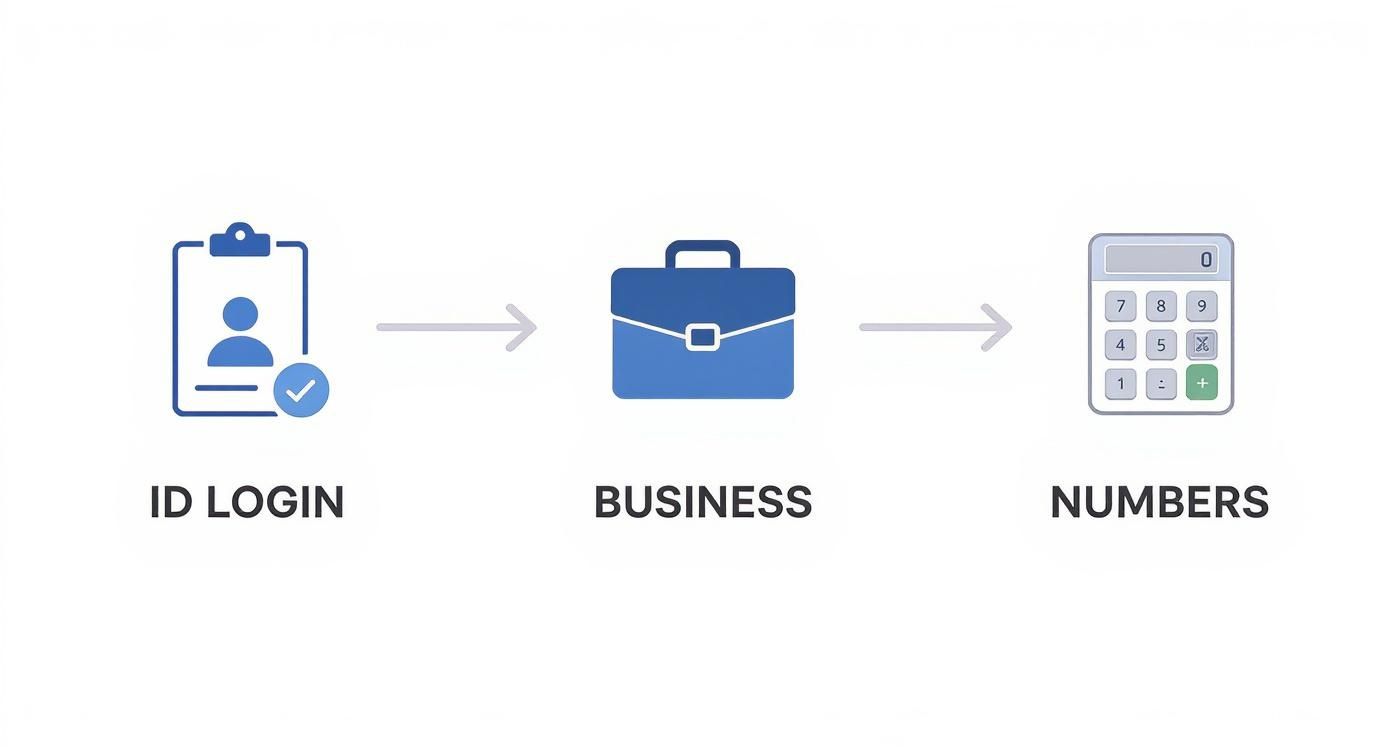
As you can see, it boils down to three key parts: verifying your identity, providing business details, and confirming the numbers. Nail these three, and you’re on the home stretch.
The first big section of the form is all about the 'who' and 'what' of your business. You'll need to pick your business type from a dropdown menu – sole trader, limited company, partnership, and so on. Your choice here dictates the questions that follow.
If you’re a limited company, you'll need your Company Registration Number (CRN), date of incorporation, and registered office address. This is why having your Companies House details ready is so important. For sole traders, it's a bit simpler, focusing more on your personal details and any trading names you use.
My Advice: Be meticulous with your data entry here. A tiny typo in your company number or postcode can cause major delays. HMRC’s systems cross-reference this information, and any mismatch will flag your application for a manual review, which can add weeks to the process.
This is also the stage where you might be asked for identity verification documents. Having the right paperwork is crucial. For a deeper dive, our guide on Companies House ID verification explains the types of documents and processes involved.
Next up, the portal gets into the financial side of things. This is where you officially state why you're registering for VAT. Most people register because they've crossed the VAT threshold, and you'll need to enter the exact date this happened.
You’ll be asked to provide:
Be sensible with your forecast. For example, if your new e-commerce store had a massive sales spike over Christmas, don't just multiply that month's revenue by twelve. A much better approach is to create a realistic projection based on your business plan, any seasonal trends, and market conditions. HMRC uses this figure to get a feel for your business's growth.
You’ll also need to describe what your business does using a Standard Industrial Classification (SIC) code. The portal has a search function, but it can be a little clunky.
One of the most important decisions you'll make is choosing a VAT accounting scheme. The default is the standard scheme, where you account for VAT based on invoice dates. But for many small businesses, there are better options.
The portal will lay out the choices, including:
The form will guide you through the eligibility criteria for each one. Think hard about your business model. A consultant with low overheads might love the simplicity of the Flat Rate Scheme. A retailer buying lots of stock, on the other hand, would almost certainly be better off on the standard scheme so they can reclaim the VAT on their inventory.
Finally, you’ll provide your business bank account details. This has to be a UK-based account in the name of your business (or you, if you're a sole trader). This is the account you'll use to pay your VAT bills via Direct Debit and where HMRC will send any refunds.
Once you've filled everything in, you'll get a summary screen. This is your last chance to check every single entry for accuracy. Read it through, double-check your numbers, and only when you're 100% confident should you hit submit. You’ll immediately get a confirmation reference number – keep it somewhere safe. It's your proof of application until your official VAT number arrives.
Even with the best preparation, the path to getting VAT registered isn’t always smooth. You’ve done the hard work and submitted the application, but sometimes HMRC’s process can throw a curveball your way. The secret is knowing what these common roadblocks look like so you can tackle them head-on and keep things moving.
One of the most frequent headaches is an unexpected delay. You hit ‘submit,’ mentally start the countdown, and then… nothing. The weeks tick by with no VAT number in sight. This is incredibly frustrating, especially when you’re itching to issue proper VAT invoices or reclaim tax on your business purchases.
More often than not, these delays are down to your application being flagged for a manual security check. It doesn’t mean you’ve done anything wrong. It can be triggered by something as simple as a tiny mismatch between the details you’ve provided and the information HMRC already holds.
If your application does get flagged, you’ll probably get a formal request for more information. This can feel a bit daunting, but it’s a perfectly normal part of the process. HMRC is just doing its due diligence, and they might ask for evidence to verify who you are, your business address, or what you actually do.
They commonly ask for things like:
My Advice: The best way to handle these requests is to be prompt and precise. Give them exactly what they’ve asked for – no more, no less. Sending back a well-organised set of documents before the deadline shows HMRC you’re on the ball and can often get you the green light much faster.
That sinking feeling when you spot a typo moments after submitting is horrible. Maybe you entered the wrong bank details or got your projected turnover slightly wrong. Don’t panic – it’s fixable.
The moment you realise there’s an error, get in touch with HMRC's VAT Registration Service. You’ll need your application reference number, so have it ready. Being proactive and flagging the mistake yourself shows honesty and can get the details corrected before they cause a major delay or an outright rejection. Just leaving it will only create a bigger headache later on.
The online VAT registration system is a critical cog in the UK’s tax machine. With VAT projected to raise a staggering £180.4 billion in the 2025-26 fiscal year, HMRC's systems are built to ensure every detail is correct. You can see the full breakdown of these VAT revenue forecasts on the OBR website.
Some business setups are just naturally a bit more complicated, and this can add extra steps to the VAT registration process. These situations almost always require more information upfront to avoid getting stuck in a lengthy review.
Here are a couple of common examples I see:
Businesses with Overseas Directors: If your limited company has directors living outside the UK, you can bet HMRC will ask for extra identity verification. Be ready to provide notarised copies of passports or other official ID for any non-resident directors from the get-go.
Complex Goods or Services: Selling a mix of items can get tricky. If your turnover includes zero-rated goods (like children's clothing) or exempt services (like insurance), your calculations can get complicated. You need to be completely transparent in your application about the split between your standard-rated sales and everything else. This is a big one for online sellers, and we’ve covered it in more detail in our guide to VAT for eCommerce businesses.
Ultimately, getting through these hurdles is all about being transparent and prepared. If you anticipate the questions HMRC might ask and have your documents ready, you can turn a potential showstopper into a minor speed bump on your way to getting that VAT number.
Getting that VAT registration certificate from HMRC feels like a big win. And it is! But don't file it away and forget about it. This isn't the finish line; it's the start of a whole new set of responsibilities for your business's finances. Your focus has to pivot from getting registered to staying compliant.
From your official registration date, you’re legally on the hook for charging the correct VAT on your taxable sales. This means more than just slapping 20% onto your prices. You now have to issue proper VAT invoices, which need to include specific details – most importantly, your shiny new VAT number. That number is now a crucial piece of your financial DNA.
A standard invoice just won't cut it anymore. Once you're VAT registered, every single invoice you send out needs to have certain information to be legally sound. Get this wrong, and it can create headaches for you and your customers, especially if they're also VAT-registered and need your invoice to reclaim their own input tax.
A compliant VAT invoice must always include:
Nailing this from your very first VAT invoice sets the right tone and keeps your records clean from the get-go. Trust me, you'll thank yourself when your first VAT return is due.
One of the biggest adjustments for any newly registered business is getting to grips with Making Tax Digital (MTD) for VAT. The old days of keying numbers into the HMRC portal are long gone. MTD rules mean all VAT-registered businesses must keep digital records and file their returns using compatible software.
Key Takeaway: You can't just use any old spreadsheet. Your accounting software must be able to link up directly with HMRC's system to send your VAT returns. This is not a 'nice-to-have'—it's a legal requirement.
This change pretty much forces you onto platforms like Xero, QuickBooks, or another HMRC-approved tool. While it sounds like a chore, this digital-first approach actually gives you a much clearer, real-time picture of your finances. It helps you see what your VAT bill is looking like long before it’s due. With around 2.73 million UK businesses registered for VAT and/or PAYE as of March 2025, pretty much everyone is in the same boat.
Your VAT certificate will clearly state when your first VAT accounting period ends and the deadline to get your return in. Most businesses are on a quarterly cycle. Your first return is all about calculating two key numbers:
The difference between the two is what you either pay to HMRC or what they owe you back. A handy tip: you can often reclaim VAT on some purchases you made before you even registered. You can usually go back four years for goods you still have and six months for services. Once you're registered, getting your quarterly VAT return filed on time is non-negotiable. Using a smarter quarterly reporting template can make the whole process feel less like a chore.
It can feel like a lot to take on at first. If you'd rather focus on running your business than wrestling with VAT rules, we can help. Check out our services for filing your VAT returns and let us handle the compliance side of things for you.
Even with the best guides, a few practical questions always pop up when you get down to the nitty-gritty of VAT registration. This is where we tackle the common queries I hear from business owners, giving you quick, clear answers to help you finish the process with confidence.
Think of this as a final sanity check. These are the details that often surface right after you’ve hit ‘submit’ or once that official VAT certificate finally lands on your doormat.
Once your application is in, the waiting game begins. HMRC usually processes online applications and gets a VAT number out to you within 30 working days, but don't set your watch by it.
That timeframe can stretch, especially if HMRC is swamped or decides your business needs a few extra security checks. If you've missed any information or there's a mismatch in your details, expect a delay while they get in touch for clarification. Your official VAT registration certificate, which confirms your number and your first return date, will arrive by post.
My Advice: Hold off on issuing any official VAT invoices until you have that certificate in your hand. In the meantime, you can let your customers know that a proper VAT invoice will follow shortly. It keeps things clean and compliant.
This is a classic chicken-and-egg situation and a major point of confusion. The short answer is no, you cannot issue a formal VAT invoice that shows a VAT number until your registration is finalised. It’s not official until it’s official.
However, if you're trading and your registration date has passed, you are still expected to account for the VAT from that date. The practical way to handle this is to increase your prices to include the VAT amount. You must be transparent with your customers, telling them the price now includes VAT and that a proper invoice will be sent as soon as your number comes through. Once you get it, you have 30 days to issue these backdated invoices correctly.
The distinction here is straightforward but absolutely vital for understanding your obligations.
Making Tax Digital (MTD) for VAT is HMRC's big push to modernise the tax system. For VAT-registered businesses, it's now a mandatory part of life, unless you've been granted a very specific exemption.
In simple terms, MTD means you have to:
You can't just log into the HMRC website and type in the figures anymore. Your accounting software must now link directly to HMRC's system to submit your returns. The whole idea is to cut down on human error and make tax reporting more accurate.
Navigating VAT can feel like a minefield, but you don't have to walk it alone. At GenTax Accountants, we specialise in taking the stress out of tax and compliance for UK businesses. From getting you registered to filing your quarterly returns, our team is here to provide expert support so you can focus on what you do best. Learn more about our fixed-fee accounting services today.
