



Drowning in manual invoices, endless data entry, and the headache of paying suppliers all over the world? You're not alone. This is exactly where Tipalti comes in – it’s an end-to-end automation platform built to handle the entire accounts payable (AP) process, from getting a new supplier set up right through to executing global payments. For growing UK businesses, it solves a massive operational bottleneck.
Take a moment to think about your company's current accounts payable process. If you're like most, it’s probably a patchwork system of paper invoices, chaotic spreadsheets, and way too much time spent chasing approvals and manually entering data. This old-school approach isn't just slow; it's a breeding ground for costly human errors and even potential fraud.
Now, imagine an air traffic control tower for all your company's outgoing money. Instead of manually tracking every payment on different systems, you get one unified dashboard that manages everything from takeoff to landing. This is the core problem Tipalti was designed to solve. It swaps that chaotic, manual workflow for a single, automated system that gives you total control.
The difference between the two approaches is night and day. Manual AP is a constant grind of chasing approvals, keying in invoice details, and fielding payment queries one by one. This archaic process doesn't just waste time; it ties up your finance team in low-value admin, stopping them from focusing on strategic work that actually grows the business. Properly managing your company’s accounts is impossible when you're stuck in the weeds.
To really see the difference, this infographic paints a clear picture of a sluggish manual workflow versus the slick, accelerated process you get with Tipalti.
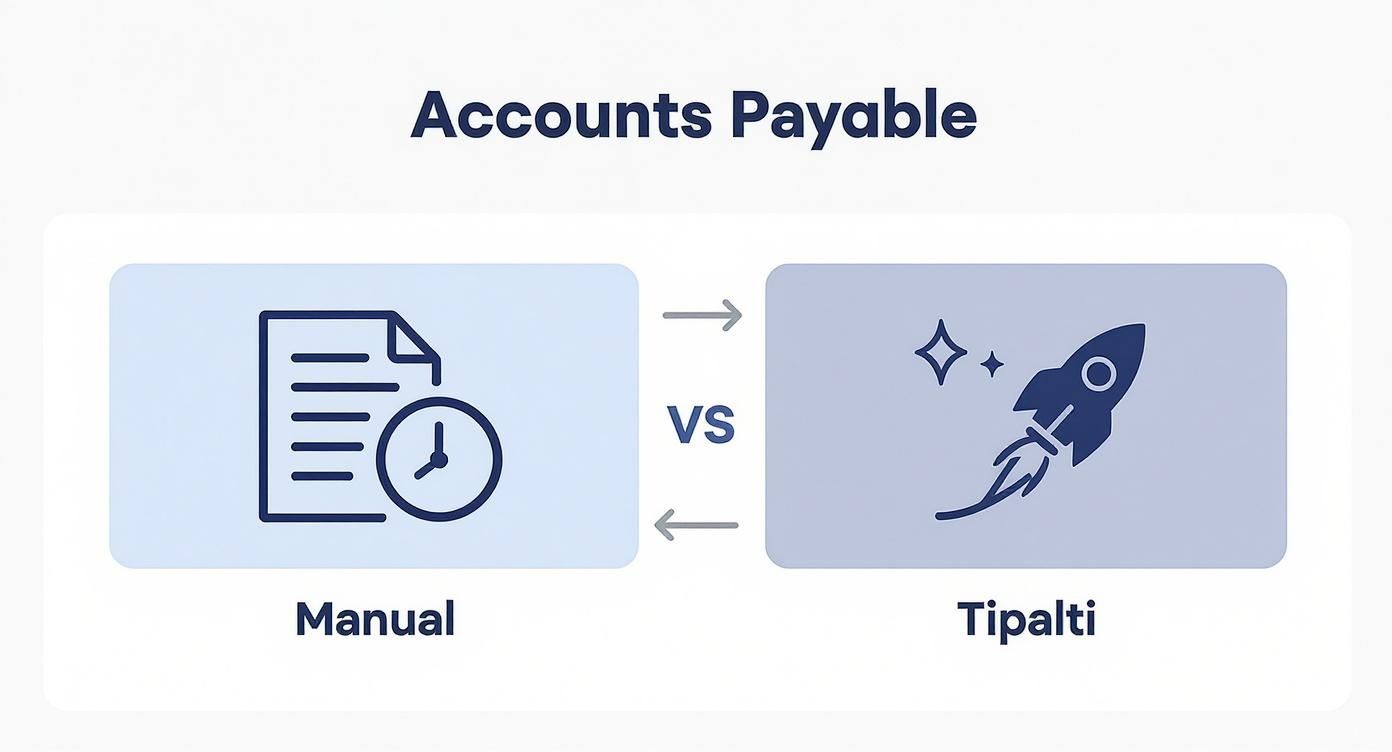
As you can see, automation just gets rid of the bottlenecks. It creates a clear, unobstructed path from the moment an invoice arrives to the final payment confirmation, all without someone having to manually push it along.
To bring this into perspective, let's break down the individual steps and see how they stack up.
The table makes it obvious: the manual approach is fragile, slow, and demands constant human intervention, while Tipalti builds a resilient, fast, and largely hands-off system.
Despite these clear benefits, it's surprising how many UK businesses are still stuck in the past. Recent research shows that only 6% of UK companies have fully automated their AP, while a staggering 47% still depend on manual methods. This has a direct impact on performance, with 70% of UK firms reporting problems with payment reliability and efficiency. You can dig into more of these insights on Tipalti's website.
By automating the entire payables lifecycle, Tipalti gives businesses the foundation they need to scale efficiently, tighten financial controls, and build for proper, sustainable growth.
So, beyond the buzzword of 'automation', what’s actually under the bonnet? The real magic of Tipalti is in how its individual features work together. Each part is built to tackle a specific headache in the accounts payable process, turning a clunky, manual workflow into something smooth and intelligent.
It helps to think of it not as a single tool, but as a well-drilled team of specialists who never drop the ball.
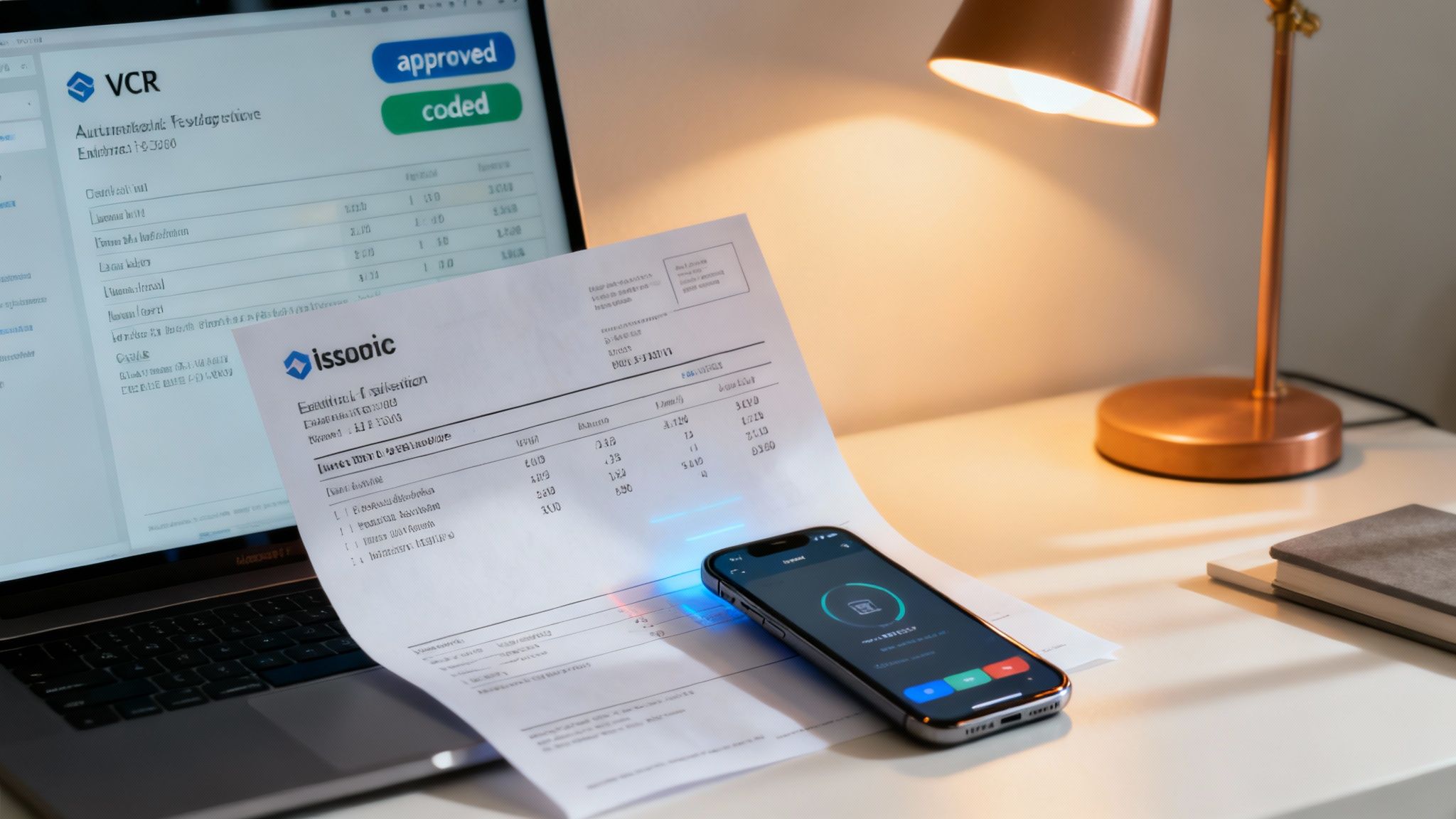
The whole process actually starts before you even get an invoice. Tipalti provides a self-service supplier portal, which smartly shifts the admin burden from your team onto your suppliers. They log in, pop in their own details, choose how they want to be paid, and upload their tax forms. It’s a proactive way to get clean, accurate data right from the get-go.
Once your suppliers are in the system, the next battle is the relentless flood of invoices. This is where Tipalti's AI and Optical Character Recognition (OCR) technology really shine. Instead of your finance team squinting at a PDF and manually keying data into your accounting software, the system does it for them.
The AI gets to work, scanning each invoice, pulling out the key details like the invoice number, amount, and due date. It even gets clever and suggests the right general ledger codes for you. For a growing agency juggling dozens of freelance creatives, this feature alone can claw back hours every single week. It flips a tedious, error-prone job into a quick review-and-approve click.
Tipalti uses over 26,000 validation rules to automatically check supplier information against global banking directories and tax databases. This drastically cuts the risk of payment errors and fraud before they even have a chance to happen.
Paying suppliers is fairly straightforward when they're all in the UK and happy with a BACS payment. But what about an e-commerce brand with manufacturers in Asia, developers in Eastern Europe, and marketers in the US? Suddenly, payments become a tangled mess of currencies, baffling banking rules, and compliance checks. This is where Tipalti truly comes into its own.
The platform’s global payment infrastructure handles everything from one central hub. It lets you pay suppliers in 196 countries and 120 currencies, automatically dealing with conversions and sticking to local payment regulations. It also has fraud controls and OFAC screening built-in, so you know every payment is secure and compliant. It’s all about making sure you can track business expenses the right way, providing absolute clarity, even when your supply chain spans the globe.
These features all dovetail to create one powerful, unified system. Embedding this level of automation is a key part of how we approach technology transformation for our clients, helping them build a financial foundation that can genuinely support rapid growth. When you remove all that manual friction, you’re left with total visibility and control over your entire payables operation.
Automating your accounts payable isn't just about paying bills a bit quicker. It’s about completely rewriting the job description for your finance team. When you get rid of the relentless cycle of manual data entry and invoice chasing, you transform the finance function from a reactive cost centre into a proactive, strategic part of the business.
This shift creates immediate, tangible value. Instead of being buried in paperwork, your finance professionals can finally use their expertise on what really matters—things like cash flow forecasting, analysing budgets, and finding new ways to save money. That’s the real prize of automation: it gives you back your team’s most valuable asset—their time.
For any UK business with growth ambitions, this newfound efficiency is a game-changer. You get genuine financial control, with a real-time view of company spending as it happens, not weeks after the fact. This clarity dramatically cuts the risk of costly payment errors, duplicate invoices, and even fraud—all things that can easily slip through the cracks in a manual system.
This isn’t just theory. Since opening its European headquarters in London, Tipalti has helped UK businesses slash their manual accounts payable workload by around 80% and speed up their financial close by roughly 25%. These aren't just impressive stats; they represent a serious operational upgrade that leads directly to smarter, faster decision-making.
By automating compliance, security, and payments, Tipalti gives businesses a rock-solid financial foundation. This allows leaders to chase growth confidently, knowing their back-office operations won't collapse under the pressure.
Tipalti also acts as a powerful springboard for going global. It removes the classic headaches of cross-border payments, currency conversion, and navigating complex international regulations. For an e-commerce brand sourcing products from Asia or an agency paying freelancers in the US, this is huge.
It allows UK companies to compete on a global stage without the massive operational overhead that once made it almost impossible. You can find out more about the types of businesses we help navigate these challenges and grow effectively.
A new piece of software is only as good as its ability to play nicely with the systems you already rely on. The good news? Tipalti isn’t designed to rip out and replace your core accounting software; it’s built to give it a serious upgrade. Think of it as a specialist extension for your financial operations, not a complete overhaul.
It’s a common worry. Businesses often dread the disruption of adopting new tech, but Tipalti was engineered from the ground up to integrate smoothly with the platforms you already use. It has pre-built connections for all the major players, including NetSuite, QuickBooks, and Xero.
For businesses still deciding on a financial foundation, our guide on the best cloud accounting software for startups offers some valuable pointers. And for those already invested in the broader Microsoft ecosystem, Tipalti also connects with existing Microsoft Dynamics 365 solutions.
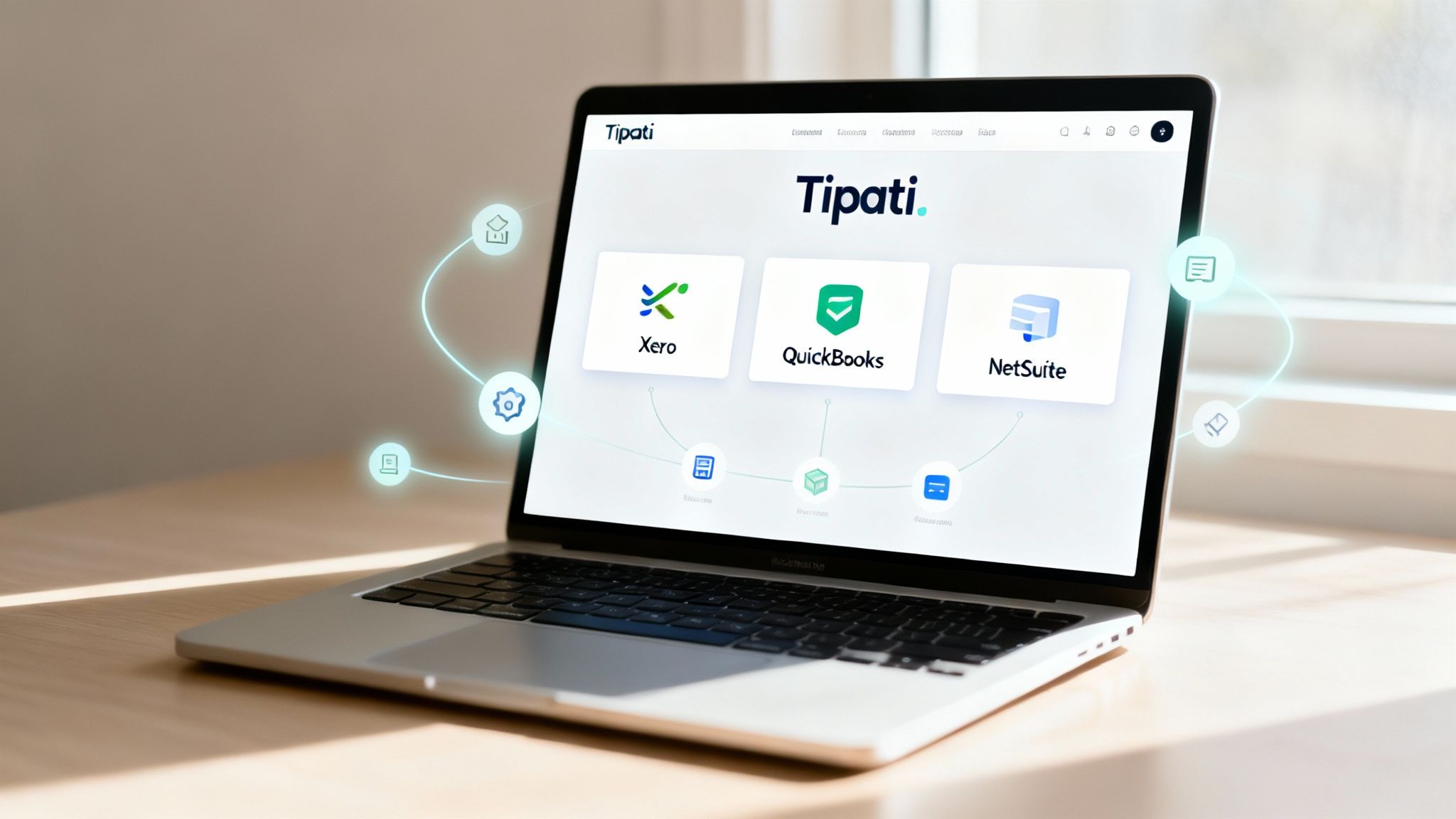
The real magic happens in the integration. It creates a seamless, two-way flow of information that finally puts an end to duplicate data entry and painful manual reconciliation. This constant communication is what keeps your financial records accurate without piling more work onto your team.
Here’s a look at how that data journey typically works:
This closed-loop process ensures your books are always accurate and up-to-date, giving you a complete, real-time audit trail. This deep integration is one of the key reasons we’ve seen such rapid adoption of Tipalti across the UK and Europe. The company’s growth is also fuelled by its Alliance Program, which brings major accounting firms on board to help businesses implement these powerful, connected solutions.
How do you know when you’ve officially outgrown your trusty spreadsheets and manual bank transfers? There’s rarely a single moment. Instead, it’s a slow burn – a series of small, nagging frustrations that gradually snowball into a serious drag on your operations. Learning to spot these signals is the first step toward getting your finance team's time and energy back.
One of the most common red flags is when accounts payable starts eating up an entire day—or even more—every single week. If your team is drowning in a sea of invoices, chasing down approvals, and manually keying in payments, that inefficiency is already costing you money. It’s a classic sign that your manual approach just can’t keep up with your growth.
Going global is another major trigger. The moment you start paying suppliers or contractors in other countries, the complexity skyrockets. All of a sudden, you're grappling with currency conversions, cross-border transfer fees, and unfamiliar banking rules you never had to worry about before.
These aren't just minor growing pains; they're clear signs that your current system is actively holding your business back. A platform like Tipalti is built from the ground up to solve these exact problems before they completely stifle your momentum.
Here are the critical signs that it’s time for a change:
When the cost of doing things manually—measured in wasted hours, payment errors, and missed opportunities—starts to outweigh the investment in automation, you have your answer. For a business that’s scaling up, that moment often arrives much sooner than you’d think.
Even after seeing all the benefits, it’s natural to have a few practical questions when you're thinking about bringing a new platform into your business. So, let’s tackle some of the most common queries we hear about Tipalti.
Think of these as the final pieces of the puzzle, clarifying the real-world details around cost, suitability, and what it actually takes to get started.
Tipalti uses a subscription model with a few different tiers. The price you pay depends on the features you need and how many transactions you’re running through the system. It’s built to grow with you.
You can start with the core accounts payable automation and then bolt on more advanced tools, like mass payments or procurement, as your business gets more complex.
To get an exact price, you'll need to have a chat with their sales team. They’ll look at what your company really needs and put together a package that fits.
This is a common question, and the answer isn't about your annual turnover – it's about complexity. Tipalti really shines for high-growth small and mid-market companies that are starting to feel the strain of manual processes.
If you’re drowning in invoices, paying suppliers all over the world, managing a growing army of contractors, or juggling finances for multiple business entities, then Tipalti will deliver a serious return on your investment. It’s designed to automate the very things that would otherwise force you to hire more finance staff just to keep your head above water.
Tipalti is built from the ground up for global business, supporting payments in over 196 countries and 120 local currencies. For UK businesses looking to expand internationally, this is huge. It removes the payment headaches that so often slow things down.
The good news is, you're not thrown in at the deep end. The timeline can vary, but a dedicated implementation team walks you through every single step. For most businesses, the whole thing can be done and dusted in a few weeks.
Getting set up involves a few key stages:
The whole process is designed to be as smooth as possible, causing minimal disruption to your day-to-day work. Of course, a key first step for any business is getting its financial foundations right; our guide explains how to set up a business bank account correctly from day one.
At GenTax Accountants, we help businesses integrate powerful tools like Tipalti to build efficient, scalable financial operations. Contact us today to learn how we can support your growth.
