



One of the very first, and most important, decisions you'll make when starting out is how to structure your business. Should you stay simple as a sole trader, or is it worth forming a limited company from the get-go?
It really boils down to a trade-off: simplicity versus protection. The sole trader route is beautifully straightforward, with minimal red tape. On the other hand, a limited company creates a legal shield between your personal finances and the business, offering serious protection for your assets.
Picking your business structure isn't just a box-ticking exercise. It fundamentally shapes your legal duties, how you're taxed, and the amount of admin you'll face. It dictates everything from how you take money out of the business to how clients, banks, and investors see you.
For many freelancers, contractors, and small service businesses, starting as a sole trader is the perfect launchpad. It’s quick, easy, and lets you focus on finding customers.
But, if you're planning to borrow money, hire a team, or simply want to protect your home and personal savings from business risks, a limited company is almost always the smarter choice. This decision isn't just for today; it’s about laying the right foundation for where you want your business to be tomorrow. For a broader look at getting started, check out our complete guide on how to start a business in the UK.
To give you a quick overview, this table breaks down the main differences between the two structures. It’s a great starting point for seeing which one aligns better with your situation. If you're after a really deep dive, this comprehensive guide on Sole Trader vs Limited Company in the UK is an excellent external resource.
There’s a reason both structures are so popular – they serve different needs perfectly. As of 2025, sole traders make up around 56% of UK businesses, making it the most common setup by far. Limited companies aren't far behind, accounting for about 37% of the business landscape, a figure that's been steadily growing as more people seek credibility and protection.
When you’re weighing up being a sole trader against setting up a limited company, the conversation always comes back to one crucial word: liability. This isn’t just some dry legal term; it gets right to the heart of your personal financial safety and what you stand to lose if things go sideways.

As a sole trader, there’s no legal difference between you and your business. You are the business. This means you have unlimited liability, and that’s a big deal. If your business runs up debts it can’t cover or gets hit with a lawsuit, your personal assets are on the line. Creditors can legally come after your savings, your car, and yes, even your family home.
Every step you take to grow—taking out a loan, signing a commercial lease, hiring your first employee—ratchets up that personal risk.
A limited company, on the other hand, is a completely separate legal entity. It’s you, but it’s also not you. Think of it as a protective firewall between your business and personal life. The company can sign its own contracts, own property, and take on debt, all in its own name.
This structure gives you the huge advantage of limited liability. Your financial exposure to the company's debts is capped at what you've invested in it—often just the small value of your shares. Your personal world is shielded. If the business fails, your personal finances are safe from its creditors.
This legal separation is precisely why so many entrepreneurs, especially those with big growth plans or in higher-risk fields, choose the limited company route. It offers a level of security the sole trader structure simply can't match.
Let’s look at how this plays out with a couple of practical scenarios:
While good insurance is a must for any business, it doesn't cover everything. You can find some of the best insurance options for self-employed professionals to get a better idea of what's out there. For those wanting that robust legal protection, GenTax offers expert support on every aspect of running a limited company, making this secure framework a cornerstone of your business strategy.
Your choice between operating as a sole trader or a limited company will have the single biggest impact on your tax bill. The two structures are taxed in fundamentally different ways, and getting your head around this is key to making a sound decision for your business's finances.
As a sole trader, the system is wonderfully direct. All your business profits are treated as your personal income for the year. You report these earnings on your annual Self Assessment tax return and pay Income Tax and National Insurance Contributions (NICs) on the entire lot—whether you’ve spent it or left it sitting in your business account.
A limited company, on the other hand, operates with a more layered but potentially more efficient tax system. The company itself is taxed on its profits via Corporation Tax. To get money out, you can take a director's salary (subject to Income Tax and NICs through PAYE) and also issue dividends to shareholders from any profits left over after tax.
For a sole trader, calculating your tax is a pretty linear process. It really boils down to a few key steps:
This simplicity is appealing, especially when you're starting out. But it means that as your profits climb, they are immediately hit by higher rates of personal tax. There's no escaping it.
Running a limited company introduces more moving parts, but this complexity is where the opportunities for smart tax planning live. The process generally looks like this:
The key advantage here is control. You decide how much profit to take out of the business and when, giving you the power to manage your personal tax bill much more effectively than a sole trader ever could.
Let's put some numbers to this. Imagine two businesses—one a sole trader, one a limited company—each making a profit of £60,000 in the 2024/25 tax year.
Sole Trader Tax Breakdown
Limited Company Tax Breakdown
Let's assume the company director takes a tax-efficient salary of £12,570 and draws the rest of the available funds as dividends.
In this specific scenario, the sole trader structure is actually marginally more efficient. But this is where the context is so important. The tax differences become much more significant as profits increase. For businesses earning under £50,000, sole trader status is often the most tax-efficient route. However, once you start pushing past the £60,000 to £70,000 mark, limited companies frequently become the smarter choice because of the greater tax planning options they unlock.
Choosing the right structure is about balancing your current income with your future ambitions. For personalised guidance, our guide on tax advice for small businesses provides actionable strategies to help you make the best decision from day one.
Beyond the big topics of tax and liability, the day-to-day reality of running your business comes down to the admin. When you're weighing up sole trader vs limited company, the difference in paperwork and ongoing costs is stark. The path you choose has a real impact on how much time and money you’ll spend just keeping things ticking over.
As a sole trader, the administrative load is refreshingly light. Your main job is to register with HMRC and file a single Self Assessment tax return each year. You’ll need to keep good records, of course, but it’s mostly a straightforward case of tracking your income and expenses to work out your profit. This simplicity means lower costs, as many sole traders can handle their own books, at least to begin with.

Setting up a limited company immediately brings a more formal and demanding set of responsibilities. Suddenly, you’re accountable not just to HMRC but also to Companies House, the UK's official registrar of companies. This dual oversight means more filings, stricter deadlines, and less room for error.
Key annual obligations for a limited company include:
Miss any of these deadlines and you’ll face automatic penalties that can escalate quickly. This higher level of compliance is why professional support from an accountant is almost always a necessity.
The added complexity of a limited company naturally leads to higher ongoing costs. While the initial setup can be surprisingly cheap, the long-term financial commitment is much greater.
Here’s a practical look at where the costs differ:
It really comes down to a cost-benefit analysis. The higher administrative costs of a limited company are the price you pay for the protection of limited liability and the potential for greater tax efficiency once your profits start to climb.
While the initial setup fee is a small, one-off charge, ongoing accountancy fees become a significant operational expense for a limited company. A good accountant will handle your payroll, VAT returns (if you're registered), year-end accounts, and all the crucial tax filings. To get a clearer picture of that initial investment, you can learn more about the specifics of company registration fees in the UK.
Ultimately, this trade-off between simplicity and structure is a central question in the sole trader vs limited company debate.
Your business structure does more than just sort out your tax bill; it sends a powerful signal about your long-term ambitions and has a direct impact on your ability to grow. When you start thinking about the future, the choice between being a sole trader or forming a limited company becomes a serious strategic decision, influencing everything from how clients see you to whether you can get your hands on capital.
A limited company often projects a more professional and stable image. That little ‘Ltd’ at the end of your name acts as a badge of credibility, assuring larger corporate clients they’re dealing with a formal, established business. This can be a game-changer when you're bidding for big contracts, as some larger organisations simply have policies that stop them from working with unincorporated sole traders due to perceived risks.
This perception of stability is just as important to lenders and investors. If you're looking for external funding—whether it's a business loan from the bank or equity from an angel investor—the formal structure of a limited company is almost always a non-negotiable. Because a limited company is its own legal entity with its own accounts, it gives a clear, transparent view of the business's financial health, totally separate from your personal finances.
Lenders see this separation as a sign of lower risk. Investors, on the other hand, need that formal structure to even have a conversation. The ability to issue shares is the basic mechanism for selling a stake in your business. For a sole trader, it's impossible; for a limited company, it's a fundamental feature.
A limited company is built for scalability. The framework allows you to bring in new directors, issue shares to investors, and create share option schemes for key employees—all essential tools for driving ambitious growth that are simply unavailable to a sole trader.
If your long-term dream is to build a business you can one day sell, a limited company is really the only practical way to go. Selling a limited company is a relatively straightforward transaction involving the transfer of shares. For a sole trader, there isn't a distinct business entity to sell; you can only sell the assets, like client lists and equipment, which is a far messier and less attractive deal for a potential buyer.
This structural difference has massive implications for your exit strategy and creating a valuable, sellable asset. A limited company has a life of its own, separate from its founders, making it a much more robust vehicle for long-term value creation. If you're serious about maximising your strategic financial planning, getting advice from an expert like a fractional finance director can give you the high-level insights needed to get your business ready for investment or sale.
While sole traders can and absolutely do grow successful businesses, the structure itself creates built-in challenges for scaling up. The model is so closely tied to one person, making it inherently less resilient. Data on business survival rates paints a stark picture; between 2011 and 2016, of the 6 million individuals who operated as sole traders, only 2.4 million were still going for the entire five-year period, showing just how high the churn is.
It’s also worth knowing that around 20% of new sole trader businesses don't make it past their first year, which really highlights the volatility of this structure. This isn't a knock on the business owners themselves, but a reflection of the limitations and risks that come with unlimited liability and a less formal framework, which can make it much harder to achieve and finance sustained growth.
Let's walk through three common situations to see exactly how income, risk, and future plans shape the right decision.
Imagine a freelance writer who consistently brings in a profit of £45,000 a year. They work from a home office with very few overheads and have no immediate plans to take on staff. Their work is generally low-risk, and keeping things simple is their top priority.
For this writer, the sole trader structure is the clear winner. Their profits sit comfortably below the point where a limited company usually starts to offer significant tax savings. The straightforward admin of a single annual Self Assessment return lets them focus on writing, not wrestling with paperwork. Plus, with little risk of liability, the legal shield of a limited company is an expense they just don't need.
Now consider an IT consultant projecting annual profits of around £80,000. Their work involves handling sensitive client data and signing hefty contracts. Crucially, some of their bigger corporate clients will only work with incorporated businesses.
In this case, a limited company is undoubtedly the way to go. First off, with profits at this level, the tax planning opportunities become very attractive. By taking a small salary and the rest in dividends, they'll almost certainly pay less tax overall. Secondly, the work itself carries real risk; limited liability is vital to protect their personal assets should something go wrong. That 'Ltd' after their name also provides the professional credibility needed to land those high-value contracts.
The decision often hinges on this balance of tax efficiency and liability. As soon as your profits start climbing past the higher-rate tax threshold or your work involves significant financial or contractual risk, the benefits of a limited company become compelling.
Our final scenario is a tech startup with a solid business plan. The founders are looking to hire two employees in their first year and will need to secure external investment to fund their growth.
For this business, a limited company isn't just a good idea—it's essential. You simply can't issue shares to investors as a sole trader. This structure also provides the formal framework needed to operate a payroll for employees and gives the founders critical protection for their personal assets as the business takes on financial commitments like salaries and office rent. Sticking with a sole trader structure would completely halt their plans for funding and expansion.
This flowchart maps out the typical journey for a growing business, highlighting how the need for funding and formal contracts often leads directly to forming a limited company.
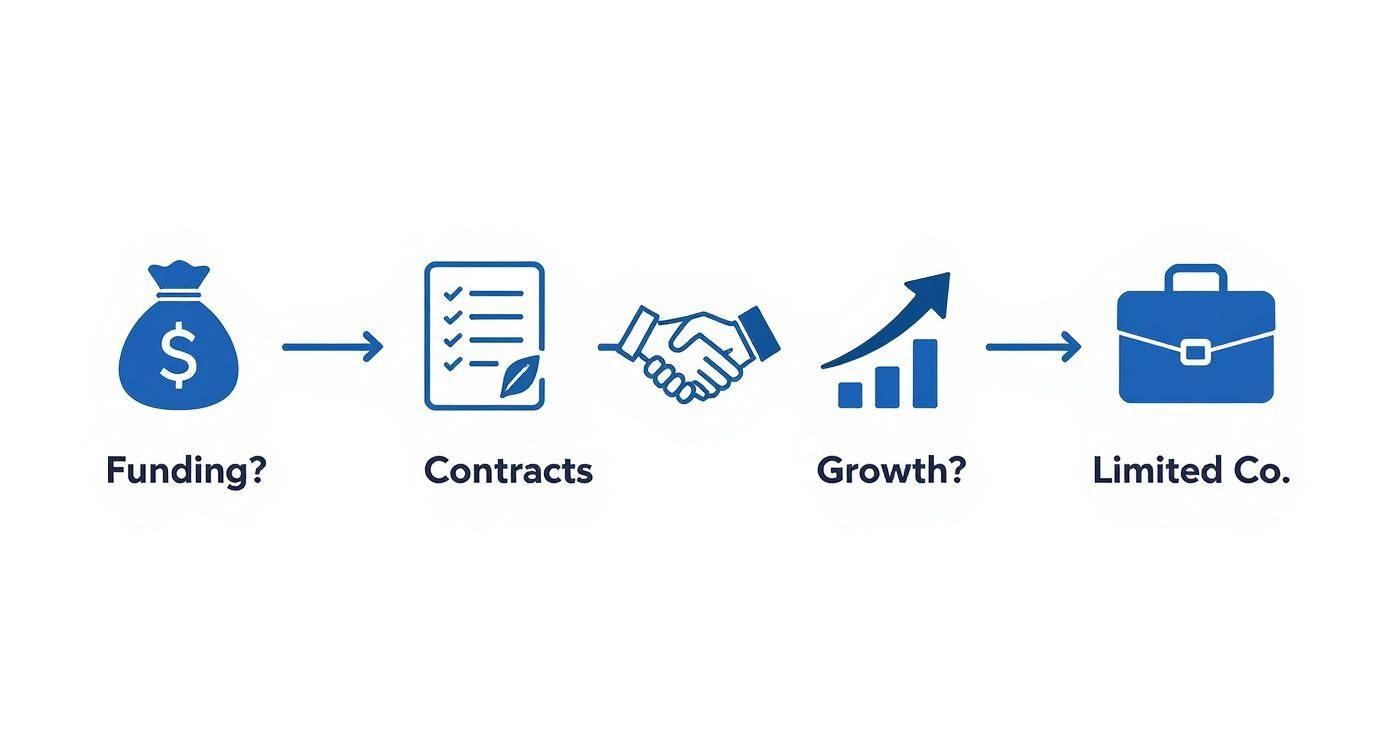
The key takeaway is clear: as a business grows and its ambitions become more formal, the limited company structure becomes the logical and necessary next step.
Deciding between being a sole trader and setting up a limited company can feel like a minefield. Below, I’ve answered some of the most common questions we get from business owners trying to figure out the best path forward.
Yes, absolutely. This is a very well-trodden path for growing businesses. Making the switch involves setting up a brand new limited company with Companies House and then formally transferring your business assets—like your client list, equipment, and cash—over to the new company.
It’s the natural next step when you start earning more, need the protection of limited liability, or want to be more tax-efficient. I’d always recommend getting some professional advice to make sure the changeover is as smooth and tax-friendly as possible.
Taking money out of a limited company is a bit more formal than just dipping into the bank account like a sole trader. There are two main ways to do it: a director's salary and shareholder dividends.
Most company directors opt for a savvy mix: a small, tax-efficient salary combined with taking the bulk of their income as dividends. This approach helps keep their personal tax bill to a minimum.
Expert Insight: Getting the salary-dividend balance right is one of the most powerful financial moves you can make as a director. It gives you a level of control over your personal tax bill that a sole trader, who pays tax on every penny of profit, simply doesn't have.
Yes, and they're quite strict. Your company name has to be unique—it can't be identical or even too similar to another name already on the Companies House register. It also can’t be offensive or include certain 'sensitive' words like 'Royal' or 'Bank' without getting official permission first.
Before you get your heart set on a name, it's always wise to use the free Companies House name availability checker online. It only takes a second and can save you a lot of hassle.
Winding down a business looks very different for each structure. As a sole trader, it’s incredibly straightforward. You just need to tell HMRC you’ve stopped trading and file one final Self Assessment tax return.
For a limited company, it’s a more formal process. If the company is solvent (meaning it can pay its bills), you’ll usually go through either a dissolution (often called 'striking off') or a Members’ Voluntary Liquidation. With either route, all the company’s debts must be paid off in full before it can be legally closed for good.
Making the right choice between a sole trader vs limited structure from the start can save you time and money. At GenTax Accountants, we specialise in helping entrepreneurs and small businesses navigate these decisions with confidence. From company formation to ongoing tax planning, we're here to support your journey. Get in touch with us today to see how we can help.
