


Think of the memorandum of association as the official birth certificate for your company. It’s a foundational legal document that the very first members sign, declaring their clear intention to form the business. It’s a historical snapshot, the moment your company legally came into existence.
This document is a simple, one-time statement created right at the start, during the company formation process. Its core job is to prove that the initial shareholders or guarantors were all on board with creating the company and becoming its first members. If it's a company limited by shares, the memorandum also confirms their promise to take at least one share each.
Since the Companies Act 2006 came into effect, the memorandum's role has been massively simplified. It’s no longer a long-winded company charter but a straightforward historical record that you create once and then file away.
The best way to think about it is this: If the Articles of Association are the detailed, living rulebook for running your company day-to-day, the memorandum is the single, unchangeable switch that first turned the lights on.
Getting your head around this difference is key for anyone starting a new business in the UK. While this document is a non-negotiable part of your official registration with Companies House here, its fundamental purpose is understood worldwide. For comparison, you can see how a Memorandum of Association (MOA) in the UAE serves a similar foundational role, just with regional specifics.
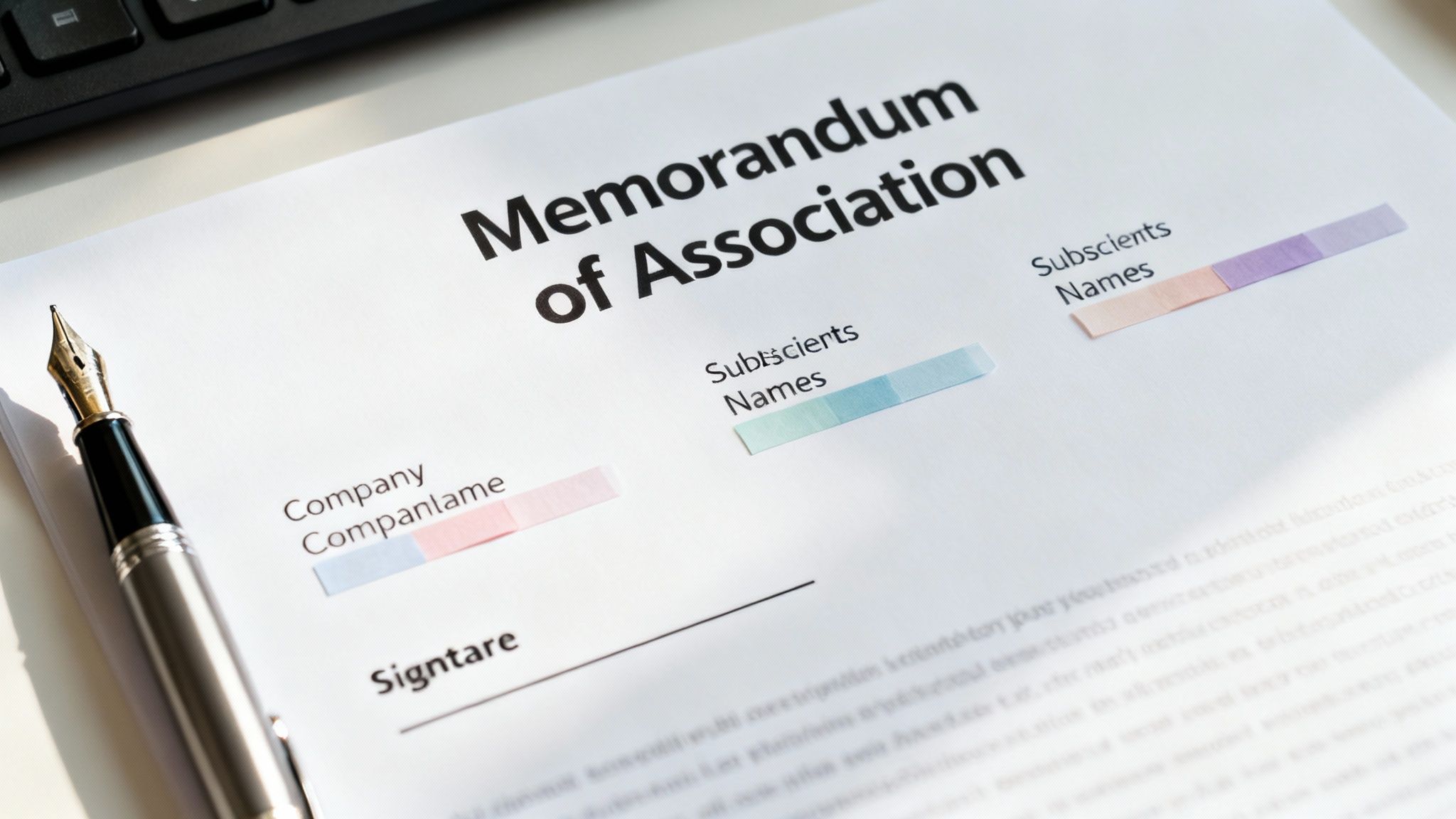
Thankfully, the modern memorandum of association is a lean, straightforward document, a far cry from the complex paperwork of the past. Its main job is to put on record the legally binding intentions of the very first members, who are known as the ‘subscribers’.
Think of it as a formal declaration. It contains a few non-negotiable pieces of information, with prescribed wording laid out in the Companies Act 2006. This ensures every new business starts on a level playing field. Essentially, each subscriber must state that they want to form a company and agree to become a member.
For a company limited by shares, the memorandum needs to tick a few specific boxes:
This simple format is a critical part of the registration for all limited companies. Its importance is highlighted by the fact it's a compulsory filing with Companies House. With over 450,000 new companies formed in the UK each year, every single one must file a memorandum of association, cementing its role as a cornerstone of UK corporate law.
Crucially, this document is a historical snapshot. It's unchangeable after the company is incorporated. Once submitted, it becomes a public record, confirming forever who the founding members were and what they committed to at the company’s birth.
To really get why the modern memorandum is so straightforward, it helps to peek into its past. Before the Companies Act 2006 came along, this document was a much bigger deal – a complex and rigid charter that laid out everything a company was allowed to do. Think less birth certificate, more detailed, unchangeable blueprint.
A huge part of the old-style memorandum was the 'objects clause'. This section strictly defined a company's legal purpose and activities. If a company stepped outside of these stated objects, it was deemed to be acting 'ultra vires'—a legal term meaning 'beyond its powers'. This wasn't just a slap on the wrist; it could make contracts invalid and cause massive legal headaches.
The memorandum's journey began in the mid-19th century, with The Joint Stock Companies Act of 1856 introducing the first templates. But the most significant transformation happened on 1st October 2009. On this date, restrictive parts like the objects clause and authorised share capital were officially booted out of the memorandum and moved into the Articles of Association instead. The UK government now provides simple guidance on these model documents for anyone setting up a company.
This was a game-changer. It turned the memorandum from a restrictive rulebook into what it is today: a simple, historical snapshot taken at the very moment of incorporation.
Understanding this history is more than just a trivia point. It helps business owners sidestep common myths based on outdated advice and truly appreciate the flexibility the modern UK system offers when running a company.
It’s easy for new entrepreneurs to get tangled up trying to distinguish between the memorandum of association and the articles of association. They sound similar, but they serve completely different purposes at very different points in your company's life.
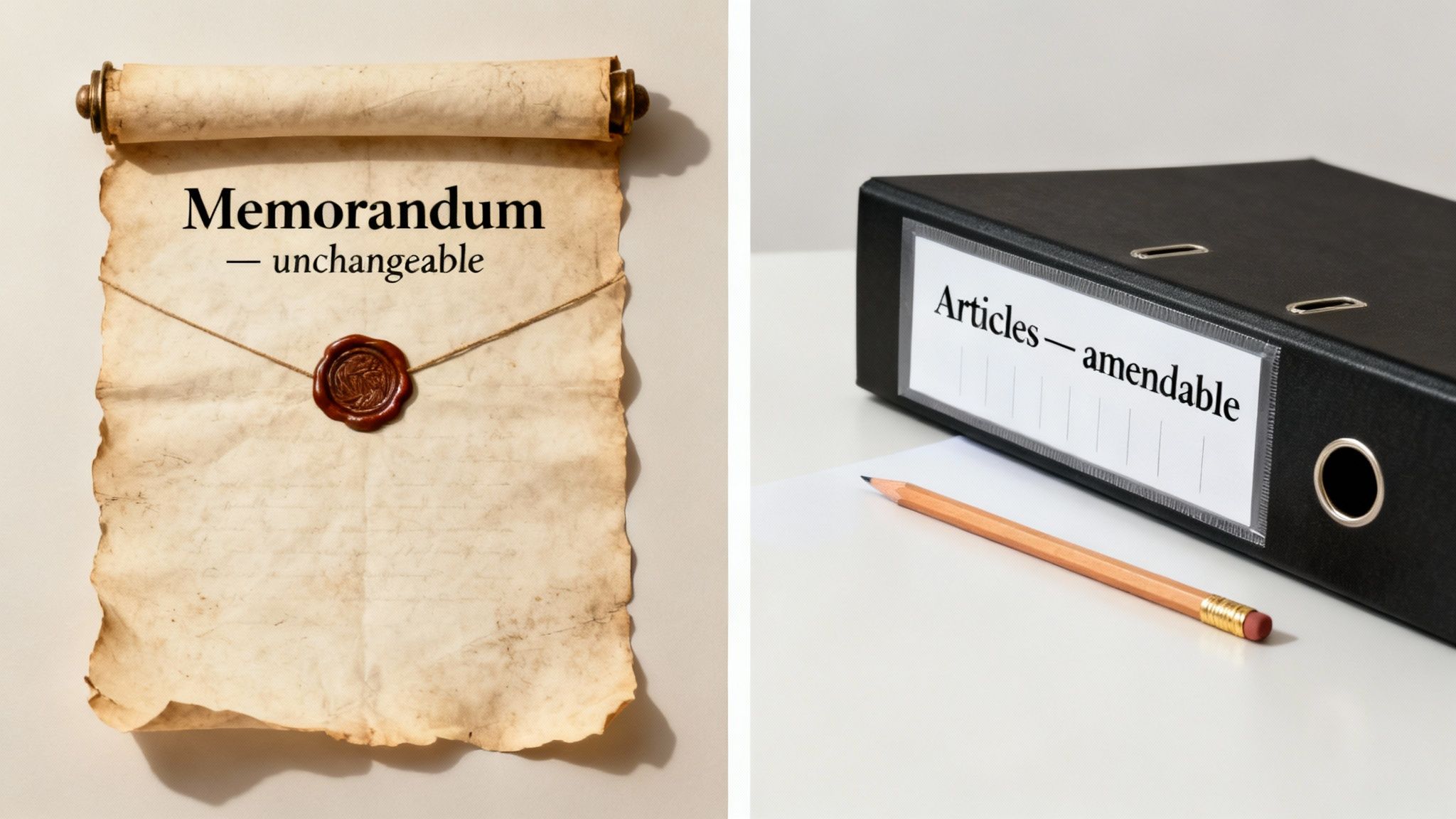
Think of the memorandum as a historical snapshot. It's a one-time declaration, created and signed the moment you incorporate, confirming the founders’ simple intention to form a company. Once it’s filed with Companies House, it's set in stone and cannot be changed. It’s a permanent record of the company's birth.
In complete contrast, the articles of association are a dynamic, living document. This is your company's internal rulebook, spelling out everything from the powers of directors to the rights of shareholders and how meetings should be run.
Unlike the static memorandum, the articles can – and often do – change over time as the business grows and evolves. As your needs change, you might find yourself needing to amend them, a process where modern tools like AI for altering Memorandum and Articles of Association can sometimes offer a helping hand.
To put it simply, one document says "we want to start a company," and the other says "here's how we'll run it." The table below breaks down these key distinctions even further.
As you can see, the memorandum is about the what and the who at the very beginning, while the articles are all about the ongoing how.
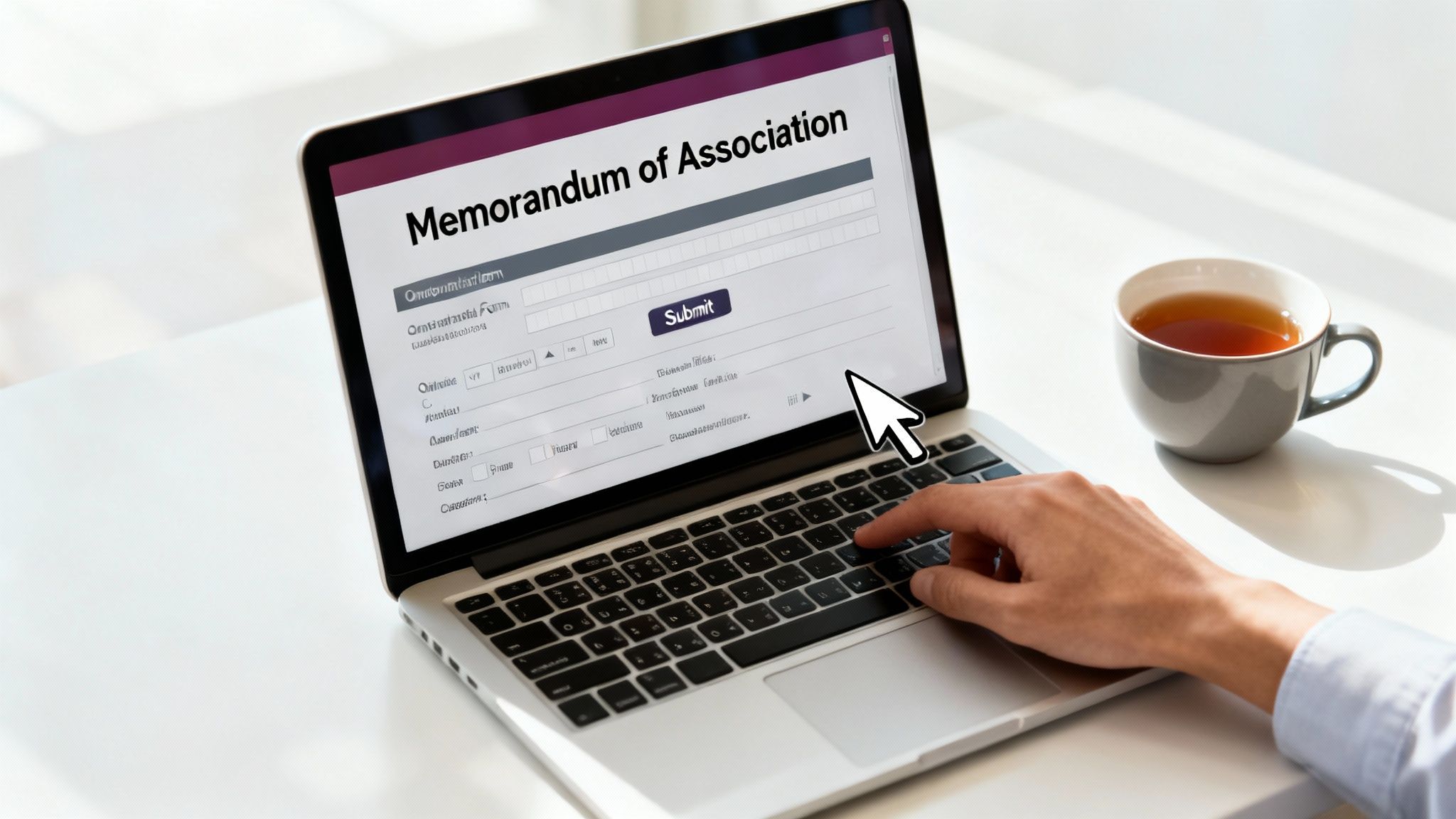
Good news: creating a memorandum of association for a new UK company is refreshingly straightforward. For most founders, this isn’t a complex legal drafting exercise but a simple step in the online incorporation process. You won’t need to create a document from scratch.
Instead, Companies House provides a standard template during your digital application. All you need to do is confirm the names of the subscribers (the initial members) and the date. This completed memorandum is then submitted electronically as part of your overall application, often called Form IN01.
While the process is simple, small mistakes can cause frustrating delays. The most crucial part is making sure every single detail is perfectly accurate.
A common pitfall is a mismatch between a subscriber's name on the memorandum and their official identification. Even a minor typo can lead to your application being rejected, forcing you to start all over again.
To avoid this headache, double-check that every subscriber's name is written exactly as it appears on their passport or driving licence. This simple check is one of the best ways to ensure a smooth registration. For a full picture of the costs involved, you can learn about current company registration fees in the UK, which will help you budget for the entire process.
When you file your company’s memorandum of association, it might feel like just another piece of startup admin. But it’s actually more than that. The details you provide—like who the subscribers are—don't just sit in a file at Companies House.
This information feeds directly into the UK's national statistics, painting a picture of business demographics, economic activity, and corporate transparency. It's the kind of data that helps the government understand the health of the economy and make informed policy decisions.
There’s even a formal agreement between UK governments to cooperate on how this company data is used for statistical purposes. You can read more on the evolution of the UK's statistical system to see how it all fits together.
Essentially, filing your memorandum is more than a legal formality. It’s a small but significant contribution to the integrity and transparency of the UK's official corporate records.
Building this clear financial picture is a vital part of running a business, and it often requires expert oversight as you grow. For many companies, this is where a part-time financial director can offer the strategic guidance needed to navigate these broader responsibilities.
To wrap things up, let's tackle a few common questions that pop up when dealing with the memorandum of association. Think of this as a quick-fire round to clear up any final bits of confusion.
In a word, no. The memorandum is a 'snapshot in time' document. It captures the founders' intentions at the very moment of incorporation and is then effectively locked. Unlike the articles of association, which you can amend later on, the memorandum remains a permanent, unchangeable part of your company's history on the public record.
Don't panic. Because it's a public document, a copy is always available from Companies House. The official register keeps the records for all UK limited companies, so you can easily retrieve essential documents whenever you need them. Accessing company information like this is often tied to the Companies House ID verification process.
For most new businesses, bringing in a solicitor is overkill. Companies House provides a standard, pre-approved template during the online incorporation process, and this is perfectly adequate for the vast majority of startups.
At GenTax Accountants, we help new businesses navigate the entire formation process with confidence. Start your journey with us today.
