


The big question: limited company or sole trader? At its heart, the difference is all about legal identity.
If you’re a sole trader, you are the business. Your personal and business finances are seen as one and the same in the eyes of the law. On the other hand, a limited company is a completely separate legal entity, which puts a protective wall between your money and the business’s money.

Picking the right business structure is one of the first, and most important, decisions you'll make as a UK entrepreneur. It’s a choice that affects everything from your personal liability right down to your final tax bill. Many people kick things off as a sole trader because it’s so straightforward, but taking the time to understand both paths is vital for your long-term success.
This isn't just about filling in a few forms. It’s a strategic move that dictates how you grow, handle risk, and take home your profits. A limited company protects your personal assets and often looks more credible to bigger clients and investors, but that comes with more admin and public disclosure of your company’s details.
For anyone just starting out, the sheer simplicity of being a sole trader is a massive draw. The setup is quick, free, and the day-to-day admin is minimal compared to running a limited company. It's often the perfect fit for freelancers, contractors, and small service businesses wanting to test an idea without hefty overheads. To get a better feel for this route, you can explore our resources on being a sole trader in the UK.
It’s no surprise that being a sole trader is the UK’s most popular business structure. The latest government statistics show there are roughly 3.2 million sole proprietorships, which is 57% of the entire private sector. For comparison, there are 2.1 million limited companies. You can dig into the full business population estimates on the official government website.
To help you see the core differences in a flash, here’s a quick side-by-side look.
This table gives you a high-level summary of the main points of comparison between the two structures.
While this gives you a snapshot, each of these points carries a lot of weight. The right choice really depends on your business goals, your industry, and how much risk you're comfortable with. In the next sections, we’ll dive deeper into what these differences actually mean for you and your business.
When you’re weighing up a limited company vs sole trader, the issue of liability is probably the most critical distinction to get your head around. This isn’t just dry legal jargon; it directly affects your personal finances and what you stand to lose if the business hits a rough patch.
As a sole trader, the law sees no difference between you and your business. You’re one and the same, which means you have unlimited liability. Any debts the business racks up—from an unpaid supplier to a client lawsuit—are legally your personal debts.
That means your own assets are fair game. If the business can't cover its bills, creditors can legally come after your personal savings, your car, and even your family home to settle the score. It's the single biggest risk of operating this way.
A limited company, on the other hand, offers what’s known as limited liability. By incorporating, you create a completely separate legal entity. Think of it as putting up a "corporate veil" between your business and your personal life.
This imaginary veil means the company is responsible for its own debts. If the business fails or gets sued, your personal assets are shielded from the fallout. Your liability is typically limited to the value of your shares in the company, which could be as little as £1.
Key Insight: The "corporate veil" is the primary legal shield that a limited company provides. It ensures that if the business encounters financial distress, your personal wealth is not automatically exposed to creditors. This protection is a non-negotiable for many entrepreneurs planning for growth or operating in higher-risk industries.
To really see how this plays out, let's look at a couple of practical examples.
Scenario 1: The Unpaid Supplier
Scenario 2: The Client Lawsuit
A client argues your consultancy advice cost them a fortune and sues you for £50,000 in damages.
This legal separation is precisely why industries dealing with large contracts, physical products, or professional advice—like construction, retail, or IT consulting—almost always lean towards the limited company structure. The protective barrier it creates offers vital peace of mind, giving you a much more secure foundation for taking calculated business risks.
For a deeper dive into the responsibilities and benefits, our specialists can provide guidance on managing limited companies effectively. This structure is built for those who want to scale a business without putting their personal life on the line.
When you're weighing up a limited company vs a sole trader, tax is often the number one decider. It’s not just about the headline tax rates; the fundamental way you are taxed is different, and getting your head around this can make a huge difference to your take-home pay.
For a sole trader, things are refreshingly simple. All your business profits are considered your personal income. You just pay Income Tax and National Insurance Contributions (NICs) on the lot via your annual Self-Assessment tax return. Easy.
With a limited company, there are a few more moving parts. First, the business itself pays Corporation Tax on its profits. Then, it's up to you, the director, to decide how you'll take money out of the company. This is usually done with a small salary and the rest in dividends, and because each is taxed differently, it opens the door to some savvy financial planning.
The big difference is in the types of tax you pay. As a sole trader, your profits are hit with Income Tax bands (20%, 40%, or 45%) plus Class 2 and Class 4 National Insurance.
A limited company director, on the other hand, typically draws a small, tax-friendly salary – often just enough to stay under the National Insurance threshold. This salary is a business expense, which handily reduces the company's Corporation Tax bill. Any remaining profit can be paid out as dividends, which have their own lower tax rates and, crucially, don't attract any NICs.
Key Insight: The main tax advantage for a limited company comes from paying yourself through dividends. Because dividends are completely free from National Insurance, you can make significant savings compared to a sole trader, whose entire profit is subject to both Income Tax and NICs.
This image really drives home the difference in personal exposure between the two structures.
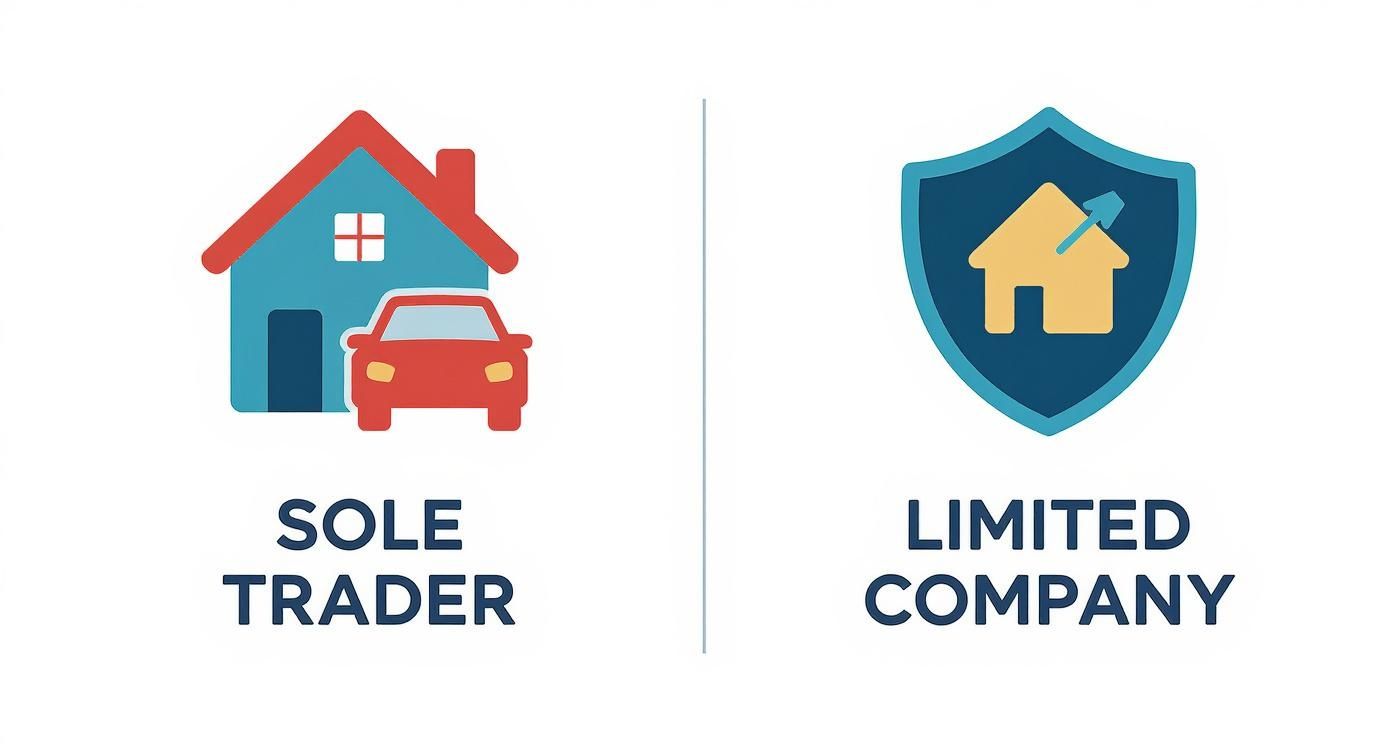
It’s this legal separation a limited company offers that lays the groundwork for the different approaches to tax and financial management.
So, at what point does it actually become cheaper to run a limited company? Honestly, it all comes down to your annual profit. When you're just starting out and profits are modest, the simplicity and lower running costs of being a sole trader usually win out.
As your business grows, however, the scales begin to tip. The crossover point often happens once your profits push past the higher-rate income tax threshold. For example, at a £50,000 profit, a sole trader is still slightly better off by around £340. But once profits climb into the £60,000 to £70,000 range, the limited company structure starts to pull ahead. That’s because the combination of 19% corporation tax and lower dividend tax rates becomes more beneficial than the income tax and NICs you’d pay as a sole trader.
To make this crystal clear, let's run through some numbers.
Here’s a quick look at the estimated take-home pay for both structures at different profit levels, showing how the tax benefits change as earnings increase.
Note: These are estimates based on 2023/24 tax rates, assuming an optimal salary/dividend mix for the limited company director.
As you can see, by the time you hit £80,000 in profit, the limited company structure puts over £1,100 extra in your pocket. To really make the most of this, it's vital to get to grips with the rules. Understanding what Corporation Tax is and how it works is the first step to legally maximising your earnings as your business scales.
Beyond the tax bills and liability, the day-to-day reality of running your business is really shaped by its admin workload. When you're weighing up a limited company vs sole trader, you're also choosing a set of compliance duties. One path is refreshingly simple; the other demands a much more formal approach to record-keeping and public reporting.
As a sole trader, the administrative burden is pretty light. Your main legal job is to tell HMRC you're self-employed and earning money. After that, it's really all about keeping good records of your sales and expenses as you go.
This all builds up to a single, annual deadline: filing your Self-Assessment tax return. This is where you summarise your income and allowable expenses to work out the profit you'll be taxed on.
The day-to-day tasks for a sole trader are straightforward and totally manageable, even if you're new to business. The trick is just to stay organised from the start to avoid that last-minute panic.
Your main responsibilities are:
With digital record-keeping becoming the norm, it's smart to stay ahead of the curve. You can learn more about the shift to Making Tax Digital for Self-Assessment and how it's going to change things.
Now, a limited company is a different beast entirely. It operates in a much more structured regulatory world. Because it’s a separate legal entity, it has formal duties to both HMRC and Companies House—the UK’s official registrar of companies. These aren't optional tasks; they come with strict deadlines and hefty penalties if you miss them.
Right from the get-go, the process is more involved. You have to formally incorporate your company, which means picking a unique name, appointing at least one director, and sorting out the share structure.
Key Takeaway: The admin jump from sole trader to limited company is huge. It demands a serious commitment to formal accounting, annual reporting to two different government bodies, and keeping a clear wall between your business and personal money.
This extra work is the direct trade-off you make for the protection of limited liability. The transparency required by Companies House is simply part of the price you pay to safeguard your personal assets.
There are other administrative hurdles too, like drafting foundational documents such as the Memorandum of Association, which sets out the initial shareholders' intention to form the company.
To really get a feel for the difference in workload, it helps to see the compliance tasks for each structure laid out next to each other.
This table really throws the layered responsibilities of a limited company director into sharp relief. A sole trader can focus on one big tax event each year, but a director has to juggle multiple filings with different deadlines for both the company and for themselves personally. It's this complexity that leads most limited companies to hire an accountant, just to make sure nothing slips through the cracks. Honestly assessing whether you’re up for managing these duties is a critical step in making the limited company vs sole trader decision.

The structure you choose for your business does more than just affect your taxes and day-to-day admin. It sends a powerful message about your brand's ambitions, shaping how clients, lenders, and investors see you from day one. Let's dig into the real-world implications of cost, credibility, and your long-term plans for growth.
At first glance, the costs look straightforward. You can start as a sole trader for free – just let HMRC know you're trading. A limited company, on the other hand, comes with a small incorporation fee payable to Companies House.
But that initial setup fee is just the tip of the iceberg. The real financial differences emerge in the ongoing expenses and, more importantly, the opportunities each structure opens up.
When you’re just starting out, the zero-cost setup of a sole trader is incredibly tempting. There are no official fees and you can start trading almost instantly without getting tangled in legal paperwork. It’s the perfect low-risk way to test a business idea.
A limited company, while not expensive, does have a few mandatory setup costs. These fees are for registering the company as a distinct legal entity. For an up-to-date look at the figures, it's worth checking a detailed breakdown of UK company registration fees.
Beyond that, you need to budget for the ongoing costs of compliance. This includes things like accountancy fees for filing annual accounts, which are usually a fair bit higher than what a sole trader pays for their Self-Assessment.
Credibility is one of those assets that's easy to underestimate, but it’s absolutely crucial. Your business structure plays a huge part in your professional standing, especially when you're trying to win over larger corporate clients or secure funding. In these scenarios, a limited company often carries an instant air of stability and seriousness.
That little "Ltd" at the end of your company name signals that your business is a formal, registered entity with its records publicly available at Companies House. For many, that transparency is a big plus.
Key Insight: Many larger businesses and public sector organisations have procurement policies that only allow them to work with limited companies. They see it as a lower-risk option, knowing the business is subject to much stricter regulatory oversight than a sole trader.
What this means is simple: if your growth plan involves tendering for big contracts or becoming a supplier to established corporations, operating as a limited company might not just be helpful—it could be a requirement.
This is where the strategic difference between the two structures really comes into focus. A sole trader structure is fundamentally tied to you, the individual. This creates a natural ceiling on how much it can grow.
A limited company, by contrast, is built for scale right from the start. Its entire legal framework is designed to handle growth, investment, and changes in ownership without missing a beat.
Think about these common growth scenarios:
Ultimately, being a sole trader is perfect for building a personal income stream with minimal fuss. Choosing to be a limited company is about building an independent commercial entity—one with its own identity, credibility, and limitless potential to grow.
So, sole trader or limited company? The truth is, there’s no single "best" answer. The right structure boils down to your industry, your appetite for risk, and, crucially, where you see your business heading in the future.
Instead of a generic pros and cons list, it’s far more useful to look at real-world situations. Let's explore a few common business profiles to help you figure out which camp you fall into.
The sole trader route is the default starting point for countless new businesses, and for good reason. It’s simple, cheap, and gets you trading fast.
You’re probably a perfect fit for the sole trader model if you’re a:
Key Recommendation: If your business has low financial risk, you’re not expecting huge profits right away, and you value simplicity above all else, starting as a sole trader is almost always the most sensible choice.
Choosing to incorporate isn’t just an administrative step; it’s a strategic decision. It signals that you’re building a serious, scalable business entity that’s protected for the long haul.
A limited company is the clear winner if you are a:
Ultimately, the decision of limited company vs sole trader hangs on your long-term vision. If you see your work as a personal craft or a direct service you provide, the sole trader structure is ideal. But if you’re building an independent brand you want to grow, sell, or get investment for, a limited company provides the solid foundation you’ll need for that journey.
Even after weighing up the pros and cons, you might still have a few practical questions buzzing around. It's completely normal. This is a big decision, after all.
Let's clear up some of the common queries that pop up when people are on the brink of choosing their business structure.
Yes, you absolutely can. In fact, it's a very well-trodden path for many successful businesses. Starting out as a sole trader is a great way to test the waters with minimal fuss and cost.
Once your business gains traction, profits start climbing, or you decide you need the safety net of limited liability, you can incorporate. The process is straightforward: you'll register a new limited company with Companies House and then transfer your existing business assets over to it. It’s a natural way for your business structure to grow along with your ambitions.
Key Takeaway: Starting as a sole trader doesn't lock you in. Transitioning to a limited company is a common and sensible strategy for businesses that are ready to scale up.
Whether you're a sole trader or run a limited company, getting the right business insurance is a smart move. While setting up a limited company protects your personal wallet from business debts, it won’t shield the business itself from a lawsuit.
Think about getting covered for the essentials:
This one trips a lot of people up. VAT (Value Added Tax) registration isn't linked to your business structure at all—it's all about your turnover.
You are legally required to register for VAT once your VAT-taxable turnover hits £85,000 within any rolling 12-month period. This rule applies equally to sole traders and limited companies.
You can also choose to register voluntarily before you reach that threshold. This can be a savvy move, especially if most of your clients are other VAT-registered businesses, as they can reclaim the VAT you charge them.
Deciding between a sole trader setup and a limited company can feel like a major hurdle, but you don't have to clear it alone. The expert team at GenTax Accountants can offer clear, practical advice tailored to your situation, helping you pick the right structure and manage your finances with confidence from day one. Get in touch with us today to see how we can support your journey.
