



To get paid as a freelancer, you need to send a professional invoice. Think of it as a formal request for payment that doubles as a legal record of your transaction. At a minimum, it should include your contact details, your client's information, a clear list of the services you provided, a unique invoice number, and your payment terms. This isn't just admin; it's what ensures you get paid correctly and on time.
Let's be honest, getting paid is the main reason you send an invoice. But a well-crafted invoice does so much more than that. It's often the last interaction a client has with your brand, leaving a lasting impression of your professionalism and setting you up for future work. It’s less of a simple bill and more of a powerful business tool.
A clear, well-structured invoice also builds trust and protects your most valuable asset: your cash flow. Late payments are a massive headache for UK freelancers, and a proper invoice is your first line of defence.
Every single document you send out reflects on your business. An organised, error-free invoice tells your client that you’re serious about your work and that you respect the relationship enough to keep the finances clear and accurate. This small detail goes a long way in building their confidence and encourages them to handle your payment with the same level of professionalism.
An invoice isn't just a request for money; it's a statement about your brand's quality and attention to detail. It reinforces your value long after the project is complete.
Freelancers are a huge part of the UK economy, contributing over £270 billion in recent years. But despite that, a worrying 44% of freelancers in some sectors earn less than the National Living Wage, often because of issues like late payments.
This is where effective invoicing becomes so critical. It helps you manage your finances and ensures you have a proper paper trail for HMRC. By creating a clear record of your income, you not only stay compliant but also gain far better control over your business’s financial health. If you need help with this, exploring accounting services for freelancers can be a great way to get your records in order.
Let's move beyond the basics. A truly effective invoice isn't just a request for money; it's a document that leaves zero room for questions or delays. It should clearly guide your client on exactly how to pay you.
Think of it as the final, professional handshake of your project.
Every single detail, from your business info to the itemised list of services, plays a role in how fast you get paid. A polished, comprehensive invoice shows you're an organised professional who respects both your work and the client's time. In my experience, that simple act of professionalism makes them far more likely to process your payment quickly.
To create an invoice that’s professional and legally compliant in the UK, you have to include certain key pieces of information. Forgetting any of these can easily lead to confusion, payment delays, or even disputes down the line.
A good invoice isn't just a bill; it's a clear, professional record of the work you've done. I use the following checklist for every invoice I send out to make sure it's complete, compliant, and gets me paid on time. It’s a simple system that saves a lot of headaches.
Consistently including these elements turns your invoice from a simple bill into a solid record-keeping tool. Proper financial records are not just good practice; they're vital for tax season. For a deeper dive into managing your finances correctly, exploring expert bookkeeping services can offer invaluable peace of mind.
A detailed and accurate invoice is your best defence against payment disputes. By clearly itemising your work, you answer most of a client's potential questions before they even have a chance to ask.
Just writing "Consulting Services" on an invoice is asking for trouble. It's vague and invites questions. You need to provide a transparent breakdown that not only justifies the total cost but also reminds the client of the value you delivered.
For instance, instead of one lazy line item, break it down like this:
This level of detail leaves absolutely no doubt about what was delivered. It reinforces your professionalism and massively cuts down the chances of a client needing to email you for clarification—which, let's be honest, is often the first step towards a delayed payment.
Vague payment terms are a freelancer's worst nightmare. They often lead to awkward client conversations, chasing invoices, and a major headache for your cash flow. Setting firm but fair terms before any work begins isn't just good practice—it's essential for protecting your income and establishing professional boundaries from day one.
Make sure your payment terms are spelled out in your contract and repeated on every single invoice. This creates a clear paper trail, prevents any "misunderstandings" down the line, and gives you a solid foundation if you ever need to chase an overdue payment.
Late payments are a massive issue for freelancers in the UK. In fact, a staggering 85% of freelancers across the globe have been paid late at some point. As more UK businesses rely on freelance talent, this problem isn't going away. Clear terms are your best line of defence.
One of the first things you need to lock down is your payment window. How long are you giving clients to pay up? Common options in the UK include:
A big part of getting paid on time is simply having a system in place. This is often called Accounts Receivable Management, and it’s really just about tracking what you're owed and following up effectively.
A good tip for new clients is to start them on a shorter payment window, like Net 14. It’s a low-risk way to see how reliable they are before you consider offering them longer terms.
Just as important as when you get paid is how. Don't leave this up to chance and assume the client will just ask. Make it as easy as possible for their accounts team to pay you by clearly listing your accepted payment methods right on the invoice.
Popular choices include BACS transfers, Stripe, or Wise for international payments. To keep your business and personal finances separate (which you absolutely should), you might find our guide on how to set up a business bank account helpful.
Also, remember to be upfront about any extra charges, like credit card processing fees. Stating these clearly on your invoice means no surprises for anyone when the bill comes.
Still wrestling with invoices in a Word document or a clunky Google Sheet? While it might feel simple, this manual approach can be a huge drain on your time and, worse, a breeding ground for costly mistakes. As a freelancer, you have access to a whole host of tools designed to take the admin burden off your shoulders, freeing you up to do what you do best.
Choosing the right software isn't just about sending a nice-looking PDF. It's about building a solid payment workflow from the ground up. The real goal here is to move past basic templates and adopt a system that actively helps you get paid faster, with a lot less chasing.
What works for one freelancer might not work for another. Your perfect tool will depend on how complex your business is and, frankly, what you prefer to use. Some people only need a simple online generator for the odd invoice, while others will benefit massively from a full-blown accounting suite.
When you're looking around, keep an eye out for these game-changing features:
The right invoicing software pays for itself by recovering time you’d otherwise spend on unpaid admin. An hour saved on invoicing is an hour you can spend on billable work.
Diving into the best cloud accounting software for startups is a great next step. It’ll give you a proper look at popular UK options like FreeAgent or Xero, which offer powerful features that go way beyond simple invoicing.
Ultimately, the best system is one that fits your budget and feels comfortable to use. Just as you need the right tool to create an invoice, it’s equally important to manage your freelance finances with the best payment tracking software solutions. Don't be afraid to start with a free tool and move to a paid one as your business grows. The key is to find a process you can stick with, making sure every invoice you send is professional, prompt, and easy to track.
Chasing money you're owed is one of the most awkward, but totally necessary, parts of freelance life. Nobody enjoys it, but having a clear, professional playbook for following up on overdue invoices is essential. It's the only way to recover your earnings without burning bridges with clients.
The secret is to start politely and escalate methodically, keeping a solid record of every single communication along the way.
Your first move should always be a gentle nudge. A friendly email reminder the day after the due date often does the trick. Invoices can easily get lost in a busy inbox, so it's best to assume it was a simple oversight rather than a deliberate delay. Keeping the tone light and helpful maintains goodwill while still making it clear the payment deadline has passed.
If that initial reminder goes unanswered, it’s time to get a bit more structured. Don't let weeks slip by without taking action. A simple, escalating timeline can work wonders.
Here's a good starting point:
Always remain professional, no matter how frustrating it gets. Your goal is to get paid while preserving the possibility of future work. Documenting each step also gives you a clear paper trail if you need to take things further.
It's also worth knowing your rights. Under UK law, you are entitled to charge interest on late commercial payments. Being aware of the Late Payment of Commercial Debts (Interest) Act 1998 gives you serious leverage if a client keeps dragging their feet. It shows you’re a serious business owner who knows their stuff. If you're unsure how late payments might affect your books, our guide on managing your business accounts has some valuable insights.
This infographic breaks down the typical journey for choosing invoicing tools, starting with simple manual methods and moving towards more sophisticated software solutions.
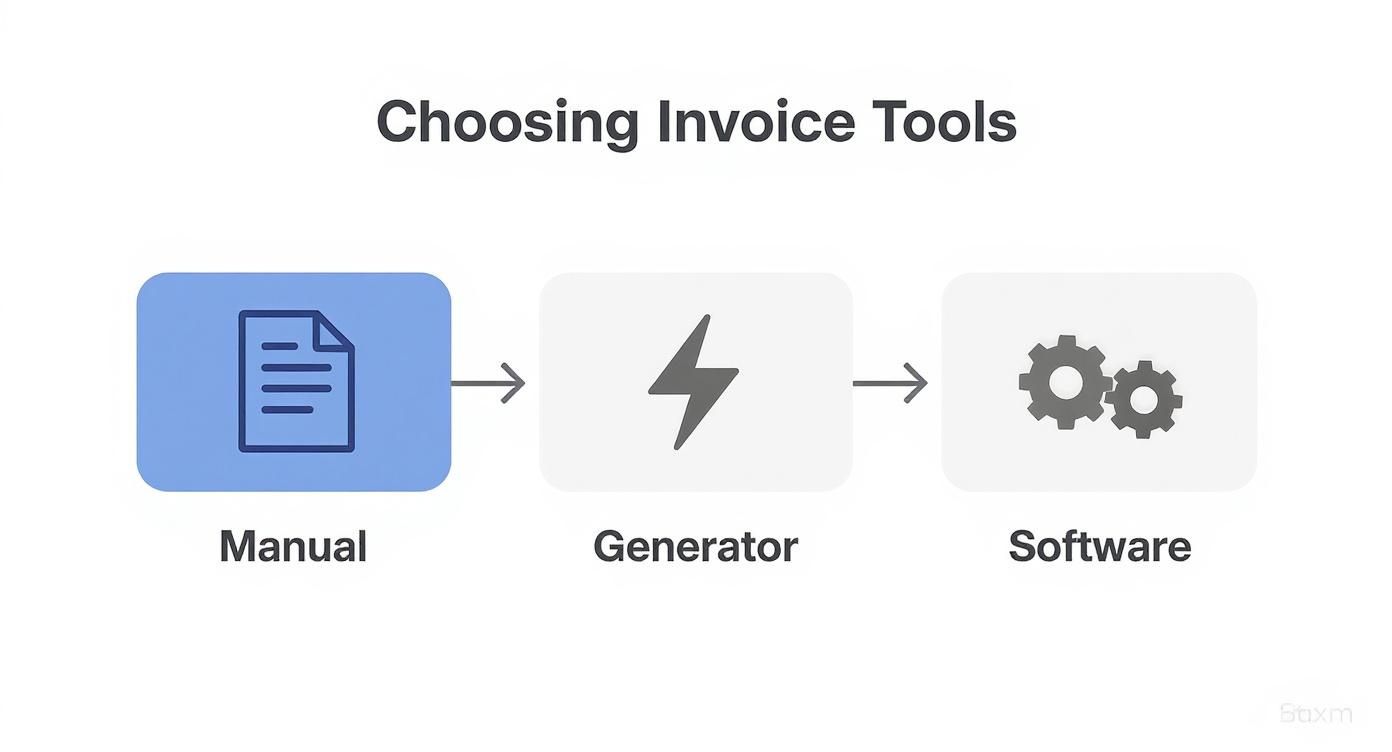
This progression shows how freelancers can really boost their efficiency by adopting automated tools as their business scales up.
Even the most buttoned-up invoicing system will throw you a curveball now and then. Getting your head around the common sticky situations is part of the freelance game, saving you headaches and keeping clients happy.
One of the most frequent questions I hear is, "what do I do if a client asks for a change to an invoice I've already sent?" It happens. If it’s a simple fix before they’ve paid, just create a new version. The key is to update the invoice number slightly – something like INV-002-REVISED works perfectly – and add a quick note explaining the change. This keeps your books tidy and everyone on the same page.
It’s easy to get these two mixed up, but they play very different roles. Think of your contract as the blueprint for the entire project. It's the "before" document, laying out the scope, deliverables, and payment terms before any work kicks off.
An invoice, on the other hand, is the bill for the work you've already done. It’s a formal request for payment based on the terms you both agreed to in the contract.
The contract is the plan; the invoice is the bill for sticking to it. They're separate documents, but one should always lead to the other.
Invoicing clients from the UK who are based overseas isn’t complicated, but it does require a few extra checks:
And what if a client queries a charge? Don't panic. This is where your contract and paper trail become your best friends. Calmly refer back to the agreed terms and any written sign-offs. Providing evidence like time-tracking reports or approved deliverables is usually all it takes to clear things up professionally.
At GenTax Accountants, we turn complex financial questions into clear, actionable answers. If you need expert help with your freelance accounts, visit us at https://www.gentax.uk to see how we can support your business growth.
