


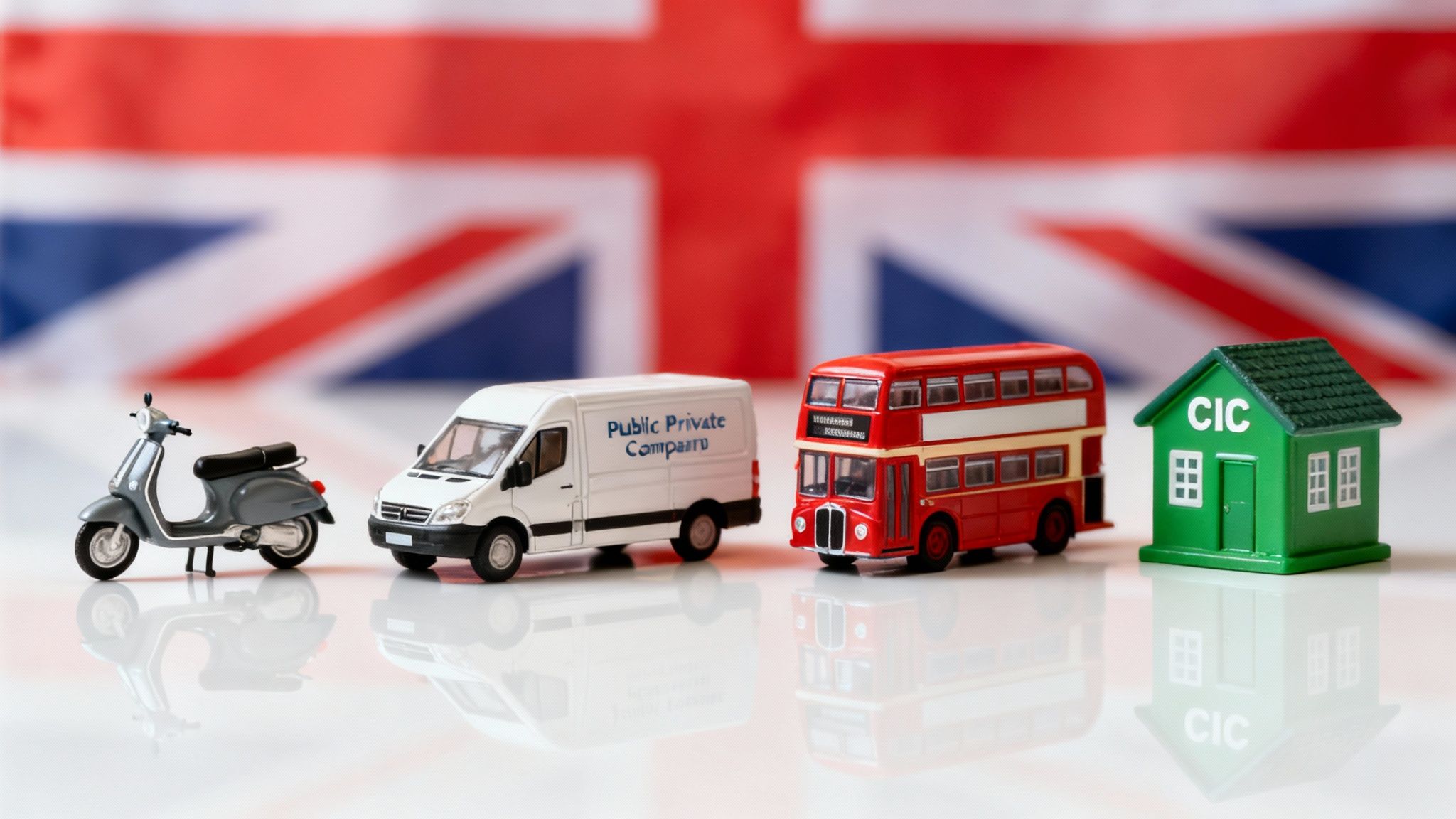
Kicking off a business in the UK throws one big question at you right from the start: which legal structure is the right fit? You’ll mainly come across four company types in the UK: the sole trader, a partnership, a limited liability partnership (LLP), and the limited company (Ltd or PLC). Each one strikes a different balance between personal liability, tax, and the amount of admin you'll have to deal with.
Think of this decision like picking the right vehicle for your business journey. A sole trader setup is like a nimble scooter – it’s quick to get going, dead simple to manage, and perfect for a solo entrepreneur. On the other hand, a limited company is more like a sturdy van; it offers serious protection for your cargo (your personal assets) and is built to handle growth and more complex operations.
This is the classic dilemma for new founders, and it’s a big one.
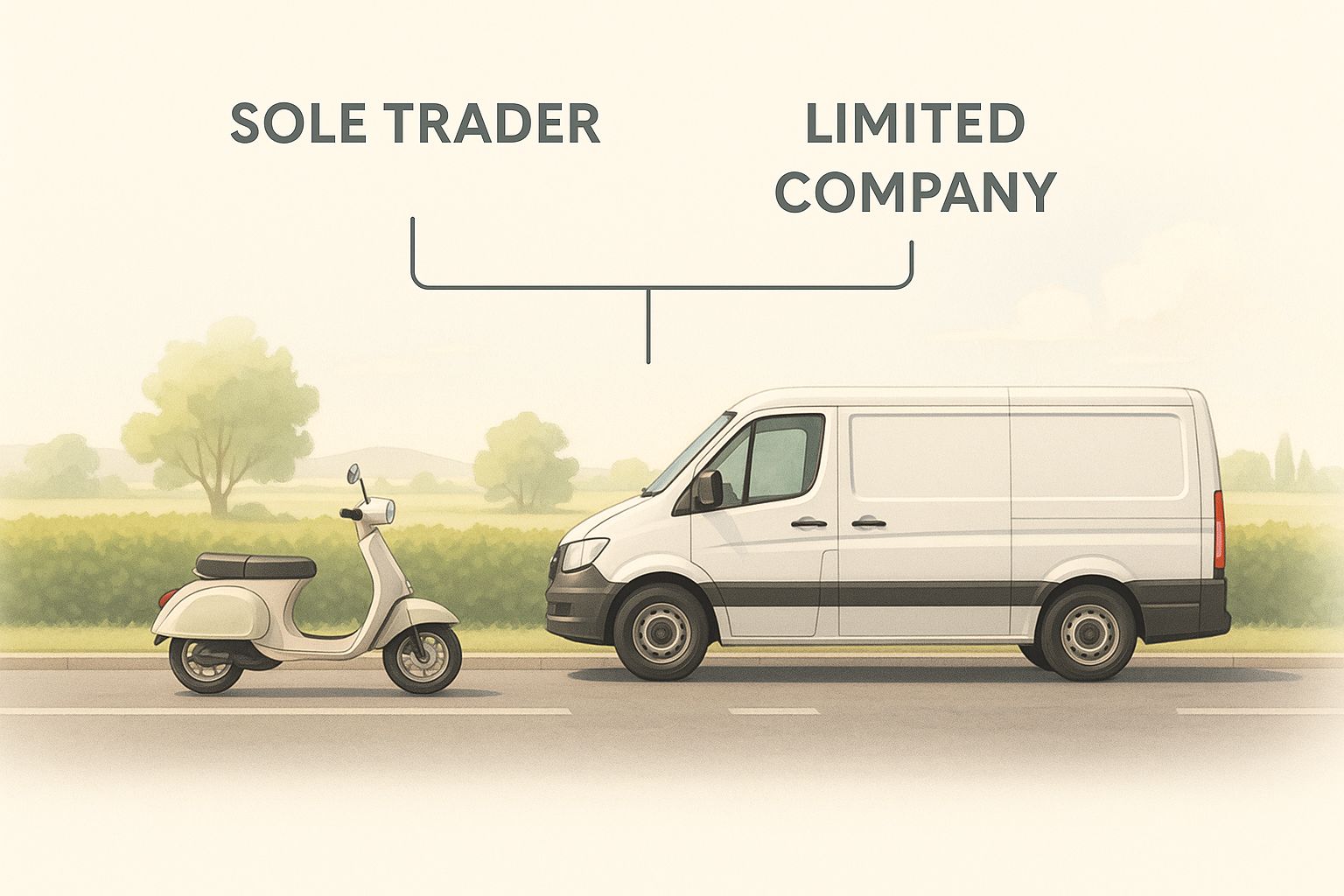
The image above pretty much sums it up. It’s a trade-off between the straightforward, low-fuss world of a sole trader versus the robust, protective shell of a limited company. The path you choose will dictate how you run your business, the way you’re taxed, and crucially, how much personal financial risk you’re signing up for.
Before getting lost in the details of each structure, it helps to zoom out and look at the core differences. Your own circumstances and what you want to achieve with the business will point you towards the best option.
It really boils down to three key areas:
Choosing your structure isn't just a box-ticking exercise on a form; it's the legal and financial bedrock of your entire business. Getting this right from day one can save you a world of headaches and money down the road.
As you weigh up your options, taking a detailed look at the Ltd Company Pros and Cons for UK Businesses can bring some much-needed clarity. And for a full walkthrough of every step, from idea to launch, don't miss our complete guide on how to start a business in the UK.
For most people dipping their toes into the world of business, the journey starts right here. The sole trader structure is by far the simplest and most direct way to get up and running in the UK. It’s all about freedom, total control, and very little red tape, which explains why it’s the go-to choice for over 3.2 million people.
Think of it like this: as a sole trader, you are the business. There’s no legal separation between your personal and business life. This is great because you keep all the profits after tax, but it also means you’re personally on the hook for any debts.
Getting started is refreshingly simple. Unlike other company types, you don’t need to register with Companies House. Your main legal task is to tell HM Revenue & Customs (HMRC) that you're self-employed so you can handle your taxes through Self Assessment.
This boils down to a few core responsibilities:
And that’s pretty much it. No directors, no shareholders, and no complicated annual reports. You can start trading almost immediately, which is perfect for freelancers, consultants, and skilled tradespeople who want to test an idea without hefty admin costs. A freelance graphic designer or a local plumber, for example, could be set up and ready to go in an afternoon.
This simplicity comes with one very important catch: unlimited liability. This is the most critical concept to grasp before you dive in. Because you and the business are legally one and the same, if your business racks up debts it can’t pay, your personal assets could be on the line.
Unlimited liability means there is no financial firewall between your business and your personal life. Creditors could potentially make a claim against your home, car, or personal savings to cover business losses.
This is the number one reason many entrepreneurs decide to switch to a limited company as their business grows and takes on bigger financial risks. A small debt might be manageable, but a significant loss could have life-altering consequences. It's a fundamental trade-off that has to be weighed against the structure's undeniable ease.
To help you make a smart decision, it helps to see the pros and cons laid out clearly. The sole trader path offers a unique mix of simplicity and risk.
This structure is a brilliant starting point, especially for low-risk businesses or if you’re just getting your feet wet. The lack of admin lets you focus on what really matters: building your business and looking after your customers. You have total freedom to make quick decisions and change direction without needing approval from a board or shareholders.
However, as your income climbs, the tax situation can become less attractive compared to a limited company, which pays Corporation Tax on its profits. On top of that, some larger corporate clients prefer the perceived stability and professionalism of working with a limited company.
If you need a hand managing your finances and staying compliant as you grow, our specialised accounting services for sole traders can give you the support and peace of mind you need.
For most entrepreneurs, forming a limited company is a huge step. It’s the moment a side hustle or a solo venture gets serious. The reason for this is a powerful legal concept called limited liability, which acts as a protective shield between your personal finances and your company’s debts. Honestly, this separation is the single biggest reason why so many business owners choose to go down this route.
You only have to look at the numbers to see how popular this structure has become. Today, limited companies make up a massive 76.7% of all businesses in the UK, leaving sole traders and partnerships in the minority. This isn't a fluke; it's a steady trend of entrepreneurs wanting the security and credibility that incorporation offers.
So, let's unpack the two main types of limited companies you’ll come across in the UK.

The Private Limited Company, or ‘Ltd’, is by far the most common choice for small and medium-sized businesses across the country. Think about your favourite local coffee shop, that digital marketing agency you follow, or a family-run construction firm. Chances are, they’re all operating as an Ltd.
This structure creates a separate legal entity from its owners. It means the company itself can sign contracts, own property, and take on debt. The owners are called shareholders, and the people running the show day-to-day are the directors. In a lot of small businesses, it’s just one person doing both jobs.
The clue is in the name: 'private'. It means the company's shares can't be sold to the general public. Instead, they’re held by a small, select group—usually the founders, their families, or a handful of private investors. This setup keeps control locked within a trusted circle.
Think of an Ltd as building a strong fence around your personal assets. If the business gets into financial hot water, creditors can only go after the company’s assets, not your home or personal savings. Your liability is 'limited' to whatever you invested in your shares.
Setting one up is pretty straightforward. You do it through Companies House, the UK's official registrar. You’ll need to pick a unique company name, appoint at least one director, and decide how your shares will be structured.
At the other end of the scale, you have the Public Limited Company, or PLC. This is the heavyweight division, designed for huge operations that need to raise serious capital by selling shares to the public on a stock exchange, like the London Stock Exchange. Your big high-street retailers, international banks, and energy giants—they're almost always PLCs.
The core difference is all about ownership and scale. While an Ltd keeps its shares exclusive, a PLC can offer them to anyone. This lets them raise vast sums of money for expansion, but it comes with a much heavier burden of regulation and transparency.
A PLC has to jump through a lot more hoops than an Ltd, including:
The level of public scrutiny is intense. PLCs are required to publish detailed financial reports and hold annual general meetings (AGMs) for all their shareholders, leaving no stone unturned.
So, which one is right for you? It really boils down to your goals, your scale, and how much admin you're willing to handle. A local tech startup will almost certainly begin as an Ltd. A business aiming for a stock market launch, on the other hand, will need to become a PLC.
To make it even clearer, let’s put them side-by-side.
This table breaks down the essential differences between the two main types of limited companies. It's a quick reference to see how they stack up on everything from shares to compliance.
Many successful companies actually start their life as an Ltd and then convert to a PLC when they’re ready for major growth. That big move is known as an Initial Public Offering (IPO), and it’s a massive milestone for any business.
Ultimately, the limited company structure—whether private or public—is the engine room of the UK economy. It gives entrepreneurs the framework to take calculated risks without betting the farm. Getting your accounting and compliance right from day one is non-negotiable for success. For specialist guidance, our expert accounting services for limited companies can help make sure your business is built on rock-solid financial foundations.

Not every business is a one-person show. For many entrepreneurs, the path to success is built with others, combining shared skills, a common vision, and pooled capital. When two or more people team up to run a business, they enter the world of partnerships, one of the most common company types in the UK for collaborative ventures.
This route offers two main models. You've got the traditional Partnership, the oldest and simplest way for multiple people to do business together. Then there’s its more modern cousin, the Limited Liability Partnership (LLP), which cherry-picks crucial legal protections from the limited company model. Each serves a very different purpose.
Think of a traditional Partnership as a 'sole trader with friends'. It’s simply an arrangement where two or more people (or even other companies) agree to run a business together to make a profit. You don’t need to register with Companies House, which makes getting started almost as straightforward as becoming a sole trader.
In this setup, the partners are in it together for everything. They share the profits, the decision-making, and—most importantly—the risks. This brings us to the single biggest feature of a traditional partnership: unlimited liability.
Just like a sole trader, every partner is personally on the hook for all of the business's debts. This isn't just about your 'share' of the debt; one partner can be held responsible for the entire amount, even if another partner’s actions caused the problem.
This principle is known as being 'jointly and severally' liable, and it's a serious point to consider. It means your personal assets, like your home and savings, are not shielded if the business runs into trouble.
Recognising the huge personal risks of unlimited liability, the Limited Liability Partnership (LLP) was introduced back in 2001. It’s a clever hybrid structure, blending the operational freedom of a traditional partnership with the legal armour of a limited company.
LLPs are hugely popular with professional service firms—think solicitors, accountants, and architects. That's because an LLP is a separate legal entity. The business itself is responsible for its debts, not the individual partners. A partner’s liability is capped at the amount of money they’ve put into the business.
This structure provides a critical safety net. If one partner makes a professional mistake that leads to a lawsuit, the personal assets of the other partners remain protected. This feature alone makes the LLP one of the most secure company types in the UK for professional collaborations.
Whether you go for a traditional Partnership or an LLP, getting a formal Partnership Agreement drawn up is non-negotiable. While it's not a legal must-have for a traditional partnership, going without one is like setting sail without a compass. This document is a legally binding contract that clearly lays out the rules for how the business will run.
A solid agreement should nail down the essentials:
Having this document in place from day one can prevent a world of pain later. It stops misunderstandings in their tracks and gives you a clear roadmap for resolving disputes, protecting not just the business but the relationships that built it.
When it comes to tax, both Partnership and LLP members are treated as individuals. The business entity itself doesn’t pay tax on its profits. Instead, the profits are divided up among the partners, and each person is then responsible for paying their own Income Tax and National Insurance contributions through Self Assessment.
Every partner needs to register as self-employed with HMRC. The partnership itself must also file an annual Partnership Tax Return, which details the business's income and shows how the profits were shared. It’s a system that keeps the tax side of things simple, much like being a sole trader, but within a collaborative business model.
While most businesses are set up to make money for their owners, a different kind of company is built around a social mission. These are organisations where purpose trumps profit, pouring their energy and resources back into the community or the environment.
The most common structure you'll see in this space is the Community Interest Company (CIC). Think of it as a limited company specifically designed for social enterprises. Imagine a local café using its profits to run free coding workshops for teenagers, or an eco-friendly cleaning company that invests its earnings into local river clean-up projects. That’s exactly what a CIC is for.
A CIC is a powerful tool for entrepreneurs who want to make a real-world difference. You get all the legal protections of a normal limited company (like limited liability), but with an extra layer of accountability to your social goals. To get the green light, your business has to pass a ‘community interest test’ to prove its main purpose is to benefit the community, not just its owners.
The absolute core of a CIC is its ‘asset lock’. This is a legal safeguard that permanently dedicates the company's assets and profits to its social mission. They can only be used for the good of the community and can't be siphoned off to private shareholders for personal gain.
The asset lock is a legal promise. It guarantees that the value generated by the social enterprise will always be used for its intended purpose, protecting its mission from being diluted by future profit-seeking motives.
This feature creates incredible transparency and builds trust, showing customers, funders, and the community that you’re genuinely committed to the cause.
Beyond the usual suspects and social enterprises, the UK offers a few other niche company types for very specific situations. They're less common, but knowing they exist gives you a complete picture of your options.
Here are a couple of notable examples:
Unlimited Company: This one’s rare. Shareholders have unlimited liability for the company's debts, just like a sole trader. Why would anyone do this? It’s sometimes used where limited liability isn't needed or is seen as a barrier to getting credit, as it shows a huge amount of confidence from its owners.
Charitable Incorporated Organisation (CIO): Designed purely for charities, a CIO gives you the benefits of being an incorporated body (like a limited company) but is regulated only by the Charity Commission, not Companies House. This really simplifies the admin for non-profits, offering limited liability without the headache of reporting to two different bodies. It's the go-to choice for organisations focused squarely on charitable work.
These specialised options show just how flexible the UK system can be. Picking one of these paths depends entirely on your unique goals, whether that’s cementing a social mission with a CIC or meeting the specific regulatory needs of a charity with a CIO.
Deciding on the right structure is the first major hurdle. Once you’ve picked your way through the different company types in the UK, the next job is making it all official. This is where your idea transforms into a legally recognised business, and it involves a few practical steps.
First up, you need a business name. It's got to be more than just memorable; it needs to pass the Companies House rules. That means it must be unique and can't be offensive or cheekily suggest a link to government bodies without permission. This name becomes your trading identity, so choose wisely.
Next, you need to appoint at least one director (for a private limited company). Directors have real legal responsibilities, like always acting in the company’s best interests and making sure it follows the law. You’ll also need a registered office address in the UK, which is your company's official home for all mail from Companies House and HMRC.
Registering your company is nearly always done online through the Companies House service. The application will ask for key details: your company's name, its registered address, who the directors and shareholders are, and a description of its business activities using Standard Industrial Classification (SIC) codes.
It's worth noting the landscape for new businesses is shifting a bit. We've recently seen a 10.0% drop in new company formations in a single financial year. This is likely down to stricter rules coming in under the Economic Crime and Corporate Transparency Act. But don't let that put you off. With over 5.4 million companies now on the register, the UK is still a buzzing place to do business. You can dig into the official data in the Companies Register activities report.
Remember, setting up is just the start. Running a company means you have ongoing duties. Every year, you’ll need to file annual accounts and a confirmation statement with Companies House to keep your company’s public record accurate.
Higher incorporation fees have also played a part in this changing environment. It's smart to stay on top of the latest company registration fees in the UK so you can budget properly for your startup costs.
As you think about the day-to-day running of your new venture, you'll need a way to take payments. Getting this sorted from the beginning is crucial, and this guide on finding the best payment gateway for your small business is a great place to start. Nailing these practical details early on builds a solid foundation for everything that comes next.
Choosing the right UK company structure can feel like a big commitment, and it's natural to have a few lingering questions. Getting these sorted is the key to moving forward with confidence. Here are the most common queries we hear from entrepreneurs just like you.
One of the biggest questions is, "Am I locked into my choice forever?" The answer is a resounding no. It’s incredibly common for a business to start life as a sole trader and later incorporate as a limited company once things take off. This switch often happens when an owner wants the protection of limited liability or finds it’s more tax-efficient as profits climb.
Another frequent question is about how quickly you can get set up. If speed is your priority, registering as a sole trader is the fastest way to get going. You just need to let HMRC know you’re self-employed, which you can do online in a matter of minutes. Forming a private limited company (Ltd) or an LLP is also surprisingly quick, often taking just 24 hours through Companies House. A PLC, on the other hand, is a different beast entirely, involving a much more detailed and lengthy legal process.
Finally, the tax implications are a huge point of confusion for many.
The crucial difference comes down to legal separation. As a sole trader, you pay Income Tax on all your business profits as if it's your personal income. A limited company, however, is a completely separate legal entity. It pays its own tax, and you are then taxed personally on the salary or dividends you draw from it.
Getting your head around this separation is fundamental. Your limited company is responsible for its own profits and must pay Corporation Tax on them. If you want to dig deeper, our detailed guide explains what is Corporation Tax and how it all works. Properly managing this distinction is vital for keeping your finances healthy and staying compliant in the long run.
At GenTax Accountants, we specialise in helping businesses of all sizes navigate these critical decisions. Whether you're a sole trader or a growing limited company, our expert team provides the clarity and support you need. Visit us at https://www.gentax.uk to see how we can help your venture succeed.
