



Think of Zoho less as a single piece of software and more like a complete operating system for your business. It’s a huge, interconnected suite of applications that covers everything from finance and sales to marketing and project management, all built to work together from the ground up.
Many UK businesses end up juggling a patchwork of different software. One tool for accounting, another for customer relationships (CRM), and maybe a third for managing projects. This approach almost always leads to data silos, double-entry, and frustrating inefficiencies. Information gets trapped, and getting a clear, unified view of the business becomes a real headache.
This is exactly the problem Zoho solves.
Imagine all your business tools acting as a perfectly coordinated team rather than a group of strangers who don’t speak the same language. That’s the core idea here. Zoho offers specialist apps like Zoho Books for accounting, Zoho CRM for sales, and Zoho Projects for task management, but because they’re all built on the same foundation, data flows between them effortlessly. This creates a single, reliable source of truth for your entire operation.
This integrated model is particularly powerful for the types of businesses we help, as it allows them to start small and scale without disruption. A contractor might only need Zoho Books to handle invoices and expenses at first. But as they grow, they can seamlessly add Zoho CRM to manage their client pipeline without the pain of migrating to a whole new system.
This unique value proposition hasn't gone unnoticed. Zoho is clearly committed to the UK market, with significant local investment and expansion in recent years. The platform’s rapid growth is proof that British businesses are hungry for a more cohesive way to run things.
The Zoho One suite, shown below, bundles over 45 of these applications into a single, surprisingly affordable subscription.
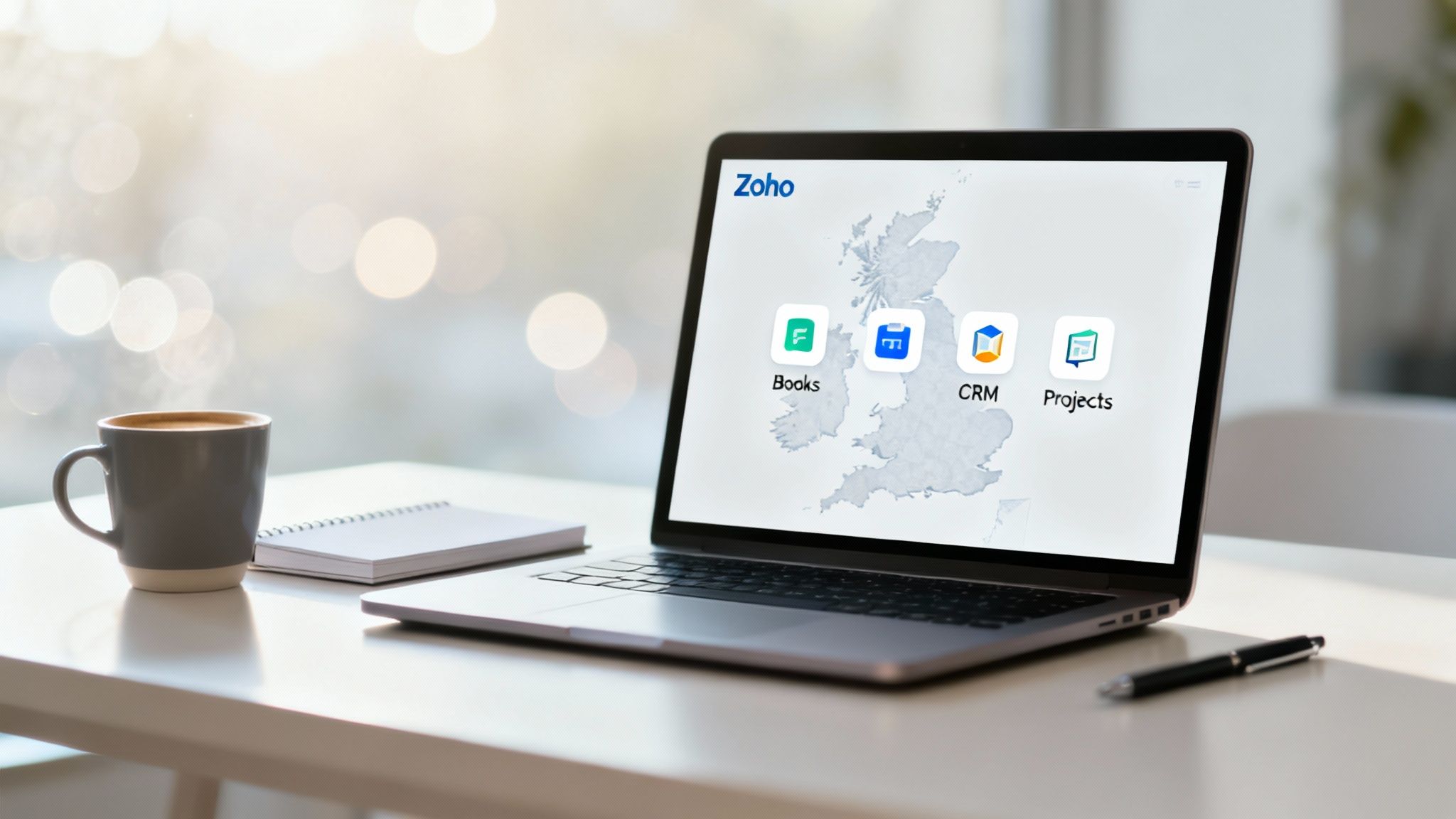
This screenshot really captures the "all-in-one" philosophy. It shows the sheer breadth of tools available under one roof, which is a key reason it stands out from the competition.
The company's UK expansion is impressive. They reported a 43% surge in UK operations over the last two years and have tripled their UK-based staff. This isn't just about numbers; it’s about providing localised support and services tailored to the UK economy, from public services to small enterprises.
The real advantage of Zoho is its scalability. It removes the friction of growth by providing a toolkit that expands with your business needs, eliminating the need for costly and disruptive software changes down the line.
For accountants and the businesses they advise, this translates into a powerful, future-proof platform. It enables a holistic view of a client's financial and operational health, moving beyond simple compliance to strategic advisory. By connecting everything from sales leads to final accounts, Zoho helps everyone make better decisions and drive genuine business efficiency.
For any UK business, navigating financial compliance isn't just a box-ticking exercise; it's the bedrock of good financial management. This is where Zoho Books really steps up. It’s more than just a piece of software with a long feature list; it's designed to solve the real-world compliance headaches that UK businesses face every day, from VAT to digital tax returns.
It means you can manage everything from creating professional, compliant invoices to generating HMRC-ready reports, all in one place. For accountants and business owners alike, that single source of truth is a massive weight off your shoulders, cutting down on admin and making sure the business stays on the right side of ever-changing regulations.
Making Tax Digital (MTD) has fundamentally changed how UK businesses report their tax information to HMRC. Zoho Books is built for this new reality, not just for today's rules but for what's coming next.
Its MTD for VAT functionality is seamless. You can prepare, check over, and file your VAT returns directly with HMRC right from the software. No more clunky bridging software or manual data entry. This direct connection ensures your numbers are accurate and creates a clear digital audit trail – something that’s absolutely essential for compliance.
But it doesn't stop at VAT. Zoho is already looking ahead to the next big shift in digital tax.
Zoho Books is officially recognised by HMRC for Making Tax Digital for Income Tax Self Assessment (MTD for ITSA). This prepares sole traders and landlords for the UK's upcoming digital tax rules, building on its existing VAT recognition to cover income tax.
This sort of forward planning is critical. The new MTD for ITSA rules are set to begin in April 2026 for those with qualifying incomes over £50,000. Getting to grips with these changes now is key, and our detailed guide on Making Tax Digital for Self Assessment breaks down everything you need to know.
Getting VAT right is non-negotiable for UK businesses. Zoho gives you the tools to handle different scenarios with precision, whether you’re on the Standard VAT scheme, the Flat Rate Scheme, or the Cash Accounting Scheme. You can just configure the settings to match your business's specific needs and let the software do the heavy lifting.
Zoho automatically calculates the correct VAT on your invoices and expenses, feeding that information straight into your VAT return as you work. This automation dramatically cuts the risk of human error, which can easily lead to costly mistakes and corrections down the line.
For businesses that trade internationally, dealing with different currencies adds another layer of complexity. Zoho Books makes this surprisingly simple with features like:
This is a huge win for eCommerce businesses, agencies with global clients, or contractors working for overseas companies. It takes all the manual calculations and guesswork out of the equation, giving you a crystal-clear financial picture.
To pull all of this together, it's helpful to see exactly how Zoho Books’ features map directly onto core UK compliance requirements. The table below gives a quick summary of what the software offers and why it matters for businesses like yours.
For businesses looking to get the absolute most out of Zoho Books, expert Zoho Books implementation services can make all the difference. An expert can ensure your setup is optimised from day one and perfectly tailored to your UK business needs. This support transforms the software from just another tool into a central pillar of your financial strategy.
The real power of the Zoho platform isn't in any single app, but in how beautifully they all talk to each other. Sure, using individual apps is helpful, but getting them to work together creates a seriously powerful, automated workflow that slashes manual data entry and kills administrative drag. It’s the difference between having a bunch of disconnected data points and a single, fluid operational process.
Think about the typical journey of a new client for a UK creative agency. Without an integrated system, you're manually copying information from the CRM to your project management tool, then again into your accounting software. Every single step is a potential pitfall—a place where details get missed or typed in wrong, leading to wasted time and, even worse, invoicing mistakes.
This is precisely the headache Zoho’s ecosystem was designed to cure. By linking the right apps, you can create a seamless flow of information from the very first hello right through to the final payment, with hardly any human intervention needed.
Let's walk through a practical scenario to see how this actually works. An agency needs to manage a new client project from start to finish, making sure every bit of billable work is captured and invoiced on the dot.
Lead Capture in Zoho CRM: A potential client fills out a contact form on the agency's website. That simple action instantly creates a new lead in Zoho CRM, capturing all their initial details. The sales team can then nurture the relationship, track conversations, and convert the lead into a client once they’ve signed on the dotted line.
Project Creation in Zoho Projects: As soon as the deal is marked as "won" in the CRM, a new project is automatically created in Zoho Projects with just one click. All the key client information from the CRM is pulled straight over, so there’s no tedious re-entering of names, contact details, or project scope.
Time Tracking and Billing: As the creative team gets to work, they log their billable hours directly against their tasks within Zoho Projects. This builds an accurate, real-time log of all work done, which is absolutely critical for checking project profitability and, of course, for accurate invoicing.
This workflow gives you a clear picture of how UK compliance tasks like invoicing, project management, and financial reporting are handled inside the Zoho ecosystem.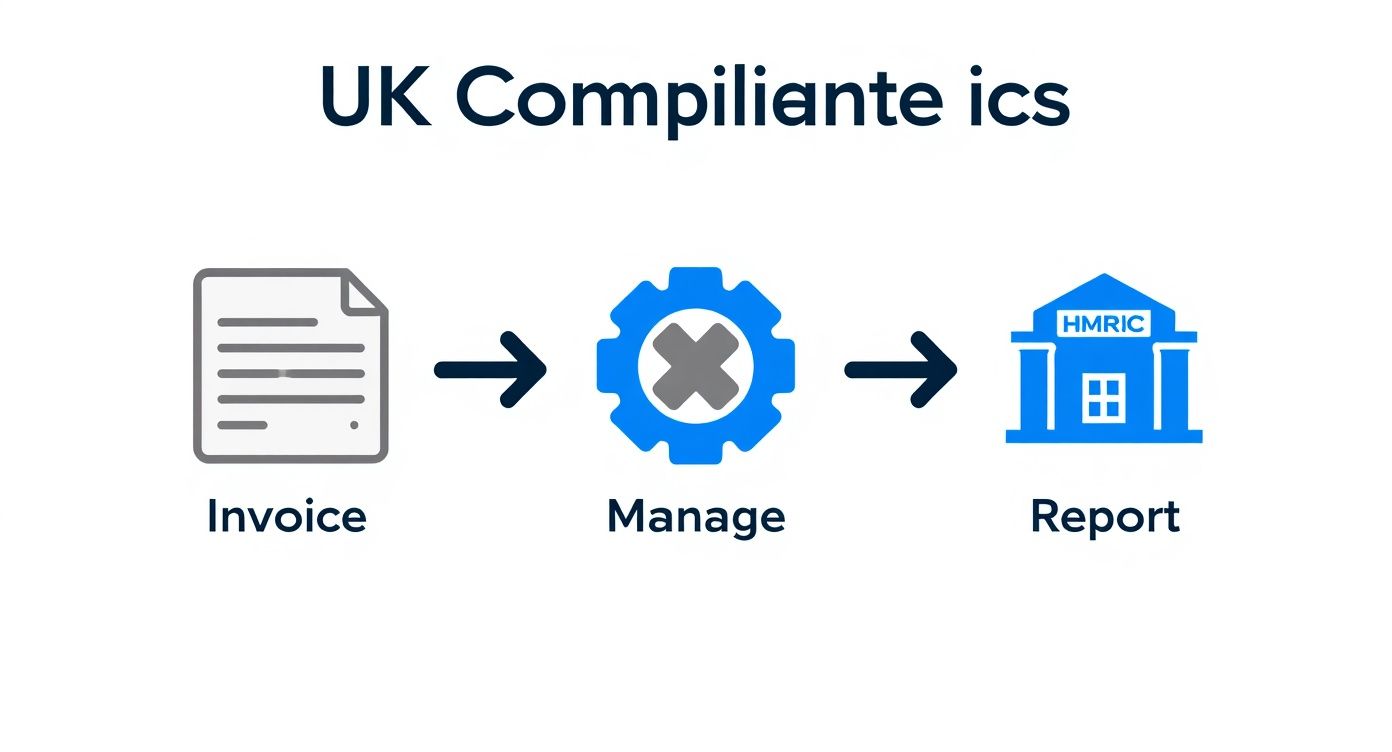
The flow chart really brings home how each stage connects to the next, making sure financial data is managed consistently from the moment it's created to its final submission to HMRC.
Automated Invoicing in Zoho Books: Now for the magic bit where the integration really pays off. When it's time to bill the client, an invoice can be generated in Zoho Books directly from the project's timesheets in Zoho Projects. All the logged hours and agreed rates are pulled across automatically, creating a detailed, spot-on invoice that’s ready to send.
Reconciliation and Reporting: The invoice goes out, the client pays up, and the payment is reconciled in Zoho Books against the open invoice. This entire journey—from a casual website visitor to a fully paid project—is tracked within one system, giving you a complete and unbroken audit trail. For businesses that want a hand with this, our expert bookkeeping services can make sure your Zoho Books are always accurate and up-to-date.
Of course, a business doesn't operate in a bubble. That’s why Zoho also shines when it comes to connecting with other essential platforms, especially in the eCommerce world. For any accountant managing the books for an online retailer, this is a total game-changer.
By integrating platforms like Shopify or WooCommerce directly with Zoho Books, every single sale, refund, and transaction fee can be automatically synced. This completely wipes out the tedious and error-prone job of manually matching up sales data from different places.
Instead of waiting for month-end reports to see what’s happened, an accountant gets a real-time, accurate picture of the business's financial health. You can see daily sales figures, track inventory levels, and monitor cash flow right from inside the accounting software. This immediate access to data allows for much more strategic advice, helping business owners make smart decisions based on what’s happening now, not what happened weeks ago. This level of automation transforms the accounting function from a historical record-keeper into a proactive business partner.
When you’re looking for accounting software, the choice in the UK often boils down to three big names: Zoho, Xero, and QuickBooks. They’re all powerful, HMRC-recognised platforms, but they come at the problem from completely different angles. Getting your head around these differences is the key to picking the right tool for your business, whether you're a contractor, a growing agency, or an e-commerce startup.
The real distinction is in their philosophy. Xero and QuickBooks are, first and foremost, dedicated accounting platforms. They do one thing—accounting—and they do it exceptionally well, building out from that solid foundation with a huge marketplace of third-party app integrations.
Zoho is different. It's an entire business operating system, and its accounting tool, Zoho Books, is just one piece of that much bigger puzzle. This all-in-one approach completely changes the conversation and how you’ll end up using the software.
Think of Xero and QuickBooks as world-class specialists. They offer deep, feature-rich accounting and then lean on a vast network of other specialist apps to handle CRM, project management, or marketing. This model gives you incredible flexibility, letting you cherry-pick what you feel is the absolute best tool for every single job.
The catch? This can quickly turn into a "Franken-suite" of software. You end up juggling multiple subscriptions, navigating different user interfaces, and just hoping the integrations between them all play nicely. Your monthly software bill can also creep up fast as you add more users and apps to the mix.
Zoho’s model is the polar opposite. It’s like a planned city where every building was designed by the same architect.
Zoho's primary strength is the native integration between its apps. Because Zoho CRM, Zoho Projects, and Zoho Books are all part of the same family, data flows between them seamlessly without relying on third-party connectors.
This creates a single, unified experience and a reliable source of truth for all your business data, from the first time a lead gets in touch to the moment you mark their final invoice as paid. For a more detailed breakdown of how different platforms stack up for new businesses, our guide on the best cloud accounting software for startups offers some valuable perspective.
The pricing models also tell a story. Xero and QuickBooks generally use tiered, per-user pricing that goes up as your team grows or you need more advanced features. For a sole trader who just needs the basics, this can be really cost-effective.
But for a growing agency, those costs can mount up. Adding a few team members to both your accounting and your CRM software can put a serious dent in your monthly outgoings.
Zoho flips this on its head, especially with its Zoho One subscription. It bundles 45+ applications for a single, predictable price per employee. This makes it an incredibly compelling offer for businesses that know they’re going to grow and will need more than just an accounting tool down the line. You get the whole toolkit from day one, ready to activate whenever a new operational need pops up.
To make the choice a bit clearer, let's put the key differences side-by-side. This isn't about every single feature, but rather the strategic considerations for a growing UK business.
Ultimately, it comes down to your vision. If you see the value in a single, connected system and know you’ll eventually need tools beyond accounting, Zoho makes a powerful and cost-effective argument. But if you prefer best-in-class specialisation and have already built a workflow around third-party tools you love, then Xero or QuickBooks might feel like a more natural fit.
Switching your core business software can feel like a major operation. Let's be honest, the thought of moving years of financial data is daunting for anyone. But a smooth and successful transition to Zoho is entirely possible with a bit of planning.
The key isn't just to shovel data from one system to another. It's about ensuring that data is clean, accurate, and ready to power your business from day one. A well-executed migration minimises disruption and genuinely sets you up for long-term success.
The first step, before you even think about importing a single file, is a thorough data cleanse. Think of it like moving house. You wouldn’t just throw everything into boxes; you'd have a proper sort-out, declutter, and get rid of things you no longer need. The same principle applies here.
Your current system likely has old contacts, duplicate entries, or outdated records that you definitely don't want cluttering up your shiny new Zoho setup. Taking the time now to archive old projects and clean up your customer and supplier lists is a critical pre-migration task that pays huge dividends later.
Once your data is tidy, the next phase is getting it out of your current system. Most accounting platforms like Xero or QuickBooks will let you export key information into standard formats, usually CSV files.
You'll need to gather several key data sets:
As you plan your transition to Zoho, the meticulous transfer of this existing data is crucial. For a deeper dive into the nitty-gritty, this guide to developing a comprehensive data migration plan is a fantastic resource.
With your data exported, you can begin setting up your UK-compliant environment in Zoho Books. This isn't just about uploading files; it's about building the correct financial framework for your specific business from the ground up. A crucial first task is configuring your Chart of Accounts to align with UK standards and your business model.
Next, you absolutely must get your VAT settings configured correctly from the very beginning. This means selecting the right VAT scheme (Standard, Flat Rate, etc.) and entering your VAT registration number. Getting this right ensures your MTD submissions will be accurate from your very first filing in Zoho.
The goal of a migration is not just to replicate your old system in a new one. It's an opportunity to improve your processes, streamline your chart of accounts, and ensure your new setup is optimised for efficiency and compliance.
Managing this entire process can be complex, which is why many businesses choose to work with an expert partner. A specialist can handle the whole thing, from data cleaning and setup to training your team. Our expert team provides dedicated technology transformation support to ensure your move to Zoho is seamless, accurate, and sets your business up for future growth.
This managed approach helps you avoid the common pitfalls and ensures you can leverage Zoho's full potential from day one.
Getting your head around an all-in-one platform like Zoho is the first step. But the real challenge? Turning all that potential into genuine, measurable results for your business. This is exactly where having an expert partner makes all the difference, taking you from a basic software setup to a truly fine-tuned operation.
At GenTax, we don't just see Zoho as another piece of software. We treat it as a strategic asset, ready to be moulded to your business's specific needs.

Our job starts with building a solid foundation. We'll personally handle the entire migration and setup, making sure Zoho is configured perfectly for your UK business right from the off. That means setting up a compliant Chart of Accounts, getting your VAT schemes right from day one, and building automated workflows that genuinely save you time and cut down on mistakes.
Just installing the software is never enough. The real magic happens when you connect the right apps from the huge Zoho ecosystem to solve your unique problems. That's where our experience comes in. We make sure you’re not just using Zoho Books in isolation, but creating smart, seamless links to Zoho CRM or Zoho Projects where it will have the biggest impact.
Our hands-on services include:
Choosing the right software is only half the battle. Expert implementation and ongoing management ensure that software delivers on its promise, turning your investment into a clear competitive advantage.
Ultimately, working with GenTax means your Zoho platform becomes perfectly aligned with your business goals. We look after all the technical bits and pieces – from setup to daily financial management – freeing you up to focus on what you actually do best: running your business. It's a partnership that turns Zoho into the engine for your financial clarity and efficiency.
Jumping into a new software ecosystem always throws up a few questions. For UK business owners and accountants weighing up a move to Zoho, getting clear on things like suitability, security, and support is non-negotiable before making the leap.
Here are some direct answers to the most common queries we hear from clients.
Absolutely. One of the best things about Zoho is how it scales. This makes it a fantastic choice for small UK contractors and sole traders who are just getting started. You don’t need to dive in and buy the whole suite from day one.
You can start lean with an affordable plan for just Zoho Books to handle your core accounting, invoicing, and MTD compliance. Later, as your business grows and you need more firepower, you can seamlessly plug in other apps like Zoho CRM for managing clients or Zoho Projects to organise your work.
This ‘grow-with-you’ approach is what makes Zoho so appealing. It gives you a cost-effective, future-proof path, letting your business expand without the headache and expense of switching platforms down the line.
It’s a smart way to operate – you only pay for what you need now. This makes it a financially sound choice whether you're a one-person band or a fast-growing agency.
This is a big one, and rightly so. Zoho takes data security incredibly seriously, running its own secure data centres to keep full control over its infrastructure. Crucially, this includes facilities right here in the EU, helping ensure rock-solid GDPR compliance.
They use multiple layers of robust security measures to keep your information safe. These include:
For UK businesses, this enterprise-grade security means your sensitive financial data is protected to a standard that often goes beyond what’s required, giving you proper peace of mind.
Yes, you can. Zoho has invested heavily in its UK operations over the last few years, recognising that local knowledge matters. They’ve built a dedicated and growing support team based right here in the UK.
This means UK customers get timely help from experts who genuinely understand our specific needs. Got a question about MTD for ITSA, UK VAT schemes, or local accounting rules? You can speak to someone who gets it. This local support is a massive plus for businesses needing quick, accurate answers to keep things running smoothly.
Ready to see how Zoho can be expertly tailored to your business? The team at GenTax Accountants can manage your entire implementation and provide ongoing support to turn Zoho into your most powerful business asset. Get in touch with us today to learn more.
