



When you're trying to figure out if your business is really making money, the first place to look is your gross profit margin. It’s a simple but incredibly telling number.
Essentially, it shows you what percentage of your revenue is left after you’ve paid for the direct costs of making what you sell—what's known as the Cost of Goods Sold (COGS). It’s the profit you make on each sale before you even think about paying for overheads like rent, marketing, or admin salaries.
Let's use a simple example. Say you run a local coffee shop. You sell a latte for £3.
To make that one latte, you need coffee beans, milk, and a cup. Let’s say those direct costs add up to £1. The £2 left over is your gross profit on that single sale.
Your gross profit margin takes that £2 and turns it into a percentage. It shows you exactly what chunk of that £3 selling price is pure profit, before all the other business expenses come into play. This one metric gives you a crystal-clear snapshot of your core financial health, telling you how well your pricing and production processes are working together.
Getting your head around this is a foundational piece of good financial analytics, as it reveals the fundamental profitability of your entire operation.
To make it even clearer, here's a quick breakdown:
This table breaks down the formula and what each part actually represents.
This shows that for every pound you earn, nearly 67p is gross profit before paying any other bills.
You might be wondering why we don't just jump straight to net profit, which accounts for everything. The reason is that gross profit margin isolates the profitability of your actual products or services. This is vital for a few reasons:
By focusing purely on the relationship between what you earn and what it costs to make your product, gross profit margin gives you an unfiltered look at how well your core business is running. It's the first financial checkpoint for any healthy company.
Figuring out your gross profit margin is surprisingly straightforward. You only need two numbers from your accounts: your total revenue and your Cost of Goods Sold (COGS). From there, it’s a simple but incredibly powerful formula.
The calculation gives you a clean percentage, showing exactly how much profit you’re making from each pound of revenue before you even think about overheads. It’s a direct look at how efficient your core operation and pricing strategy really are.
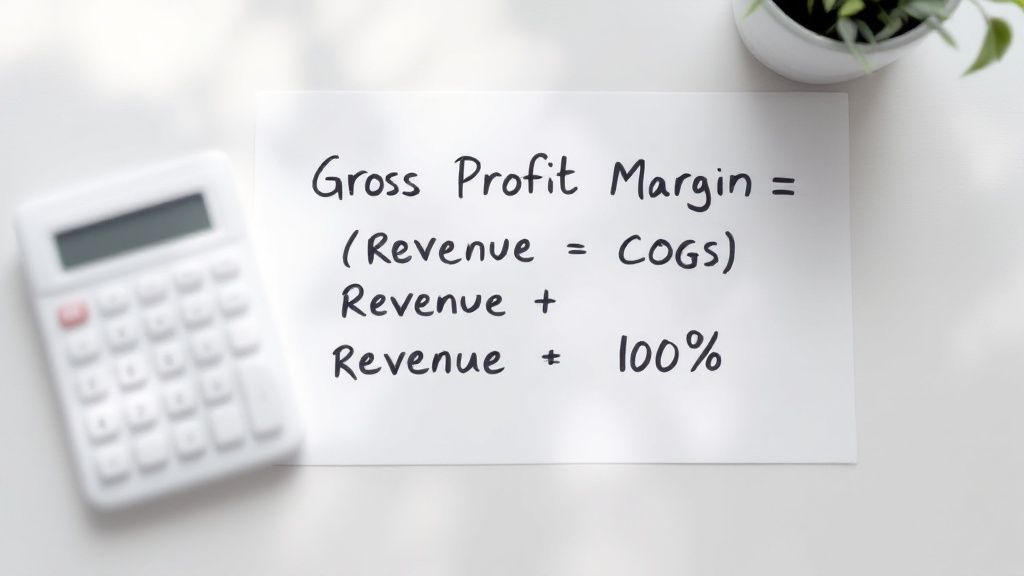
Gross Profit Margin Formula
[(Total Revenue – Cost of Goods Sold) / Total Revenue] x 100
This little formula gets right to the heart of your business's profitability. To use it, you'll first need your total revenue – that’s all the money that came in from sales over a certain period. Next, you need your COGS, which are the direct costs of producing what you sell, like raw materials or the wages of the people making the product. Keeping these figures spot-on is crucial, and good bookkeeping services can make all the difference.
Let's walk through an example. Imagine a craft brewery here in the UK. Over one quarter, they brought in £100,000 in revenue from selling their beer.
To work out their COGS, they need to add up all the direct costs of brewing:
That gives them a total COGS of £40,000. Now, they can simply pop these numbers into the formula.
So, the brewery’s gross profit margin is 60%. What does this actually mean? For every pound of beer they sell, they have 60p left to cover all their other business costs, like rent, marketing, and admin salaries.
This infographic is a great way to visualise how revenue, direct costs, and your profit margin all fit together.
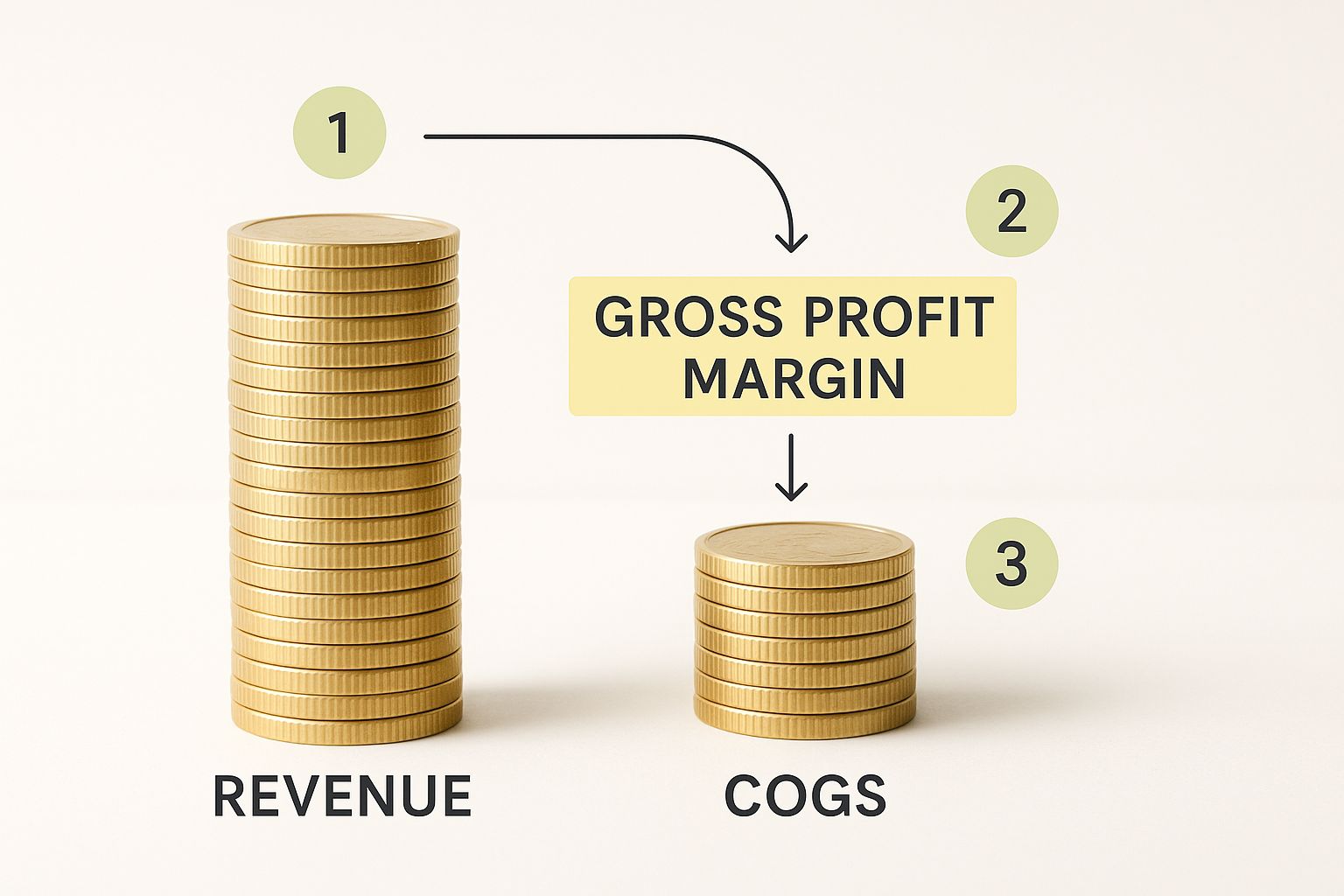
As you can see, the gross profit margin is that valuable chunk of your revenue that’s left standing after the direct costs of production have been paid off.
You've calculated your gross profit margin, and you have a percentage staring back at you. The immediate question is, "Is this any good?"
Well, the honest answer is: it depends. There isn't a single magic number that works for everyone. What’s considered a fantastic margin in one industry could spell serious trouble in another.
Context is absolutely everything here. A software-as-a-service (SaaS) business, for instance, has very low direct costs to deliver its product. It’s not unusual for them to aim for a gross profit margin of 80% or even higher. On the other hand, your local corner shop deals with high stock costs and might be thriving with a margin closer to 30%.
The huge differences you see from one industry to the next boil down to the business model and what it actually costs to deliver the product or service.
Trying to compare your coffee shop's margin to a tech startup's is like comparing apples and oranges—it just doesn't make sense. The only comparison that truly matters is how you stack up against your direct competitors and the benchmarks for your specific industry.
A "good" gross profit margin isn't a fixed number. It's a relative one that shows your business is running efficiently and profitably compared to others playing in the same field.
Knowing where you stand is vital. For example, the gross profit margin in the UK grocery retail sector typically hovers around 30-35%. But industries like energy and banking report much higher figures. Digging into the average profit margins across different UK industries can give you a much clearer picture.
For anyone selling online, getting these numbers right is even more critical because the competition is fierce. We provide specialised accounting support for eCommerce businesses precisely because we understand the unique financial hurdles they face.
Ultimately, a "good" margin is one that's healthy for your sector, allows you to comfortably cover all your other running costs, and still leaves you with a decent net profit at the end of the day.
Your gross profit margin is so much more than a number on a spreadsheet. Think of it as a story about your business's health – how efficient you are, and whether your pricing has real power in the market. A strong, steady margin tells you that you’ve got a good grip on your production costs and a solid pricing strategy that customers are happy with.
But what if that margin starts to dip? That’s a red flag. It could be whispering (or shouting) that your supplier costs are creeping up, there’s waste somewhere in your production line, or maybe your prices just aren’t competitive enough to cover what it costs to make your product anymore. Tracking this metric over time is the key to spotting these trends before they turn into serious headaches.
Checking in on your margin isn’t a one-and-done job. You need to keep an eye on it regularly to understand which way the wind is blowing.
Think of your gross profit margin as the first chapter in your financial story. It sets the scene for everything that follows. A weak opening chapter makes it much harder to reach a happy ending (i.e., a healthy net profit).
The story your gross profit margin tells is also vital for understanding your company's overall financial health and, ultimately, its valuation. A strong, consistent margin is a huge green light for potential investors, as you can see with this handy Business Valuation Estimator. This is exactly why we believe in regularly monitoring these figures with detailed management accounts – it turns raw data into a clear, actionable narrative.
It's an interesting time, too. Recent analysis shows that across the UK, markups and gross profit margins have generally been on the rise over the last two decades. This suggests many businesses have successfully strengthened their pricing power. In fact, a GOV.UK report on UK competition highlights that aggregate markups have risen by 10% to 40% since 1997.
If you focus on these two areas, you’ll directly boost your core profitability. Even small, consistent tweaks can make a massive difference to your bottom line over time, freeing up cash to cover your overheads and plough back into the business.
One of the most straightforward ways to fatten up your margin is simply to earn more from the things you already sell. Before you go slapping new price tags on everything, though, it pays to be a bit more strategic.
A healthy gross profit margin isn’t just about slashing costs; it’s about squeezing every last drop of value out of each sale. Strategically increasing what you earn per transaction is often the quickest way to stronger profits.
At the same time, you need to get a firm grip on your Cost of Goods Sold (COGS). Trimming these direct expenses means more profit is left over from every pound that comes through the door.
Start by digging into your biggest cost centres. You can often find savings without having to sacrifice the quality of what you deliver. This is where having the best cloud accounting software for startups becomes a game-changer, giving you a crystal-clear view of where your money is going.
Here are a few tactics to think about:
Your company's gross profit margin doesn't exist in a bubble. It's constantly being shaped by the wider UK economy, so understanding that bigger picture is key to building a more resilient business strategy. Think of it like this: you can't control the weather, but you can prepare for it. The same goes for macroeconomic forces like economic cycles, policy changes, and new technology—they all influence your profitability.
If we look back, these trends become crystal clear. UK corporate profit margins have seen some significant ups and downs over the decades. A deep dive into the history books shows a noticeable drop in profitability from 1950 all the way to the mid-1970s. This was followed by a long period of growth between 1975 and 1997. You can dig into the data yourself in these long-term UK profitability findings.

Why does this long-term view matter? Because it's absolutely crucial for solid strategic financial planning. It helps business owners and managers get ready for economic shifts, making sure their company stays financially healthy no matter which way the wind is blowing.
By understanding historical economic trends, you can better contextualise your own performance and make more informed decisions for the future, turning reactive measures into proactive strategies.
Navigating these often-choppy financial waters is where expert guidance can make all the difference. The insights from a fractional finance director can help you translate broad economic data into smart, actionable strategies tailored specifically for your business.
Once you get the hang of calculating gross profit margin, a few practical questions almost always pop up. Let's run through some of the things business owners often ask.
It sounds like a great problem to have, doesn't it? But yes, a margin that's sky-high compared to your industry could be a red flag. It might suggest your prices are too steep, which could drive customers away over the long run.
On the other hand, it could also mean you're skimping on the quality of your materials or labour to cut costs. That might boost profits now, but it's a risky game that can damage your reputation and customer loyalty down the line.
Unfortunately, yes. A negative gross profit margin means it’s costing you more to make your product than you’re selling it for. It’s a completely unsustainable situation and a massive warning sign that you're losing money on every single sale, before you even think about paying for rent, marketing, or other overheads.
Think of it this way: a negative margin means you're literally paying customers to take your products off your hands. It's a critical fire you need to put out immediately, usually by raising prices, finding serious cost savings in production, or even ditching the unprofitable product altogether.
You should make checking your gross profit margin a regular habit. As a bare minimum, you'll want to review it quarterly to see how you're trending.
However, if you're in a fast-paced business like retail or hospitality where stock moves quickly and costs can change, checking it monthly is a much smarter move. This gives you a real-time pulse on your profitability and lets you react to problems before they get out of hand.
Ready to turn these financial insights into a clear strategy for growth? The team at GenTax Accountants can help you dig into your numbers and make decisions that count. Find out how we can support your business.
