



Navigating the world of tax can feel like a headache waiting to happen, but getting to grips with the Construction Industry Scheme (CIS) is a must for anyone in the UK construction trade. It’s a crucial piece of the puzzle that affects how and when tax gets paid.

So, what exactly is the Construction Industry Scheme?
In simple terms, it's a special set of tax rules created by HMRC just for the construction sector. Think of it as a bit like PAYE (Pay As You Earn) for the self-employed. It requires contractors to deduct tax directly from their subcontractors' payments before paying them. This money is then sent straight to HMRC.
Essentially, it’s a way of collecting a down payment towards a subcontractor's annual tax and National Insurance bill. Rather than facing a huge bill at the end of the year, tax is collected at the source, which helps prevent tax evasion and keeps everything above board.
The scheme's net is cast wide, covering almost every type of construction work you can think of—from site preparation and building work to decorating and even demolition. Its impact is massive; in the 2022/23 tax year alone, CIS tax receipts hit over £6.3 billion, with more than 1.2 million businesses registered. You can explore more about the role of CIS in tax compliance on pricemann.co.uk.
At its core, CIS is about creating a fair and transparent tax process within an industry that heavily relies on self-employed and temporary labour.
To help you get started, here's a quick breakdown of the main ideas we'll be covering in this guide.
Whether you're a contractor trying to figure out your obligations or a subcontractor wanting to keep more of your hard-earned cash, this guide has you covered. We'll walk you through:

First, you need to pin down your function in the CIS framework. The labels ‘contractor’ and ‘subcontractor’ can be misleading—they’re not reserved for big building firms. What really counts is the work you commission or carry out, not just your trading name.
A contractor is any business that pays someone else to perform construction activities. That might be a high-street builder, but it also covers a property developer bringing in a crew of tradespeople. In CIS terms, if you’re cutting the cheques, you’re contracting.
Sometimes the scheme catches organisations off-guard. Spend more than £3 million on construction in any rolling 12-month period and HMRC automatically deems you a ‘contractor’, even if it’s not your main trade. Big retailers and local authorities often get stung by this rule.
You must register as a contractor if you:
Tick any of these boxes and CIS obligations kick in. For deeper insights, check out our specialised advice for UK construction contractors on gentax.uk.
A subcontractor, on the other hand, is simply the person or company doing the work. That covers sole-trader electricians, partnership plumbers or limited companies specialising in plastering.
Simply put, if you perform construction work for another business and issue an invoice for your services, you are acting as a subcontractor in that relationship.
Often the same business switches hats. A building firm might act as a subcontractor when working for a developer, then become the contractor when it brings in an electrician. Spotting your role in each transaction is the key to staying CIS-compliant.
At the heart of the Construction Industry Scheme are the deduction rates. These numbers directly hit a subcontractor's cash flow, so getting your head around them is non-negotiable.
When a contractor is about to pay a subcontractor, they must first verify their status with HMRC. This quick check tells them exactly what percentage of tax to hold back from the payment. It's not a choice; it's a rule.
There are three possible outcomes from that HMRC check, each with a different deduction rate.
The Standard Rate (20%): This is the most common scenario. It applies to any subcontractor who is properly registered for CIS. The contractor will deduct 20% from the labour portion of their invoice and pay it directly to HMRC. Think of it as an advance payment towards the subcontractor's end-of-year tax and National Insurance bill.
The Higher Rate (30%): This is the one you want to avoid. If a subcontractor isn't registered for CIS, or if the details the contractor provides don't match HMRC's records, a hefty 30% must be deducted. This higher rate is a powerful incentive to get registered and keep your details up to date.
Gross Payment Status (0%): This is the goal for most established subcontractors. If you qualify for Gross Payment Status, you get paid in full with 0% deducted. The cash flow advantage here is massive, as you're not waiting until your tax return is filed to get back any overpaid tax. You're in control of your money from day one.
To make it clearer, here’s a quick comparison of how the rates stack up.
As you can see, getting registered is the bare minimum, but achieving Gross Payment Status is the real game-changer for your business's financial health.
Think of Gross Payment Status as earning a 'trusted trader' badge from HMRC. It shows you have a solid track record of paying your taxes on time and running a legitimate, well-managed business. In return, they trust you to handle your own tax affairs without taking deductions upfront.
Qualifying for Gross Payment Status isn’t a walk in the park. You’ll need to pass a few strict tests, which include proving your tax affairs are in order, showing your business is run through a bank account, and meeting a minimum turnover threshold.
For many construction businesses, juggling these deductions, verifications, and monthly returns is a core part of their payroll and payment processes. Having an expert eye on things isn't just helpful; it's essential for staying compliant and keeping your cash flow healthy.
Knowing your role in the CIS is the first step, but taking action is what keeps you compliant and clear of any trouble with HMRC. Both contractors and subcontractors have specific, ongoing jobs to do to stay on the right side of the rules.
For contractors, the checklist is straightforward and there’s no room for negotiation. Your main duties kick off the moment you decide to hire your first subbie. You’ve got to register as a contractor with HMRC and then verify every single subcontractor before you pay them. After that, it's all about calculating and deducting the correct CIS percentage from their payments.
These deductions need to be paid over to HMRC every month, along with a detailed CIS return. And here’s a crucial point that catches people out: you must file a return every month, even if you haven't paid any subcontractors. Consistency is absolutely key to avoiding fines.
For subcontractors, the most important job is registering with HMRC. Just doing this one thing ensures you're taxed at the standard 20% rate instead of the much higher 30%. Think of these deductions as advance payments towards your annual tax and National Insurance bill. Keeping meticulous records with professional bookkeeping services for your business is essential for squaring everything up at year-end.
This infographic clearly shows how a subcontractor’s verification status directly affects the rate a contractor will deduct.
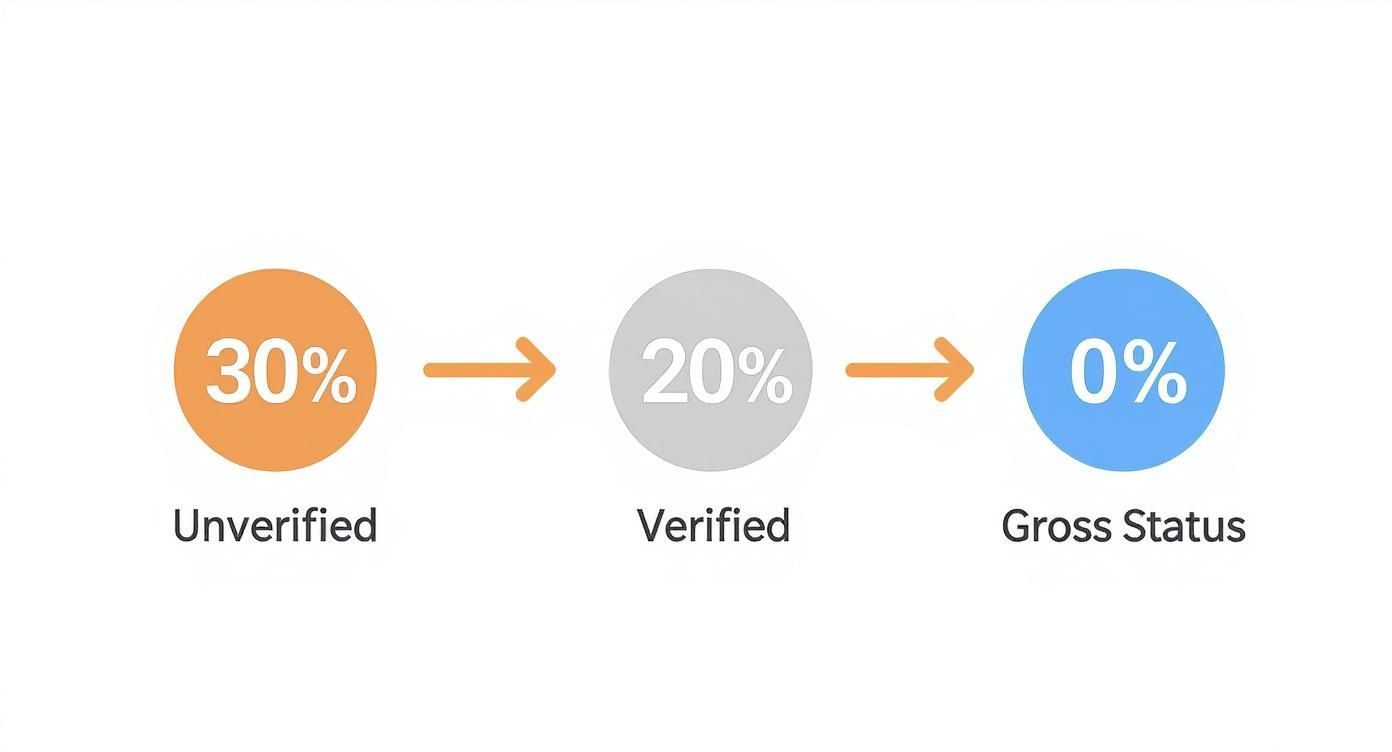
As you can see, getting from unverified status all the way to Gross Payment Status has a massive impact on your immediate cash flow.
It’s also worth noting a recent change that requires businesses to keep a close eye on their spending. If your business’s total spend on construction work tops £3 million over any rolling 12-month period, you now have to register as a contractor. This is designed to bring more major players into the scheme, with HMRC expecting it to pull in an extra £15 million in tax each year. You can get the full details by reading about the recent changes to CIS on GOV.UK.
Think of the Construction Industry Scheme as a direct link between the payments you get on-site and your year-end tax bill. For subcontractors, those deductions aren't lost money; they're simply advance payments towards your final tax and National Insurance liability.
When it's time to file your annual Self Assessment, you need to declare your full gross income—that's the total amount before any CIS deductions were taken off. You then report the total CIS tax that's been withheld during the year as tax you've already paid. Getting this right is absolutely crucial.
In many cases, the deductions taken at 20% add up to more than your final tax bill. When this happens, you’re due a tax refund from HMRC, which can be a welcome cash injection for your business. For lots of subcontractors, planning for this refund is a key part of their financial year.
The scheme puts different financial pressures on everyone involved. Subcontractors often feel an immediate squeeze on their day-to-day income, while contractors carry the administrative burden of verifying, deducting, and reporting every month.
The secret to navigating CIS without the stress is proactive financial management. Don't let deductions or admin tasks catch you off guard; build them into the financial rhythm of your business from day one.
Here are a few practical tips for keeping your money straight:
For many in the trade, figuring out how CIS deductions fit in with personal tax can feel like a puzzle. Having clear guidance on registering for Self Assessment Tax is a great starting point. Getting professional help with your annual tax returns can make all the difference, ensuring you get every penny you're owed back from HMRC without the headache.
Getting your head around the Construction Industry Scheme is one thing, but actually managing it day-to-day is another beast entirely. The deadlines are sharp, the rules can feel like a maze, and a simple mistake can lead to hefty penalties that put your business at risk. This is exactly where having an expert in your corner makes all the difference.
At GenTax Accountants, we live and breathe CIS so you don’t have to. We specialise in helping construction businesses navigate the scheme with total confidence, turning a major headache into a smooth, simple process.
Our whole approach is designed to lift that administrative weight off your shoulders, letting you get back to focusing on your projects. We can jump in and help with:
And for subcontractors, we make sure your Self Assessment is filed perfectly to reclaim any overpaid tax as quickly as possible, giving your cash flow a much-needed boost.
If you're tired of chasing CIS paperwork and want to be certain you're fully compliant while making your finances more efficient, we're here to help. To see how we can make your CIS obligations a whole lot simpler, get in touch with our team of accountants today.
Got a question about the Construction Industry Scheme? You’re not the only one. It can be a tricky system to navigate, so here are a few of the most common queries we get from clients.
The scheme casts a pretty wide net, catching most construction work that happens in the UK. Think of anything from preparing a site and laying foundations to building, alterations, repairs, demolition, and even decorating.
But it’s not all-encompassing. Certain professional services usually get a pass. For example, the work done by architects and surveyors, or simply hiring out scaffolding without providing the labour, generally falls outside of CIS. If you’re ever in doubt about a specific job, it's always best to check HMRC's official guidelines.
HMRC doesn't mess around with deadlines. Submitting your monthly CIS return late triggers an automatic penalty, even if you’re just a single day behind. That first slip-up will cost you £100.
It gets worse if it becomes a habit. The penalties keep climbing for continued late filings, first to £200, then £300. If a return is more than 12 months overdue, you could be looking at an additional penalty of up to £3,000. On top of the financial hit, persistent failures can also put your own Gross Payment Status at risk.
Yes, absolutely. This is a very common scenario for limited companies working as subcontractors. Any CIS deductions taken from your invoices throughout the year are essentially treated as advance payments towards your company's tax liabilities.
These deductions are then set against your company’s PAYE/NI contributions and its final Corporation Tax bill. If the total CIS you've paid is more than what you owe, your company is entitled to claim that difference back from HMRC once you've filed your final payroll reports for the year.
Managing CIS deductions, returns, and compliance is a heavy lift, but you don't have to figure it all out on your own. At GenTax Accountants, we specialise in making CIS simple for contractors and subcontractors across the UK. Discover how our expert accounting services can save you time and money.
