



At its heart, accounts payable (AP) is the money your business owes to suppliers, while accounts receivable (AR) is the money that customers owe you. Think of it this way: AP is your stack of bills to pay, and AR is your stack of invoices waiting to be paid. Getting a firm grip on the difference is the first step to mastering your cash flow.

To really understand what separates these two, let's imagine you run a bustling local café.
When you order a fresh batch of coffee beans from your roaster on credit, the bill you owe them goes into accounts payable. On your balance sheet, this is a short-term liability—it’s cash you know you’ll have to pay out soon. Staying on top of your AP is crucial for keeping your suppliers happy and avoiding any awkward conversations or late payment penalties.
Now, flip the scenario. A local office places a big catering order for sandwiches and pastries, and you send them an invoice. That invoice, and the money they owe you for it, is your accounts receivable. This is a current asset because it represents cash that will be flowing into your business. Chasing these invoices effectively ensures you have the money to pay for those coffee beans and keep the lights on.
Together, AP and AR are the two sides of your business's financial heartbeat. They show you what you owe and what you're owed at a glance. Balancing them isn’t just a bookkeeping chore—it’s a fundamental strategy for survival and growth.
To make it even clearer, let's break down the core differences in a simple table.
Effectively managing these two sides of the same financial coin is absolutely vital. When you handle them properly, you gain clarity, stay compliant, and can make smarter strategic decisions. It’s why so many UK businesses turn to experts for help with their company accounts, ensuring nothing gets missed.
So, we’ve covered the theory. Now, let’s get practical and trace an invoice’s journey through your business. Thinking about what is accounts payable and receivable in terms of day-to-day workflows makes these concepts much easier to get your head around. It all comes down to creating clear, repeatable processes.
For accounts payable, the whole thing kicks off the moment an invoice from a supplier lands, whether it’s a paper copy in the post or a PDF in your inbox. The end goal is simple: verify it, approve it, and pay it without any fuss.
The typical lifecycle of a supplier invoice has a few crucial checks and balances before any money actually leaves your bank account.
Good AP management isn't just about paying bills on time. It's about keeping your suppliers happy, dodging late fees, and making sure your financial records are spot-on and organised.
On the other side of the coin, your accounts receivable cycle starts the second you finish a job or send out a product. This whole process is geared towards one thing: getting paid for your hard work, and quickly.
It all begins with creating a clear, professional sales invoice. This document needs to have all the key details: an invoice number, dates, a description of the work, your payment terms, and of course, your bank details.
Once that invoice is sent, the clock starts ticking. Your AR process from here on involves:
Letting either of these workflows get disorganised is a fast track to cash flow headaches. For many growing UK businesses, getting these daily tasks professionalised is a huge priority, which is why expert bookkeeping services are so crucial for keeping the business financially healthy.
To really get your head around what is accounts payable and receivable, you have to see how they're recorded in your books. Every single financial transaction in your business tells a two-sided story – a core principle known as double-entry bookkeeping. This clever system makes sure your accounts always balance out, giving you a crystal-clear and accurate picture of your financial health.
Let's break this down with a real-world example. Imagine you’ve just received a £500 invoice from a supplier for some new marketing materials. This isn't just a straightforward expense; it's also a brand-new liability on your books.
To log this properly, you need to make two entries:
When you eventually pay the bill a few weeks later, you create another two-sided entry to clear that debt off your books. You’ll debit Accounts Payable by £500 (which reduces what you owe) and credit your Cash or Bank account by £500 (showing the money has left your business). This simple process keeps everything perfectly in balance.
The flowchart below gives you a great visual of the different workflows for managing money you owe versus money you're owed.
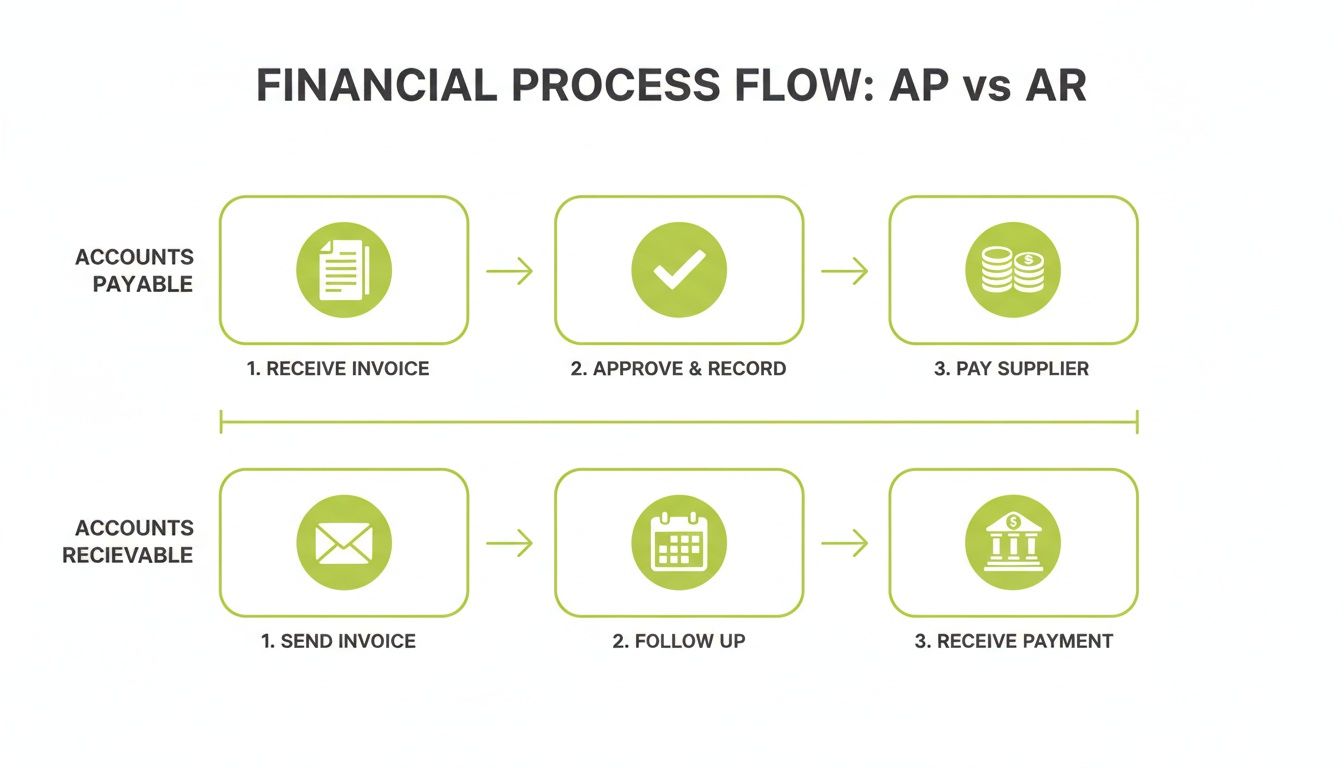
As you can see, AP is all about managing the bills coming in, while AR is focused on handling the invoices going out and getting that cash collected.
Now, let's flip the coin and look at the other side. You've just finished a project for a client and sent them an invoice for £1,000. Just like with payables, this transaction needs two entries to be recorded correctly.
A journal entry isn't just a record; it's the official recognition of a financial event. Recording an invoice in Accounts Receivable immediately reflects that value on your balance sheet as an asset, even before the cash arrives.
First up, you need to record the sale itself:
Once your client pays up, you simply debit your Cash account and credit Accounts Receivable, which clears the balance. Trying to track all these entries manually can be a real drag, which is why exploring the best cloud accounting software for startups is such a smart move. These tools automate your journal entries, slashing the risk of errors and freeing up your valuable time.
Knowing the definitions is one thing, but how accounts payable and receivable actually play out in the real world changes dramatically depending on your business structure. The way a limited company thinks about these numbers is worlds apart from how a sole trader or an eCommerce seller does. While the core ideas are the same, the priorities, legal duties, and day-to-day wrangling look very different across UK businesses.
Getting to grips with these differences isn't just about tidy bookkeeping; it’s about smart financial strategy. For a growing digital agency, it’s the constant juggling act of paying freelancers on time while chasing client retainers. For a sole trader, it’s about making sure their Self Assessment tax return is spot on.
If you run a UK limited company, accounts payable and receivable aren't just items on a to-do list; they're formal, critical parts of your financial statements. They take centre stage on your balance sheet, a document you’re legally required to file with Companies House.
For limited company directors, managing and reporting AP and AR correctly is a legal obligation. These figures directly shape how financially healthy your company appears, influencing everything from your ability to secure a business loan to attracting new investors.
As a sole trader, you might feel that terms like AP and AR sound a bit too corporate for your one-person operation. But they are just as important for you, especially when it's time to file your Self Assessment tax return with HMRC. Your profit is your income minus your allowable expenses, and both AP and AR feed directly into those calculations.
Good AR management means you're declaring all the income you've actually earned in a tax year, even if a client hasn't paid you by the 5th of April. On the flip side, solid AP tracking ensures you claim every allowable expense you've incurred, which helps lower your taxable profit. Get this wrong, and you could end up overpaying tax or, worse, facing penalties from HMRC.
The classic principles of accounts payable and receivable have to adapt to modern business models, which throws up some unique challenges and opportunities.
For a Digital Agency:
An agency is often balancing huge project fees and monthly retainers (AR) while paying a whole team of freelance designers, writers, and developers (AP). It's all about the timing. You absolutely have to get client payments in before you need to pay your freelancers, otherwise you’ll hit a cash crunch fast.
For an eCommerce Seller:
Your accounts receivable probably won’t be a neat stack of invoices. More likely, it's the cash being held by payment processors like Stripe or PayPal. There’s nearly always a delay of a few days between a customer clicking 'buy' and that money actually landing in your bank account. All the while, you’ve got bills to pay for stock, shipping, and marketing ads—a delicate balancing act to keep your cash flow in the black.
Getting your head around what accounts payable and receivable are is one thing, but their real power is in how they directly control your business's financial lifeblood: cash flow. Managing these two sides of the coin isn't just an accounting task; it’s a core strategy for keeping your business stable and fuelling its growth.
Think of it like this: your accounts receivable is the tap controlling money coming in, while accounts payable is the valve for money going out. If you can open that AR tap wider by getting paid faster, while carefully adjusting the AP valve to pay bills at the best possible time, you gain direct command over your liquidity.
This balancing act ensures you always have the cash on hand to cover payroll, invest in new stock, or jump on an unexpected opportunity.
For any UK business registered for Value Added Tax (VAT), AP and AR management becomes even more critical. Every single transaction carries tax implications that feed directly into your quarterly returns to HMRC.
The goal is to track both sides meticulously. The difference between the output VAT you've collected and the input VAT you've paid is what you either owe to HMRC or can reclaim from them. Flawless AP and AR records are non-negotiable for filing compliant and accurate VAT returns.
In the UK, the challenge of managing accounts receivable is enormous, with late payments posing a serious threat to business survival. The problem is widespread; recent industry analysis showed UK firms logged a staggering £109.2 billion in overdue invoices in just nine months.
The impact on small and medium-sized enterprises (SMEs) is particularly severe. Surveys reveal that a shocking 62% are currently owed money from unpaid invoices. You can discover more insights into the UK's accounts receivable landscape on quadient.com.
This isn't just an inconvenience; it's a direct drain on liquidity that can grind operations to a halt. Proactive AR management—clear payment terms, consistent follow-ups, and making it easy for customers to pay—is absolutely essential for any business wanting to thrive.
Knowing the difference between Accounts Payable and Receivable is one thing, but turning that knowledge into a healthier business is where the real work begins. Optimising these two functions is about moving from being a passive bookkeeper to an active cash flow manager.
This shift starts with keeping a close eye on the right numbers. Two of the most critical metrics—often called Key Performance Indicators (KPIs)—are Days Sales Outstanding (DSO) and Days Payable Outstanding (DPO).
In simple terms, DSO tells you the average number of days it takes you to get paid after making a sale. DPO, on the other hand, shows how long your business takes to pay its own bills. A low DSO combined with a strategically managed DPO is a sure sign of a cash-efficient operation.
Regularly reconciling your accounts isn't just good practice; it's non-negotiable. This process involves carefully matching the transactions logged in your accounting software against your bank statements. It’s the best way to catch discrepancies, accidental duplicate payments, or missed invoices before they become bigger problems.
It’s a straightforward but powerful habit that shields your business from costly errors and potential fraud. The sheer scale of receivables can be staggering, even for large organisations. For example, the UK Statistics Authority recently reported total trade receivables of £24.6 million.
Another key strategy is bringing in automation. A smart first step is to automate invoice processing workflows, which immediately boosts both your team's efficiency and accuracy. Modern accounting software can handle chasing overdue invoices, scheduling supplier payments, and generating real-time reports without you lifting a finger.
By automating routine AP and AR tasks, you not only reduce the risk of human error but also free up invaluable time. This allows you to focus less on administration and more on strategic growth activities.
Getting these systems in place doesn't have to be a headache. It all starts with a clear understanding of your current processes, which paves the way for a successful technology transformation for your business. The end result? Better financial control and sharper decision-making.
Even when you've got a handle on the basics, a few tricky questions always seem to pop up in the day-to-day running of a business. Let's tackle some of the most common ones that business owners ask.
Yes, they’re closely related but they aren't the same thing. Think of an expense as the actual cost you've incurred—say, buying new marketing materials. Accounts payable is the holding account for that cost. It's the "I owe you" note in your books for when you've received the materials but haven't yet paid the supplier's invoice.
So, the expense is what you bought, and accounts payable is the record showing you still owe the money for it. Once that bill is paid, the accounts payable entry for that specific invoice disappears.
You should record a sale in accounts receivable the moment you've earned the money. For most businesses, this means as soon as you've delivered the goods or finished the service for your client. This is a cornerstone of accrual accounting.
The second you raise that invoice, you have a legal claim to the cash. Recording it straight away in AR gives you a true picture of your company's assets, even if the money hasn't physically landed in your bank account yet.
Chasing late payments is an unfortunate but common reality of running a business. The secret is to have a clear and professional system in place so you're not just winging it.
Managing your business finances can feel like a minefield, but you don't have to navigate it alone. Our tech-focused accounting services at GenTax are built to make your life easier—from daily bookkeeping to sorting your year-end accounts—giving you the clarity you need to focus on growth. Discover how GenTax can help your business today.
