



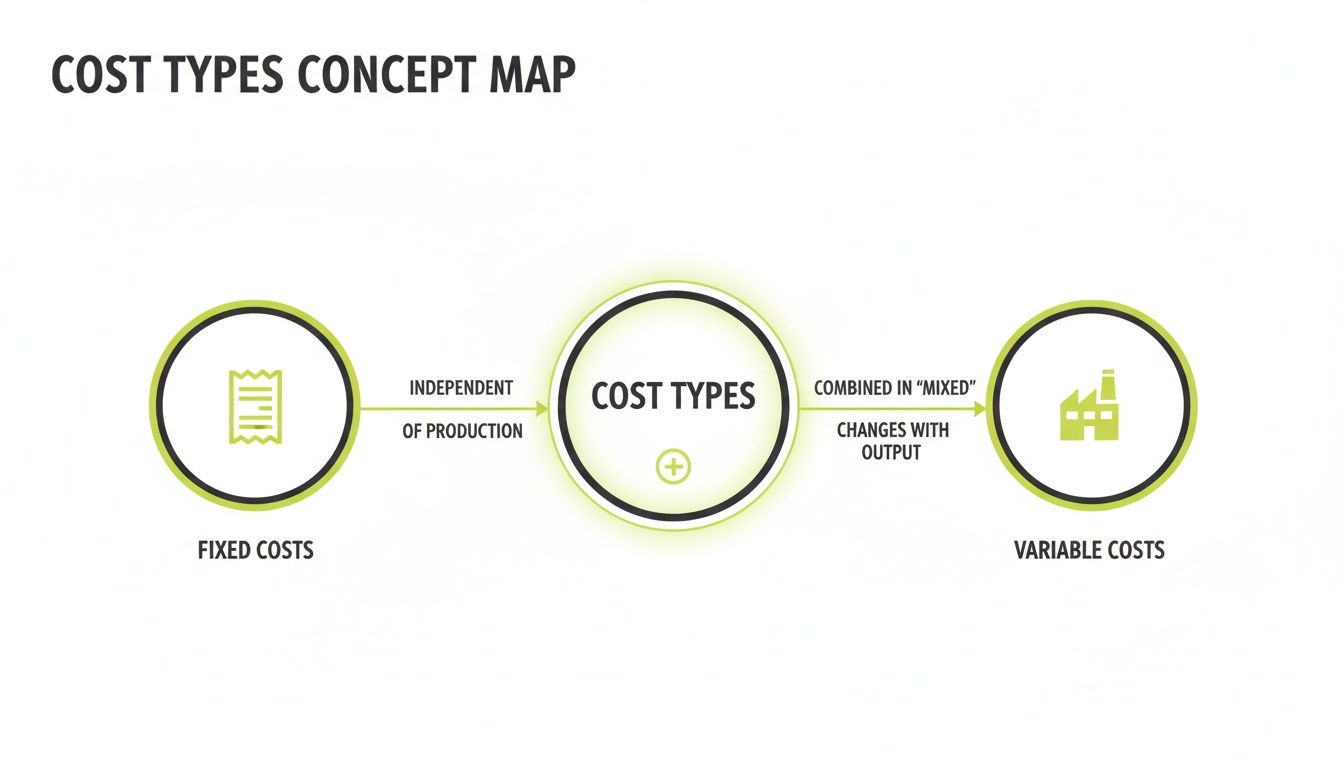
Get to grips with your business spending, and you'll find every expense falls into one of two buckets: fixed costs and variable costs. One stays put, the other moves with your sales. Nailing the difference isn't just for accountants; it's the bedrock of smart financial decisions, from pricing your products to knowing when you can afford to grow.

Let’s imagine you run a cosy coffee shop in Manchester. That prime spot on the high street costs you £1,500 in rent every single month. It doesn't matter if you sell one flat white or a thousand – that bill lands on your desk like clockwork. That £1,500 is a classic fixed cost.
Think of these as the steady, predictable expenses that form the foundation of your business. They're the costs that keep the lights on and the doors open, providing the capacity you need to operate day in, day out.
Fixed costs are usually time-based, like monthly or annual payments. You’re committed to them in the short term, which gives your business stability but also creates a baseline of spending you absolutely have to cover, no matter what.
For a typical UK business, these often include:
Now, back to your coffee shop. For every latte you whip up, you use coffee beans, milk, and a disposable cup. If you have a bumper week and sell twice as many lattes, you’ll burn through twice as many supplies. The amount you spend on these items rises and falls directly with your sales. That’s a variable cost in a nutshell.
Variable costs are tied directly to the action—the making of a product or the delivery of a service. When your output goes up, they go up; when things quieten down, they drop. They’re dynamic and give you a real-time pulse on your business activity. Getting these categories right is vital, and for a deeper dive into how this all comes together, it’s worth understanding your Profit and Loss (P&L) statement.
Grasping the difference between fixed and variable costs isn't just an accounting task; it's the key to unlocking strategic insights about your business's profitability, pricing, and break-even point.
To make the distinction crystal clear, let's put them side-by-side.
This quick table breaks down how each cost type behaves as your business activity changes.
Sorting your costs into these two camps is the first step towards building a solid financial strategy. It gives you the power to properly analyse your spending, forecast your profits, and make the kind of informed decisions that pave the way for long-term success.

Think of fixed costs as the financial heartbeat of your business. They are the predictable, recurring expenses you have to cover just to keep the doors open and the lights on, whether you sell one item or one thousand. They form the baseline of your budget – the bills you know are coming, month in, month out.
This predictability is their biggest strength. It makes financial planning much simpler because you know exactly what you need to earn just to break even, before a single penny of profit is made.
But not all fixed costs are set in stone. It’s useful to split them into two camps: committed and discretionary.
Knowing the difference between these two is the key to getting a real grip on your outgoings. It shows you where you’re locked in and where you have some wiggle room.
The thing to remember is that fixed costs only stay 'fixed' within a certain level of business activity. If your freelance photography business gets too big for your spare room, you might decide to rent a studio. That rent becomes a new, higher fixed cost. This is often called a 'step cost' because it represents a step up in your company’s growth.
The fixed costs you’ll face depend entirely on your business. What's a must-have for a small agency might be completely irrelevant for a sole trader tapping away on a laptop at home.
Let’s look at a couple of real-world examples.
A freelance graphic designer working from home as a sole trader would likely have fixed costs like:
Now, for a limited company running a small marketing agency, that list gets a bit longer:
Those accountancy fees are a perfect example of a non-negotiable fixed cost that delivers huge value. Keeping your company accounts in order isn't just a legal requirement; it’s essential for making smart financial decisions.
While these costs are stable, they aren't immune to what’s happening in the wider economy. For example, recent UK data shows that even with slow economic growth, rising inflation and wage growth are putting pressure on things like rent and salaries – which are core fixed costs for many businesses.
Getting a handle on these bedrock expenses is the first step. Once you know what you must spend each month, you're in a much stronger position to build a resilient and profitable business.
While fixed costs give you a predictable baseline, it’s your variable costs that really show the day-to-day pulse of your business. These are the expenses that fluctuate in direct proportion to your activity. Sell more, and they rise. Have a quiet month, and they drop. Think of them as the fuel for your operations, directly powering every single sale you make.
For a UK-based online craft shop, for example, variable costs are easy to identify. They'd include the yarn needed for each hand-knitted scarf, the packaging materials for shipping, and the delivery fees from Royal Mail for every parcel sent out. Crucially, none of these costs are incurred unless a sale is actually made.
Similarly, an online consultant has variable costs like the transaction fees charged by Stripe or PayPal on each paid invoice. The more clients they bill, the higher these specific costs climb.
Seems straightforward, right? But what about those costs that refuse to sit neatly in either the 'fixed' or 'variable' box? In the real world, some expenses have a split personality. We call these semi-variable costs, or mixed costs. They’re made up of a fixed element you have to pay regardless of activity, and a variable part that goes up and down with usage.
It's a bit like your mobile phone contract. You pay a fixed monthly fee just to keep the line active, but if you burn through your data allowance, you're hit with extra charges based on what you use. The line rental is fixed; the data overage charge is variable.
A common mistake is to classify a mixed cost as entirely fixed or entirely variable. This can distort your financial analysis, making it harder to accurately calculate your break-even point or understand the true profitability of your products and services.
This is a puzzle many business owners face. Utility bills are a classic example. Your business electricity bill probably has a fixed daily standing charge, plus a variable charge based on the kilowatt-hours (kWh) you actually use. Being able to separate these two parts is vital for accurate budgeting.
This is perfectly illustrated in UK government data on energy pricing, which breaks down electricity tariffs into their different components.
Here’s a look at how government statistical datasets present this information.
The tables clearly distinguish the fixed standing charge from the variable unit price, showing how these two elements combine to create your total bill.
What the data reveals is that fixed standing charges make up a significant chunk of the total cost, especially for businesses with lower energy consumption. Understanding this split is critical for making smart decisions about energy efficiency and picking the right tariff. You can dig into more detailed regional figures in the published UK government tariff component tables.
So, how do you actually untangle these hybrid expenses? The main goal is to isolate the fixed part from the variable part so you can categorise them properly.
A salesperson's pay package is another classic mixed cost. They might get a £25,000 base salary (a fixed cost) plus a 5% commission on all the sales they generate (a variable cost). To account for this correctly, you’d treat the salary as a fixed operational expense and the commission as a variable cost directly tied to sales.
For things like utilities, you can look back over past bills to pinpoint the fixed charge. From there, you can work out an average variable cost per unit (like the cost per kWh). This small bit of homework lets you forecast your future expenses much more accurately. While you can do this with a spreadsheet, modern accounting tools make the job far easier. In our guide to the best cloud accounting software for startups, we look at platforms that help automate this classification, saving you a heap of time and boosting accuracy.
By carefully identifying and separating your variable and semi-variable costs, you get a much sharper picture of your business's financial health. That clarity is absolutely essential for making smarter decisions on everything from pricing strategies to operational improvements.
Getting your head around the difference between fixed and variable costs is the first big hurdle. Now it's time to turn that theory into some powerful financial insights for your own business.
By plugging your numbers into a few simple formulas, you can go from just listing expenses to making smart, strategic decisions that will genuinely drive growth and profitability.
The most fundamental place to start is your Total Cost. This figure gives you the complete picture of what’s going out the door over a certain period. It’s simply the sum of everything you spend, combining the predictable foundation of your fixed costs with the fluctuating expenses tied directly to your sales activity.
The formula itself is pretty straightforward:
Total Costs = Total Fixed Costs + (Average Variable Cost Per Unit x Number of Units)
Think of this equation as the bedrock of your financial analysis. It's the key to forecasting expenses with any real accuracy and is the launchpad for more advanced calculations, like figuring out your break-even point.
The break-even point is that magic number every business owner needs to have pinned down. It’s the exact level of sales where your total revenue equals your total costs. At this point, you aren't making a profit, but crucially, you aren't making a loss either.
Sail past this number, and you're in the black. Fall short, and you're in the red. It's that simple.
To find it, you first need to grasp another powerful concept: the Contribution Margin.
The Contribution Margin is the revenue left over from a single sale after you've covered the variable costs linked to that specific sale. This 'contribution' is what's left to go towards paying off your fixed costs and, eventually, generating your profit.
Here’s how you break it down:
Let’s bring this to life with a fictional UK-based online retailer, "Bristol Baskets," that sells handmade gift baskets.
Let's imagine Bristol Baskets has the following monthly numbers:
First, we work out the Contribution Margin for each basket sold:
With that number, we can now calculate the break-even point:
This tells us that Bristol Baskets must sell exactly 100 baskets each month just to cover its costs. Every single basket sold after the 100th contributes a clean £20 directly to profit. Suddenly, a vague sales target becomes a concrete, achievable goal.
The table below provides a clear, step-by-step walkthrough of this break-even calculation.
This example clearly shows that selling 100 gift baskets is the minimum monthly target to avoid making a loss.
This kind of analysis isn't just about breaking even, though. Understanding your contribution margin is a versatile tool that can guide critical business decisions. It helps you assess if you can afford to take on a special one-off order at a discount, or figure out which of your products are the most profitable and deserve the biggest marketing push.
This process—from identifying costs to strategic analysis—is fundamental for any organisation, no matter the sector. For instance, this detailed nonprofit budgeting guide and templates shows how the same core principles apply everywhere.
Of course, consistently performing these calculations is so much easier when your financial records are properly organised. Learning more about how management accounts improve business performance can show you how regular financial reporting transforms raw data into the kind of strategic insights that really move the needle.
Understanding the difference between fixed and variable costs is far more than just a bookkeeping chore; it's one of the most powerful strategic tools you have. The unique blend of these costs in your business—what we call your cost structure—directly shapes how your company behaves, how much risk it carries, and its potential for explosive growth. Getting this right isn't just about accounting—it's about building a more resilient and profitable business.
The mix of fixed versus variable expenses is what determines your operational leverage. This is a simple measure of how sensitive your profits are to a change in your sales. A business with high fixed costs and low variable costs is said to have high operational leverage, which creates a high-stakes, high-reward scenario.
Think of it like pushing a heavy boulder up a hill. That initial effort is immense. You have to cover a mountain of fixed costs—rent, salaries, equipment leases—before you even begin to see a return. But once you reach the top (your break-even point), every tiny push (each additional sale) sends that boulder rolling downhill, gathering speed and momentum with very little extra effort.
A business with high operational leverage can see its profits multiply rapidly once its fixed costs are covered. Because the variable cost of each new sale is low, the majority of the revenue from each new customer drops straight to the bottom line. This is fantastic during a sales boom, turning good times into incredibly profitable ones.
However, this leverage is very much a double-edged sword. During a sales slump, those same unchangeable fixed costs become an incredibly heavy burden. Revenue might fall off a cliff, but the bills for rent and salaries keep coming, which can drain your cash reserves and put the business at serious risk.
This dynamic is especially clear in industries that rely on significant infrastructure, like transport.
A business's cost structure is its financial DNA. A high fixed-cost structure means higher risk during downturns but offers greater profit potential when sales accelerate. Conversely, a high variable-cost structure provides flexibility but can limit the ceiling on profitability.
The UK bus industry gives us a stark example of how a high fixed-cost base creates vulnerability. Even when fewer passengers are travelling, the core costs of running the service—like vehicle leasing, depot maintenance, and core staff salaries—remain largely unchanged.
Research from the Confederation of Passenger Transport (CPT) shows that fixed costs make up nearly a quarter (23.7%) of a typical bus operator's total costs. This means that if passenger demand drops by 10%, the company can't simply cut its spending by the same amount. Those fixed costs still have to be paid, putting immediate and severe pressure on cash flow and profitability. You can see the full breakdown in the CPT's cost monitor report.
Knowing your cost structure and operational leverage informs almost every major decision you'll make.
Making these high-level strategic decisions requires a deep, intuitive understanding of your financial data. This is where expert guidance becomes invaluable. Exploring how a fractional finance director can provide this kind of strategic oversight is a logical next step for businesses looking to turn their financial information into a genuine competitive advantage. By analysing your cost structure, they can help you navigate financial challenges and unlock your true growth potential.

Knowing the difference between fixed and variable costs is one thing, but actively managing them is how you build a resilient, profitable business. Effective cost control isn't about swinging an axe; it's about making smart, strategic adjustments. That all starts with having a crystal-clear, real-time view of your financial health.
Modern cloud accounting software completely changes the game here. It can turn a tedious manual chore into an automated, intelligent process. These platforms categorise your spending as it happens, giving you an accurate, up-to-the-minute picture of where your money is going. This clarity lets you spot trends and identify areas where you might be overspending, long before your month-end reports even land.
With solid data at your fingertips, you can start making targeted moves to trim both types of costs. Don't underestimate the power of small, consistent actions – they add up to significant savings over time.
Audit Your Fixed Costs: Go through all your subscriptions and recurring payments with a fine-tooth comb. Are you really using that project management software? Could you get a better deal on your insurance? Cancelling services you no longer need is a quick and easy win for your bottom line.
Negotiate with Suppliers: Remember, your variable costs aren't set in stone. Talk to your key suppliers about better rates for buying in bulk or agreeing to longer-term commitments. Even a small discount on raw materials can make a substantial difference to your contribution margin on every single sale.
Boost Your Operational Efficiency: Scrutinise your processes for waste. For a café, this could be as simple as optimising stock rotation to cut down on food spoilage. For a service-based business, it might mean using time-tracking tools to make sure projects are staying on budget.
Turning financial data into profitable decisions requires more than just good software. It demands expert interpretation to uncover the hidden opportunities and risks within your numbers.
This is exactly where professional guidance becomes indispensable. A good accountant does far more than just prepare your year-end statements. They act as a strategic partner, helping you read between the lines of your financial data to find cost-saving opportunities you might have otherwise missed.
They can help you analyse the true impact of your fixed and variable costs on your profitability and cash flow. For instance, getting expert support with your bookkeeping services ensures your costs are classified correctly from day one, giving you a rock-solid foundation for every strategic decision you make. This kind of collaboration transforms accounting from a compliance headache into a powerful engine for business growth.
Getting your head around fixed and variable costs is a massive step, but it often brings up some practical questions. Here are the answers to a few common queries we get from UK business owners just like you.
This one’s a classic “it depends”. The monthly salary you pay a full-time, permanent team member is a fixed cost. It doesn’t matter if you have a bumper month or a quiet one; their paycheque stays the same.
On the other hand, things like overtime, sales commissions, or the wages for temporary staff you bring on during your busy season are variable costs. They move up and down in direct response to your business activity.
Yes, and these are often called semi-variable or mixed costs. Think about your business's electricity bill. There’s usually a fixed standing charge you have to pay no matter what, plus a variable element that depends on how much energy you actually use.
A salesperson's pay is another great example, often mixing a fixed base salary with a variable commission based on their performance.
The real trick to smart financial analysis is splitting these mixed costs into their fixed and variable parts. Doing this gives you a much sharper picture of your break-even point and your true profitability.
As a rule of thumb, you should be taking a good look at your costs at least quarterly. Regular check-ins help you spot expenses that are creeping up, find new ways to save money, and make sure your pricing is still profitable.
Beyond that, a deep-dive annual review is vital for proper strategic planning and setting the budget for the year ahead. It’s what keeps you nimble in a market that’s always changing.
They absolutely do. While fixed costs are predictable in the short term, they can definitely change as your business hits new milestones. This is what's known as a "step cost."
For instance, your monthly office rent is a fixed cost. But if your team grows and you have to move to a larger space, that rent will suddenly jump to a new, higher fixed amount. It doesn't fluctuate month-to-month, but it steps up to a new level.
Ready to turn your financial data into a real strategic advantage? The team at GenTax Accountants can help you classify, track, and manage your costs for maximum profitability. Explore our accounting services today.
