



Getting your head around Self Assessment starts with one simple thing: its unique calendar. The UK tax year for self assessment doesn't follow the calendar year. Instead, it runs from 6th April to 5th April the following year.
Think of it as a financial 'school year'. Everything you earn and every expense you claim within this timeframe gets tallied up for one big end-of-year report.
For anyone just starting out, this timeline is probably the most confusing part. We’re all used to thinking in terms of January to December, but HMRC’s financial calendar has its own rhythm. This quirky schedule is the foundation for every calculation, deadline, and rule you need to follow.
Why the odd dates? It's a historical hangover, a quirk left over from centuries ago when Britain switched from the Julian to the Gregorian calendar. The history is a fun bit of trivia, but what really matters for you today is remembering to group all your income and allowable expenses within this April-to-April window.
Getting this right from the start is absolutely essential. Here’s why:
Forgetting this simple rule is the root cause of so many mistakes, which can lead to filing the wrong figures and even facing penalties from HMRC.
To put it simply: when you sit down to do your Self Assessment, you're always looking back at the financial year that has just finished. The money you're earning right now won't be dealt with until after the next 5th April.
To help you get a clear picture, it’s useful to see the current, previous, and upcoming tax years laid out. This will help you know exactly which period you should be filing for and what’s coming up next. As tax becomes more digital, keeping these dates straight will be more important than ever. You can learn more about these changes in our guide to Making Tax Digital for Self Assessment.
Here’s a simple table to keep you on the right track.
Once this April-to-April schedule clicks, you've built the foundation for a stress-free and accurate tax return. It’s the first—and most critical—piece of the Self Assessment puzzle.
Getting your head around the April-to-April schedule is the first step, but the real test is hitting the critical deadlines that HMRC sets for Self Assessment. Let’s be clear: missing these dates isn't just a minor slip-up. It can trigger automatic penalties, even if you don't actually owe any tax.
Think of these deadlines as non-negotiable appointments in your financial calendar.
To help you visualise the flow of the entire process, this timeline shows the start and end of a typical tax year for self assessment.

This simple visual reinforces that all your income and expenses for a single return must fall neatly between these two specific dates. Now, let's break down the key deadlines you’ll face during and after this period.
Before you can even think about filing, you need to tell HMRC you exist. If you’re new to self-employment or have started earning untaxed income for the first time, you are legally required to register for Self Assessment.
The deadline to register is 5th October following the end of the tax year you started trading in. So, if you kicked off your sole trader business in June 2024 (which is in the 2024/25 tax year), your registration deadline is 5th October 2025. Miss this, and you’re already on the back foot, facing delays and potential penalties. It's the first date to circle in red.
Once you're registered, you have two key deadlines for actually submitting your tax return. The path you choose has a big impact on your timing.
Given the extra time and reduced stress, filing online is the sensible choice for just about everyone.
Choosing to file online isn’t just about having more time; it’s about having a smarter, more secure, and more efficient process. It minimises the chance of manual errors and ensures you have a digital record of your submission.
Knowing when to file is only half the story – you also have to know when to pay. There are two key payment dates you absolutely need to be aware of, as they are crucial for managing your business’s cash flow.
The main payment deadline is the same as the online filing deadline: 31st January. This is when you must pay the tax you owe for the previous tax year in full.
On top of that, many people will also need to make Payments on Account. These are basically advance payments towards your next year's tax bill. The deadline for the second Payment on Account is 31st July.
Interestingly, a growing number of people are choosing to get their returns done and dusted much earlier. In the first week of the 2024/25 tax year alone, a record-breaking 299,419 taxpayers submitted their Self Assessment returns. This shows a real shift towards proactive financial management, letting people know their tax liability months ahead of schedule and avoiding that frantic January rush.
Juggling all these dates can be a real headache, which is why so many business owners turn to a professional for help. If you're looking for support, our experts can help you manage your tax returns and make sure you never miss a critical deadline again.
So, you've got your head around the dates. The next big question is pretty simple: does any of this actually apply to you? Self Assessment isn't just for classic business owners; it’s HMRC’s way of collecting tax on any income that hasn't already been taxed through a standard payroll system (what's known as PAYE).
Figuring out whether you need to file can feel a bit murky, especially if you’re juggling a few different income streams. Let’s cut through the confusion and break down the most common reasons you'd need to register with HMRC and get a tax return done.
This is the group most people think of. If you work for yourself as a sole trader, it's down to you to declare your earnings and pay the right amount of tax. You’ll need to register for Self Assessment if you earned more than £1,000 from self-employment during the tax year.
This rule catches everyone, whether you're a full-time freelancer, a jobbing contractor, or just running a small side hustle in the evenings. It’s the same story if you're a partner in a business partnership – you'll have to file your own tax return to declare your slice of the profits. You can get into the nitty-gritty in our guide for sole traders.
Renting out a property? Any money you make from letting property or land in the UK needs to be declared through Self Assessment.
And this isn't just for career landlords with a big portfolio. Even if you're just renting out a spare room or a flat you inherited, that income is taxable. The good news is you can subtract your allowable expenses, which brings down your profit and, in turn, your tax bill.
Just because you’re a company director doesn’t automatically mean you have to file a tax return. If all your income is a salary paid through PAYE, you might be in the clear. But that's rarely the full picture. Many directors take a portion of their income as dividends, which aren't taxed before they hit your bank account.
If you have a decent amount of untaxed dividend income, or your financial life is just a bit more complicated than average, you’ll almost certainly need to file. This gives HMRC the complete picture of what you've earned across the year.
It’s a common myth that only business owners need to think about the tax year for self assessment. The truth is, anyone with untaxed income from savings, investments, or even a side gig could easily find themselves needing to file.
Beyond the big categories, there are a handful of other situations that will pull you into the Self Assessment net. You’ll definitely need to send a return if you:
The goalposts do move, so it's worth keeping an eye on changes. For the 2024/25 tax year onwards, the threshold that used to pull many PAYE earners over £50,000 into Self Assessment has been scrapped for those with simple tax affairs. However, if you earn over £150,000, you're still required to file. You can find more detail on these updates for the 2024/25 tax year to see exactly how they affect you.
When in doubt, it’s always better to check than to risk getting a penalty down the line.
One of the biggest head-scratchers in the whole Self Assessment journey is a system called Payments on Account. It catches countless newly self-employed people by surprise, but the idea behind it is actually simpler than it sounds.
Think of it as prepaying for next year's tax bill, using this year's earnings as a guide.
HMRC introduced this system to help you spread the cost of your tax, rather than getting hit with one massive bill every January. It helps their cash flow and, in theory, stops you from having to find a huge lump sum all at once.

This system kicks in automatically if your Self Assessment tax bill is over £1,000 for the year. There's one other condition: less than 80% of your tax can have been collected 'at source' (like through a PAYE job). If you tick both boxes, HMRC basically assumes you'll earn a similar amount next year and asks you to start paying towards it in advance.
The calculation itself is pretty straightforward. Your total Payment on Account for the upcoming year is simply 100% of your previous year's tax bill. This total is then sliced into two equal payments.
Each of these payments is exactly 50% of your previous year's total tax bill. This becomes a rolling cycle – the payments you make for the next tax year are always based on the bill you've just filed.
Here’s the part that trips up so many people in their first year. When you're new to Self Assessment, you get hit with what’s often called the 'first-year surprise' or the '150% tax bill'. It’s a real cash flow challenge if you’re not ready for it.
Let's imagine you've just wrapped up your first year of trading, and your tax bill works out to be £3,000. When that 31st January deadline rolls around, you don't just pay that £3,000. You also have to make your first Payment on Account for the next tax year.
Here’s a breakdown of what you'd actually owe on 31st January:
That means on your first big payment deadline, your total bill comes to £4,500 – a whopping 150% of your actual tax liability for the year. This is precisely why planning ahead is critical; you have to budget for a much larger initial payment than you might expect.
You would then pay the second £1,500 instalment by the 31st July deadline. Getting your head around this from day one is a cornerstone of good financial management. You can find more essential strategies in our guide offering tax advice for small businesses.
So, what happens if you know your income is going to be lower next year? Maybe a big contract has ended, or you're planning to take some time off. It wouldn't be fair to prepay tax based on a higher income you're no longer earning.
Thankfully, you can ask HMRC to reduce your Payments on Account. You can do this through your online tax account or by filling out the relevant section on your paper tax return.
A word of caution is needed here, though. You must have a genuine reason and make a realistic estimate of your lower earnings. If you reduce your payments too much and end up underpaying tax for the year, HMRC will charge you interest on the shortfall. It's always better to be cautious and slightly overpay than to get it wrong and face extra charges later. This is where getting professional advice can be invaluable.
Simple errors on your tax return can quickly spiral into stressful penalties and unwanted attention from HMRC. Navigating the tax year for self assessment is mostly about good record-keeping and a bit of awareness, but a few common pitfalls catch people out year after year. Think of this section as your final pre-flight check before you hit 'submit'.
Getting these details right means you can file with confidence, pay the right amount of tax, and keep your finances clean. Let's walk through the most frequent tripwires and, more importantly, how you can sidestep them.
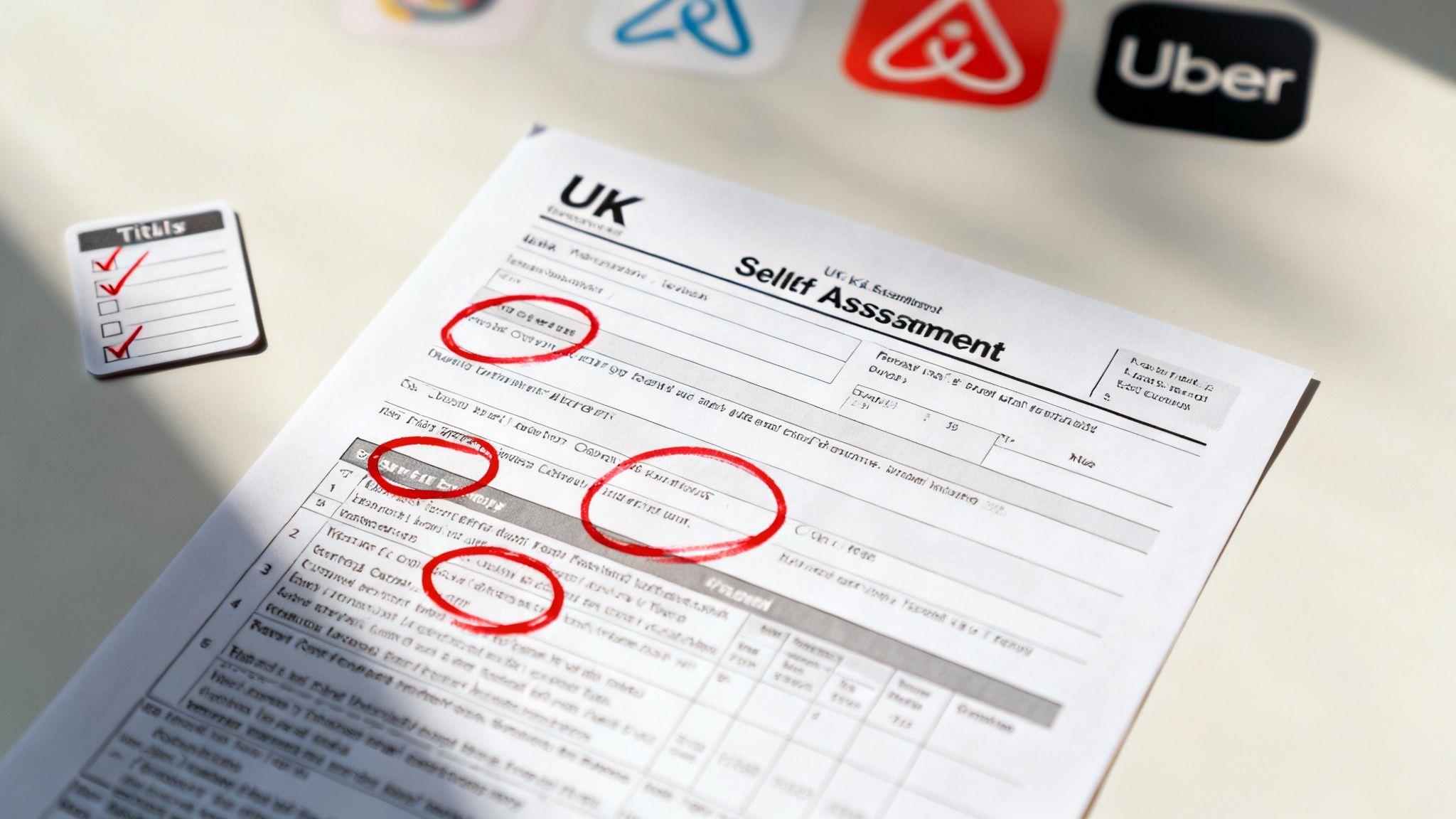
This is probably the biggest mistake people make, and it’s often not deliberate. It's incredibly easy to forget about that small side-hustle you ran for a few months or a one-off freelance project you did early in the tax year. The rule is simple: all income, no matter how small or irregular, must be declared.
HMRC is making this harder to miss. From January 2025, online platforms like Airbnb, Uber, and Deliveroo will be required to report their sellers' earnings directly to the tax office. This automatic data-sharing means it's never been easier for them to spot income you haven't declared.
Actionable Tip: Before filing, pull up your bank statements for the entire tax year (6th April to 5th April). Go through them line by line and cross-reference every payment you received against your income log. It's the only way to be sure nothing has slipped through the cracks.
Claiming for allowable business expenses is one of the best ways to lower your tax bill, but the lines can get blurry. A classic error is claiming for things that have a dual business and personal purpose without splitting the cost correctly. You can't, for instance, claim your entire mobile phone bill if you also use it to call your mates.
You have to be fair and only claim for the business portion of any cost. If 40% of your phone usage is genuinely for work, you can only claim 40% of the bill. Guessing isn't good enough – you need a reasonable method for working out the split and the records to back it up if HMRC asks.
We've already covered the deadlines, but it's worth hammering this point home: missing them is a costly mistake. An automatic £100 penalty lands the day after the filing deadline, even if you owe no tax at all. The longer you leave it, the more the penalties rack up.
Get these dates in your calendar now:
A big part of avoiding errors comes down to managing your documents. Tools like an AI finance tax document analyzer can help process invoices and receipts more efficiently, which cuts down the chance of manual slip-ups. Treat these dates as non-negotiable and you'll avoid throwing money away on penalties you could have easily prevented.
While it’s perfectly possible to manage your own Self Assessment, there’s a point where doing it yourself stops saving you money and starts costing you time, stress, and missed opportunities.
Deciding to hire an accountant isn’t giving up; it’s a smart business move. It’s about freeing yourself up to focus on what you do best, knowing your finances are not just compliant, but optimised.
But how do you know when you’ve hit that point? For most people, the trigger is complexity. If your finances have grown beyond a simple list of income and expenses, it’s probably time to call in a professional.
Think about getting an accountant if any of these situations sound familiar. These areas are full of tricky rules and small details that are easy to get wrong, which can lead to paying too much tax or, worse, an enquiry from HMRC.
Hiring an accountant is an investment, not an expense. A good one will often save you more than their fee by spotting tax-saving opportunities you never knew existed and ensuring your business stays compliant as it grows.
Ultimately, the decision boils down to one simple question: what’s your time worth? Every hour you spend wrestling with spreadsheets and trying to make sense of tax jargon is an hour you’re not spending on growing your business or looking after your customers.
An expert doesn’t just give you accuracy; they give you certainty. Knowing your obligations for the tax year for self assessment are being handled properly removes a huge weight from your shoulders. They can look after everything from your day-to-day bookkeeping to filing your final return, giving you clarity and support along the way.
If you’re ready to see how professional guidance can make your life easier, find out more about our dedicated accounting and bookkeeping services.
Even when you think you’ve got a handle on Self Assessment, a few nagging questions can pop up. It happens to everyone. Below are some quick, straightforward answers to the most common queries we get, helping you clear up any confusion and manage your taxes with confidence.
This is a big one. Missing the 5th October deadline to register for Self Assessment won’t land you an immediate penalty, but it sets off a serious chain reaction. The main problem is that without registering, you won’t get your Unique Taxpayer Reference (UTR) number, and you simply cannot file your return without it.
This delay makes it practically impossible to meet the 31st January filing deadline. Miss that, and you’re looking at an automatic £100 late filing penalty, straight off the bat. If you realise you've missed the boat, get registered immediately. The sooner you act, the better your chances of minimising the damage.
Yes, absolutely. It’s more common than you think to hit ‘submit’ and then remember a forgotten expense or spot a mistake. HMRC knows this happens and gives you a window to make corrections.
You have up to 12 months after the filing deadline to amend your return. So, for the 2023/24 tax year, which has a filing deadline of 31st January 2025, you’d have until 31st January 2026 to make any tweaks. The easiest way to do this is online through your Government Gateway account. If the change means you owe more tax, you’ll have to pay it along with any interest that’s built up. If you’ve overpaid, HMRC will send you a refund.
Don't panic if you spot an error. Making an amendment is a completely standard part of the process and is always a better option than just hoping HMRC won't notice. Being upfront is the best policy.
This is a crucial point, particularly if you run a limited company, but it’s good for everyone to understand.
The tax year is set in stone for every individual taxpayer in the UK: it always runs from 6th April to 5th April. This is the period HMRC uses to calculate your personal income tax.
An accounting year, however, is the 12-month period a business uses for its financial records. While sole traders usually just align their accounts with the tax year to keep things simple, a limited company can choose its own accounting year-end (for instance, 31st December or 31st March). The key takeaway is that a limited company's accounting period is a separate concept from the personal tax year of its directors.
Feeling like you’re drowning in dates and details? You don't have to go it alone. At GenTax Accountants, we specialise in turning tax chaos into a simple, stress-free process. We’ll make sure you’re compliant, efficient, and never miss a deadline. Find out how our expert accounting services can help your business thrive.
