



Facing your first tax return as a sole trader can feel like a huge hurdle, but it's just a standard part of being your own boss. In simple terms, it's how you tell HMRC what you've earned and spent, so they can work out how much tax you owe. Think of it as your annual financial report card to the government.
Welcome to the world of self-employment! As a sole trader, you are the business. This keeps things simple, but it also means your business profits are treated as your personal income, and you're responsible for sorting out your own taxes through a system called Self Assessment.
This guide is your roadmap. We’ll break down every step, turning what feels like a confusing chore into a manageable process.
The number of self-employed people in the UK has shot up over the last decade, with sole trader businesses growing by 462,000 (17%) between 2010 and 2025. With around 4.39 million of us working for ourselves by late 2025, getting to grips with tax is more important than ever.
This isn't just about filling in a form; it's about understanding the whole tax year from start to finish. We'll walk you through everything, making sure you know exactly what’s expected of you.
Here's a quick look at what we'll cover:
Think of your Self Assessment tax return not as a test, but as a summary of your hard work. Organised records are your foundation, and understanding the rules is the key to paying the right amount of tax—no more, no less.
Before we dive in, it’s crucial to know the key dates and figures. Missing a deadline can trigger an automatic penalty from HMRC, so getting these in your calendar is a must.
Here's a quick reference table with the most important milestones for any UK sole trader.
Navigating these requirements can feel a bit much at first. If you need a hand, GenTax offers expert accounting services for sole traders to make sure you stay compliant and stress-free.
Before you can even think about filing your first tax return, you need to get on HMRC’s radar. This is what's known as registering for Self Assessment, and it’s the official first step of your sole trader journey. Think of it as putting your hand up and saying, "Hello, I'm in business!" – it's an absolute must-do.
The most critical date to circle on your calendar is the registration deadline. You must tell HMRC you've started trading by the 5th of October in your business's second tax year. It sounds a bit confusing, but it's simple in practice. If you started your business in July 2024 (which falls into the 2024/25 tax year), your deadline to register is 5th October 2025.
Don’t leave this to the last minute. Missing the deadline can lead to penalties before you’ve even filed a single return. My advice? Get it done as soon as you start trading. It avoids any eleventh-hour panic and ensures you’re set up correctly from day one.
To make the online registration a breeze, it's a good idea to have all your details lined up and ready to go. The form itself is pretty straightforward, but a bit of prep work will save you from scrambling around looking for documents.
You'll need to have these bits of information handy:
Once you’ve sent all that off, HMRC will get to work processing your registration. Soon after, you'll receive a very important letter in the post.
Your Unique Taxpayer Reference (UTR) is a 10-digit number that HMRC will post to you after you register. Guard this number carefully—it’s your unique identifier for all things related to Self Assessment. You will need it to file your tax return, speak to HMRC, and authorise an accountant.
When that letter with your Unique Taxpayer Reference (UTR) number arrives, it's official – you're in the Self Assessment system. This 10-digit number is the key to everything tax-related from here on out. Keep it somewhere safe, as you’ll need it every single time you file your tax return.
Now that you're registered, the real work begins: getting your record-keeping in order. This is the foundation of a stress-free tax return. It's also a process that's becoming more and more digital. To get ahead of the curve, check out our guide to Making Tax Digital for Self Assessment to see how technology is changing the game for sole traders.
Think of your business finances like a well-organised library. Good record-keeping is the cataloguing system that lets you find exactly what you need, when you need it. For a sole trader, this isn't just about being tidy—it's the foundation of an accurate, stress-free tax return and, quite often, a lower tax bill.
Frankly, it's your best defence against chaos come January. The whole process starts with diligently tracking every penny that comes in and goes out. HMRC expects you to keep a clear trail of your business activities, and trust me, doing so will make completing your tax return as a sole trader infinitely easier.
At a bare minimum, you must keep organised records of all your business sales and outgoings. This isn't just good practice; it's a legal requirement. As a general rule, you must hang onto your records for at least five years after the 31st January submission deadline of the relevant tax year.
So, what should you be collecting? Here are the core documents:
Creating professional invoices is the cornerstone of tracking your income properly. For anyone just finding their feet, a comprehensive guide to invoicing for freelancers is a great place to start to make sure you're including all the crucial details from day one.
Now for the part that can actively save you money: allowable expenses. These are simply the legitimate running costs you incur to operate your business. The more of these you can correctly identify and claim, the lower your taxable profit will be, which directly slashes your final tax bill.
The golden rule from HMRC is that an expense must be "wholly and exclusively" for business purposes. If something has both a personal and a business use, you can only claim the business portion.
Think of it like this: you buy a new laptop. You use it 80% of the time for client work and 20% for watching Netflix. In that case, you can claim 80% of the laptop's cost as a business expense. It’s always smart to keep a simple log to justify how you’ve split the cost if HMRC ever asks.
Modern tools can make this whole process almost painless. Using the best cloud accounting software for startups lets you snap pictures of receipts on your phone, categorise spending as you go, and keep a real-time view of your finances.
To make life a bit easier, HMRC created a system called simplified expenses. This allows you to claim a flat rate for certain costs instead of painstakingly working out the actual business portion of the expense. It's a hugely popular choice for people working from home or using their personal vehicle for business trips.
You can use simplified expenses for:
This method can be a real admin-saver. However, it's always worth doing a quick calculation to see if you'd be better off claiming the actual costs. For some, the flat rate is a gift; for others, tracking the actual spend results in a bigger, more valuable deduction.
Spotting every potential deduction is the key to paying the right amount of tax, not a penny more. This checklist covers some of the most common categories of allowable expenses that sole traders can claim on their tax return.
Getting a grip on these categories is a massive step towards a stress-free tax season. Keep this list handy, and you'll be in a great position to claim everything you're entitled to.
Right, you’ve wrestled your income and expenses into neat piles. Now for the bit that often feels the most daunting: working out what you actually owe HMRC. But honestly, it’s not as scary as it sounds. It's just a logical process of figuring out your profit and then applying the right tax rates.
Think of it like following a recipe. You’ve got all your ingredients (your financial records), and now you just need to follow the steps to get the right result.
This is the most important number on your tax return. Your taxable profit is the figure that both your Income Tax and a chunk of your National Insurance will be based on. Crucially, it's not your total turnover; it's what's left after you've covered all your business running costs.
The formula is beautifully simple:
Total Business Income - Allowable Business Expenses = Taxable Profit
Let's imagine you're a freelance designer. You earned £45,000 in the tax year and had £5,000 in allowable expenses (things like software subscriptions, insurance, and client travel). Your taxable profit is £40,000. That's the number we'll use for the next steps.
As a sole trader, your business profit is treated as your personal income. The UK uses a progressive tax system, which means you pay different rates on different 'bands' of your earnings. The good news is everyone gets a Personal Allowance – an amount you can earn each year before paying a penny of tax.
For the 2024/25 tax year, the Personal Allowance is £12,570.
Here’s how the tax bands work for any profit you make above that allowance:
Going back to our designer with £40,000 in taxable profit, the first £12,570 is completely tax-free. They only pay tax on the amount left over, which is £27,430 (£40,000 - £12,570). So, the income tax they owe would be £5,486 (£27,430 x 20%).
Next up is National Insurance, or NICs. This is what pays for state benefits like the State Pension and Maternity Allowance. This is where it can get a little fiddly for sole traders because you might have to pay two different types.
Think of National Insurance as two separate contributions. Class 2 is your flat-rate ticket that qualifies you for state benefits. Class 4 is a percentage of your profits that kicks in once you start earning more.
For the 2024/25 tax year, here are the rules:
Sticking with our £40,000 profit example, the designer is earning enough to pay both Class 2 and Class 4 NICs.
Let’s pull all those numbers together to see the final tax and NI bill for our fictional freelance designer with £40,000 of taxable profit.
Income Tax:
Class 2 National Insurance:
Class 4 National Insurance:
Total Bill = £5,486 (Income Tax) + £179.40 (Class 2) + £2,468.70 (Class 4) = £8,134.10
That final figure is what our designer would need to pay HMRC for the year. For a deeper dive into managing these sorts of costs, you might find our guide covering tax advice for small businesses really useful.
To get your own numbers spot-on, you could explore tools that use AI for financial analysis to ensure total accuracy. As you can see, getting these calculations right is the key to filing a correct tax return and avoiding any nasty surprises from HMRC.
You've done the hard work of tracking your income and expenses all year. Now for the final hurdle: filing your Self Assessment tax return and paying what you owe to HMRC. Getting this part right is all about hitting your deadlines and understanding how the payment system works, so you can avoid any last-minute stress or penalties.
These days, almost everyone files online. It's quicker, more secure, and you get an instant receipt confirming HMRC has your return. The online system is pretty user-friendly and guides you through each section, making it simpler to pop your income and expense figures in the right boxes.
The deadline for filing online is midnight on 31st January after the tax year ends. If you're old-school and prefer a paper return, you'll need to be much more organised – the deadline for that is midnight on 31st October. You can see why most people stick with the digital option.
Filing the return is one job, but paying the tax is another. The main deadline for paying your tax bill is also 31st January. This payment settles up everything you owe for the previous tax year's Income Tax and National Insurance. It’s often called a 'balancing payment'.
But that's not always the end of the story. HMRC often requires sole traders to make advance payments towards their next tax bill, which is where things can get a bit confusing.
This is known as a 'Payment on Account'. Think of it as HMRC’s way of helping you spread the cost of your next tax bill. You make two payments a year, each one being 50% of your previous year's bill. It’s designed to stop you from facing one massive, potentially crippling bill every January.
The idea of paying tax before you've even technically earned all the profit can feel a bit strange at first. But once you get your head around it, it’s a massive help for cash flow.
You’ll generally need to make Payments on Account if your last Self Assessment tax bill was over £1,000. The only exception is if more than 80% of your tax was already paid at source (for example, through a PAYE job on the side).
The two key dates for your diary are:
Let’s say your tax bill for the 2023/24 tax year was £4,000. You’d need to pay that by 31st January 2025. On top of that, you’d also have to make two Payments on Account towards your 2024/25 bill: £2,000 on 31st January 2025 and another £2,000 on 31st July 2025. Budgeting for that first January payment is absolutely crucial.
The simple calculation below shows how your taxable profit is worked out – this is the number that all your tax calculations, including Payments on Account, are based on.
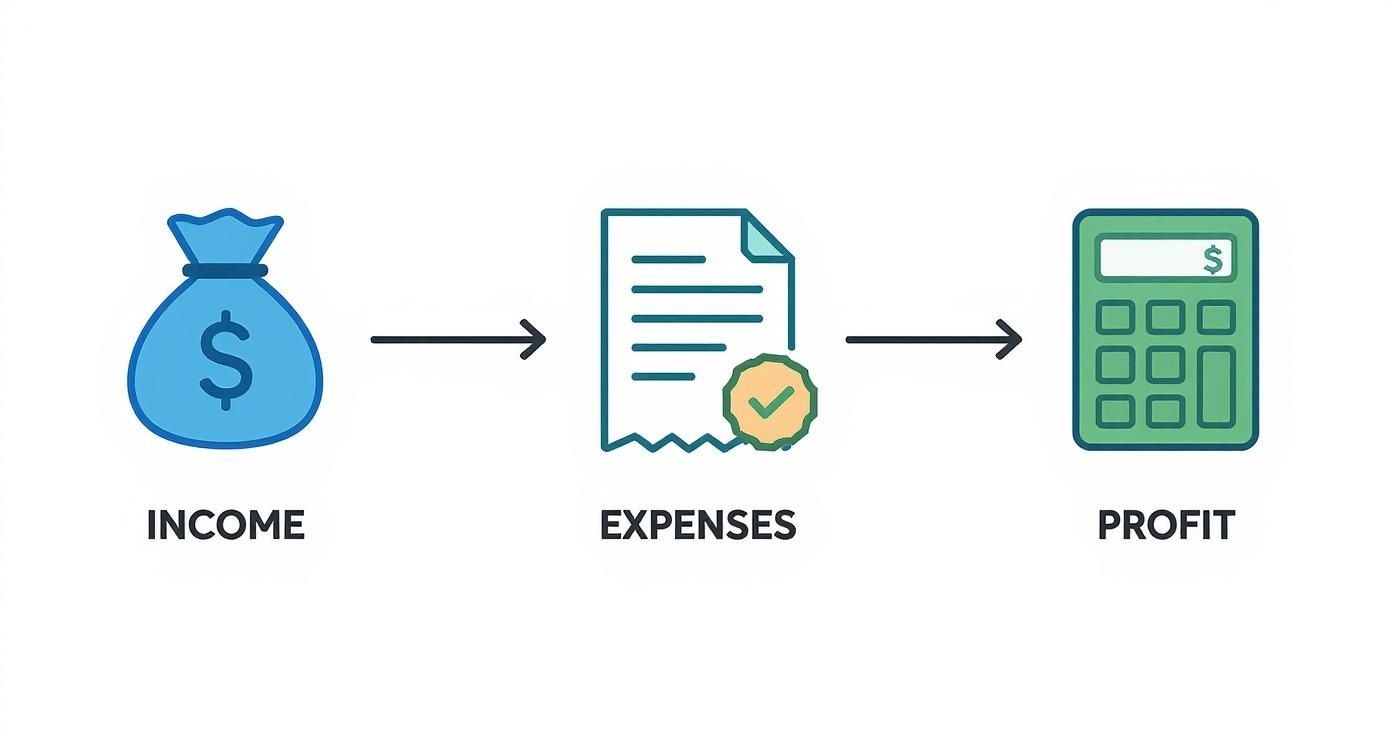
This process – income minus expenses equals profit – is the foundation of the entire Self Assessment system.
The tax landscape is always shifting. In the 2023-2024 tax year alone, there were 7.0 million people in the Self Assessment system. The next big change on the horizon is Making Tax Digital (MTD) for Income Tax, which will eventually require most sole traders to keep digital records and send quarterly updates to HMRC.
Making sure everything is filed correctly and paid on time can feel like a lot to handle on your own. If you’d rather have an expert in your corner, GenTax offers fixed-price help with sole trader tax returns to give you complete peace of mind.
Let's be honest, nobody enjoys dealing with taxes. But getting your head around the common pitfalls is the single best way to avoid stressful HMRC enquiries and painful penalties down the line.
Most mistakes aren't born from trying to cheat the system. They’re usually the result of simple human error – a rushed submission, messy records, or just plain forgetting about that small side hustle you started last year. Accidentally claiming for a personal meal out or making a tiny calculation error might seem harmless, but they can all attract unwanted attention.
These small slip-ups have a nasty habit of snowballing. HMRC has a very clear penalty system for both late filing and late payment, and the costs can climb surprisingly quickly if you don’t get on top of them.
HMRC’s penalty structure isn't just a slap on the wrist; it's designed to make sure everyone files on time and accurately. Think of it less as a punishment and more as a serious financial consequence that can put a real dent in your business's cash flow. Knowing the stakes is a powerful motivator to get things right the first time.
Here are the most common penalties you need to know about:
Think of your financial records as your ultimate protection. If HMRC ever does open an enquiry, organised, clear, and complete records are your best defence to show you’ve taken ‘reasonable care’ to get your tax right.
While some HMRC compliance checks are completely random, certain things can make your return more likely to be flagged for a closer look. Consistently filing late, big unexplained swings in your income, or claiming expenses that look unusually high for your industry can all raise a red flag.
The key to avoiding this scrutiny is simple: diligence.
Before you hit that submit button, take a breath and double-check everything. Does your income match your bank statements and invoices? Have you made sure every expense claim is strictly for business purposes? Do the final figures feel right? A quick sense-check can save you a world of hassle.
And if you do realise you've made a mistake after filing, don't panic. The absolute best thing you can do is be proactive. You can easily amend your return online up to 12 months after the filing deadline. Telling HMRC about an error yourself will almost always lead to a better outcome than waiting for them to find it.
Even with the best plan in the world, the reality of doing a tax return can throw up some tricky questions. We get it. This is where we tackle the common "what ifs" and "am I allowed tos" that crop up for sole traders.
Think of this as your quick-reference guide. From what to do if you have a bad year to whether you really need professional help, we’ll clear up those lingering doubts.
First off, don't panic. Making a loss, especially when you're just starting out, is far more common than you’d think. The crucial thing is to still declare that loss on your tax return. Why? Because HMRC allows you to use it to reduce your tax bill later on.
You’ve got a couple of options here:
There’s no law saying you must use an accountant. Plenty of sole traders with simple finances manage to file their own Self Assessment return every year. HMRC's online system is designed to be user-friendly enough for most people to navigate.
However, hiring a good accountant is often one of the smartest investments you can make. It’s not just about compliance; it’s about peace of mind. They make sure everything is spot on, hunt down every last allowable expense you’re entitled to, and can save you a mountain of time and stress. If your business is growing or you find yourself scratching your head over the rules, their fee is often easily covered by the tax savings they find for you.
It's a common myth that accountants are only for big businesses. The truth is, getting expert advice early on sets a sole trader up for long-term financial health and saves costly mistakes down the line.
Yes, absolutely. But here’s the important bit: you can only claim for the business portion of the cost. This is a classic example of an expense where you need to be fair and sensible about splitting the personal and business use.
If you have a separate phone line or broadband connection purely for your business, great – you can claim 100% of that cost. Most people, however, use their personal mobile and home internet. In that case, you need to work out a reasonable percentage. For instance, if you figure that about 60% of your phone use is for work calls and emails, you can claim 60% of your monthly bill. Just be prepared to explain how you got to that number if HMRC ever asks.
Getting your finances and tax return right is fundamental to your success as a sole trader. At GenTax Accountants, we blend expert knowledge with clever tech to make the whole process straightforward and stress-free. Let us crunch the numbers, so you can get back to doing what you love. Discover our fixed-price accounting services today.
