



Salesforce is a powerful tool known as a Customer Relationship Management (CRM) platform. At its heart, it acts as a central hub for all your client data and interactions. For a growing UK accountancy firm, it’s the perfect replacement for scattered spreadsheets and siloed inboxes, creating an organised, single source of truth to manage client relationships properly.
If you've written off Salesforce as something reserved for giant corporations, it’s time for a rethink. It’s less about being a complex bit of software and more like the central nervous system for your client relationships. It gives you a structured way to track every single interaction, from the first time a potential client enquires about your services to managing their annual returns and compliance deadlines.
This isn't just about storing contact details in a fancier way. It’s about building a complete, 360-degree view of every client. Having that organised data helps you understand what your clients need, anticipate their questions, and deliver proactive advice, moving you well beyond simply reacting to their requests. It’s a genuine strategic asset for any forward-thinking firm looking to build stronger relationships and make day-to-day operations far more efficient.
Salesforce isn't just some big global name; it has a significant and growing presence right here in the UK. In fact, it's the leading CRM in the United Kingdom, commanding 13.9% of UK users and supporting thousands of businesses from small startups to household names like British Airways and Aston Martin.
What does that mean for you? This large local ecosystem translates into better support, a wider choice of integration partners, and a vibrant community of professionals to tap into. You can find more details on its impact in the Salesforce UK ecosystem report.
By centralising client data, your firm can spot opportunities for new services, automate routine follow-ups, and ensure compliance requirements, such as those covered in our guide to Making Tax Digital for Self Assessment, are always met on time.

So, what does Salesforce actually do for an accountancy firm? It’s one thing to hear about it, but another to see how it fits into your day-to-day. Let’s translate its core language into terms that make sense for your practice. The goal is to move you away from clunky spreadsheets and scattered notes into a single, organised system.
To get started, it helps to understand how Salesforce thinks about your client relationships. This quick table maps its key terms to concepts you already use every day.
This structure gives you a clean, organised record for every single business and person you work with, ending the hunt for stray email threads or contact numbers.
At its most basic, Salesforce organises your client data around Accounts and Contacts. The ‘Account’ is the client’s company, and ‘Contacts’ are the people you deal with there. Simple enough.
But where the magic really happens is with Opportunities. Think of an ‘Opportunity’ as the journey of a new service you’re offering. A prospect rings up asking for a quote on VAT returns? You create an Opportunity. This single record then tracks every single stage – from the initial chat and proposal right through to the signed engagement letter. Suddenly, you have a crystal-clear pipeline of future work and revenue.
This structure is the foundation for some seriously powerful reporting and automation. With every client email and call logged against their record, anyone in your team can pick up a query with the full backstory. No more asking clients to repeat themselves. It’s a seamless, professional experience.
Even better, you can automate the boring stuff. Imagine setting up automatic reminders for upcoming tax deadlines or chase-up emails for proposals you’re waiting on. This kind of workflow automation saves a huge amount of admin time and cuts down on human error, freeing up your team for proper advisory work.
By combining organised client data with workflow automation, Salesforce stops being a simple database and becomes a proactive engine for managing your practice. It helps you anticipate client needs and run your firm far more efficiently.
Once you’re comfortable with these fundamentals, you can start exploring how other technologies build on this. If you’re curious about how artificial intelligence is changing the game, take a look at our guide on the upcoming features of ChatGPT 5 and its UK business use cases. Staying ahead of these trends is vital for any modern firm.

One of the biggest worries for any accountancy firm is whether a shiny new tool will actually play nicely with the software you already rely on. Thankfully, Salesforce is built to be a central hub, not an isolated island. It’s fantastic at connecting with other platforms, creating one single, reliable source of truth for all your client data.
This completely gets rid of the risky and soul-destroying task of manually copying and pasting information between systems. Just imagine automatically creating an invoice in Xero the moment a new service is marked ‘Closed-Won’ in Salesforce. That’s the sort of connected workflow we’re talking about.
The secret to this connectivity is the Salesforce AppExchange—think of it as an app store, but for business software. This is where you’ll find pre-built connectors for all the UK’s favourite accounting platforms.
Here are a few key ones for UK firms:
Hooking these systems up gives you a true 360-degree view of every client. Your team can see a full financial history alongside every email, call, and meeting note without ever having to leave Salesforce. If you're still deciding on a platform, our guide on the best cloud accounting software for startups might help you make the call.
By linking your CRM and accounting software, you break down those frustrating data silos. This means your client service team can answer billing questions accurately, and your finance team has the full story on client relationships. It just makes the whole operation run smoother.
For even deeper insights, many firms also find it incredibly useful to master Google Analytics Salesforce integration to see how their marketing efforts translate directly into sales.
Theory is all well and good, but what really matters is seeing how a system can solve the day-to-day problems your clients actually face. Let's walk through a few practical scenarios to show how different UK businesses can get real value from Salesforce, which in turn helps you offer sharper, more strategic advice. Think of each one as a mini-story about fixing a common operational headache.
The platform’s popularity across the UK isn't just hype; it speaks volumes about how adaptable it is. The Salesforce economy here is booming, with European revenues projected to reach around $8.89 billion in 2025. Given that it holds a 20.7% CRM market share in the UK, you’ll find it everywhere from professional services to retail and manufacturing, proving it’s not a one-trick pony. You can find out more about Salesforce adoption trends on backlinko.com.
For your limited company clients, staying on top of compliance is non-negotiable. Salesforce can be set up to automate these crucial obligations, taking the manual effort and guesswork out of the equation. Imagine automated reminders firing off for Companies House filing deadlines, annual confirmation statements, and corporation tax due dates.
But it goes beyond just compliance. Think about managing shareholder communications. Every interaction, from dividend payment records to meeting minutes, can be logged in one central place. This creates a complete, easily auditable history that’s ready for inspection at a moment's notice.
Sole traders and contractors are constantly juggling multiple projects, and it's easy for things to fall through the cracks. Salesforce gives them a clear project pipeline, letting them track each stage from the initial quote right through to the final payment. It can even be configured to automate invoicing when project milestones are hit, making sure they get paid faster.
For startups, managing investor relations is a full-time job in itself. Salesforce offers a structured way to track every single interaction with potential and current investors. That means timely follow-ups, organised pitch materials, and a far more professional approach to securing that all-important funding.
By applying Salesforce to these specific client needs, you move from being a compliance-focused accountant to a strategic partner. You’re not just managing their books; you’re helping them build a more organised, efficient, and scalable business.
This shift towards advisory is what sets a modern accounting firm apart. Getting your own internal systems in order is the first step, and our expertise in technology transformation can provide the roadmap for bringing powerful tools like Salesforce into your practice.
Figuring out Salesforce pricing is your first step towards making a smart investment. It’s based on a straightforward ‘per user, per month’ subscription, which is great because you only pay for the team members who actually need to use it.
For most UK accountancy firms and small businesses, the conversation usually circles back to the entry-level plans. They’re designed to give you the core client management tools you need without bogging you down with features you won't touch. You get the essentials for managing contacts, tracking leads, and basic reporting – a solid foundation to build on.
For most small firms, the choice boils down to two main plans: Salesforce Essentials and Salesforce Professional.
Picking the right plan is all about balancing what you need today with where you want to be tomorrow. Start with the plan that solves your most pressing problems right now, safe in the knowledge you can always upgrade as your firm and client base grow.
Making this call often needs a clear view of your financial strategy. To make sure your tech investments line up with your business goals, you might want to consider the benefits of working with a fractional finance director. They can help map out a budget and provide the strategic oversight needed to ensure you invest wisely without overstretching your resources.
https://www.youtube.com/embed/P987XWSZkws
Bringing a new system like Salesforce into your firm can feel like a mammoth task, but breaking it down into manageable steps makes all the difference. Success isn’t just about the technology itself; it’s about smart planning and, crucially, getting your team on board right from the start. A phased rollout is almost always the best approach.
Instead of trying to do everything at once, focus on one core area first, like streamlining client onboarding or automating annual returns. This lets you build momentum, gather real-world feedback, and score an early win that proves the value of the change. A solid CRM implementation project plan is your roadmap here, guiding you through the initial stages and helping with user adoption.
Before you even touch the migration button, you need to be crystal clear on your goals. What specific problems are you trying to fix? Is it about getting a better handle on your sales pipeline, automating compliance reminders, or simply having a single, clear view of all client communications? Defining these objectives upfront will shape every decision you make.
Next up is the big one: your client data. Tipping messy, outdated, or duplicated information into a shiny new system is a recipe for disaster. It’s the classic ‘rubbish in, rubbish out’ scenario. Your pre-launch checklist absolutely must include:
Getting this right means your team starts with a clean, reliable source of truth from day one. It’s non-negotiable.
The success of your Salesforce rollout really boils down to one thing: user adoption. If your team doesn't actually use the platform, even the most perfect technical setup is completely worthless. Make training practical and focus on the specific daily tasks that will make their jobs easier.
Looking ahead, it's clear that AI is becoming central to modern business. Salesforce is investing heavily in this area in the UK, with projections suggesting it could generate over $41 billion in new business revenues by 2028. With 78% of UK C-suite executives already using AI agents in their organisations, adopting a platform like Salesforce is key to staying competitive.
This infographic neatly summarises the key things to think about when choosing your plan.
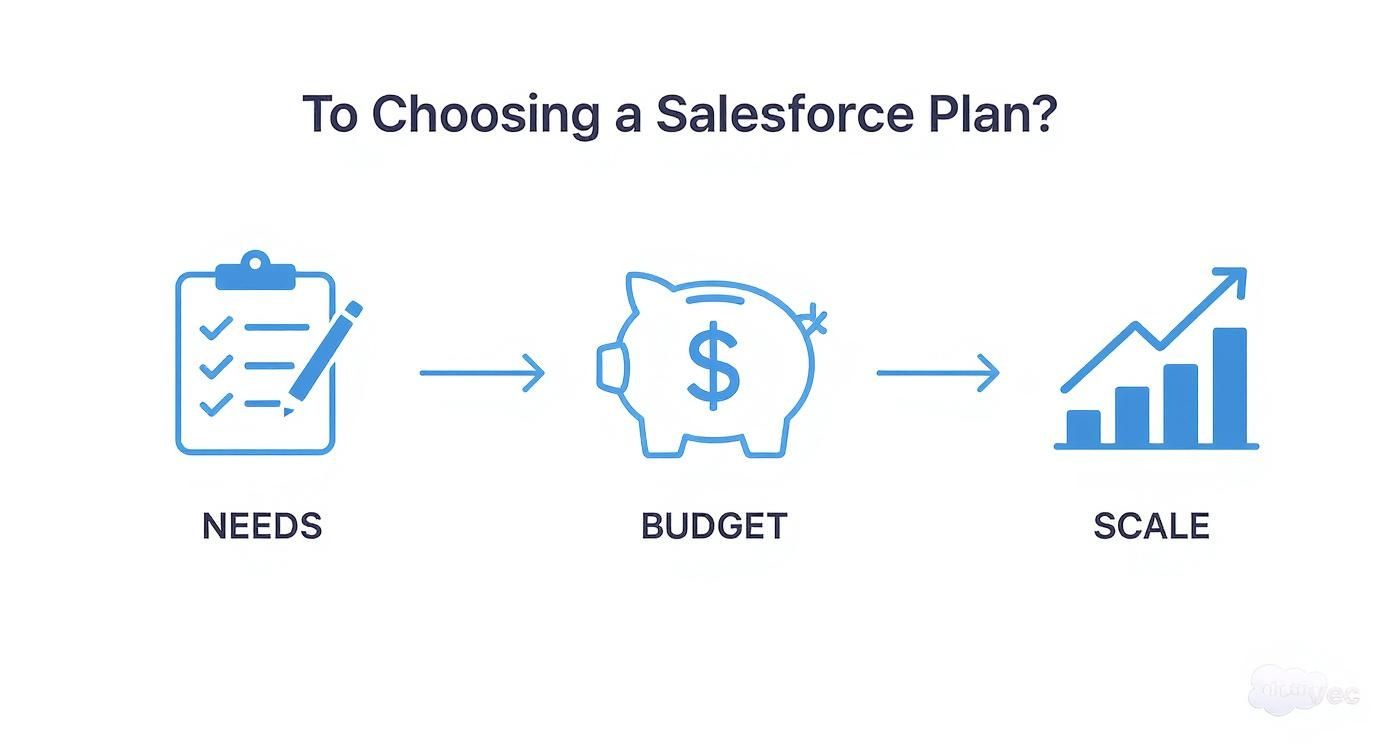
As the visual shows, the right choice is all about balancing what you need right now with where you plan to be in the future.
Thinking about bringing Salesforce into your practice? It’s only natural to have a few practical questions. We get asked these all the time by UK accountants and SME owners, so let’s tackle them head-on to give you the clarity you need.
Not at all. While Salesforce is famous for powering global giants, its Essentials and Professional plans were built specifically with smaller businesses in mind. You get the core CRM tools you need to organise clients and automate your workflow, without the eye-watering cost or complexity of the enterprise-level editions. The trick is to start simple and grow into it.
For a smaller firm using a standard plan, you’re looking at weeks, not months. A basic setup can be up and running surprisingly quickly. The exact timeline really depends on how much client data you need to bring across and whether you want any special customisations. Our advice is always to roll it out in phases – get the essentials working first, then add the bells and whistles later.
While Salesforce isn't an MTD tool itself, it’s a critical piece of the puzzle for a modern, compliant practice. Think of it as your client management hub. When you link it with your MTD-compliant software like Xero or QuickBooks, Salesforce keeps track of the client relationship and workflow, while your accounting package handles the actual submissions to HMRC.
It creates a seamless, organised process from start to finish. Every client email, call, and deadline related to compliance is tracked in one place, making your entire practice more organised and less prone to error.
For smaller firms on the Essentials or Professional plans, a full-time admin is usually overkill. What we see work really well is nominating a tech-savvy person in your team to be the 'Salesforce champion'. They might spend a few hours a week keeping things ticking over. As your firm grows and your use of the platform becomes more sophisticated, you can then look at bringing in a freelance consultant for bigger projects.
Ready to see how a modern, tech-focused approach can help your business thrive? At GenTax Accountants, we specialise in helping UK firms use technology to streamline their finances. Get in touch to see how we can help you.
