


Before you pour your life savings into a business idea, you need to know if anyone actually wants what you're selling. This is where validating your idea with real-world data becomes absolutely critical. The modern way to do this blends deep, AI-powered niche research with cheap, rapidly-built test pages to see if customers are genuinely interested—before you spend serious time or money. It’s all about swapping guesswork for hard evidence.
The road to success is paved with brilliant ideas that nobody ever bought. It's a harsh reality, but a shocking 90% of startups fail, often because they skip this one crucial step: checking for market need. Too many founders fall in love with their solution, build it out in a bubble, and only then start looking for a problem it might solve. That's a surefire recipe for burnout and wasted cash.
The modern validation blueprint flips that old model on its head.
Instead of locking yourself away for a long development cycle, this approach is all about learning as fast as possible. The main goal is to de-risk your idea by testing your biggest assumptions cheaply and quickly. This usually breaks down into two phases: deep research, followed by rapid testing.
First, you become a detective. You'll use clever tools to dig into specific customer pain points, find audiences that aren't being served well, and spot gaps in the market. Once you have those insights, you form a clear hypothesis and bring it to life with a simple, AI-generated landing page. Its only job? To capture real user interest.
This flow chart maps out the whole process, from initial research to the final test.
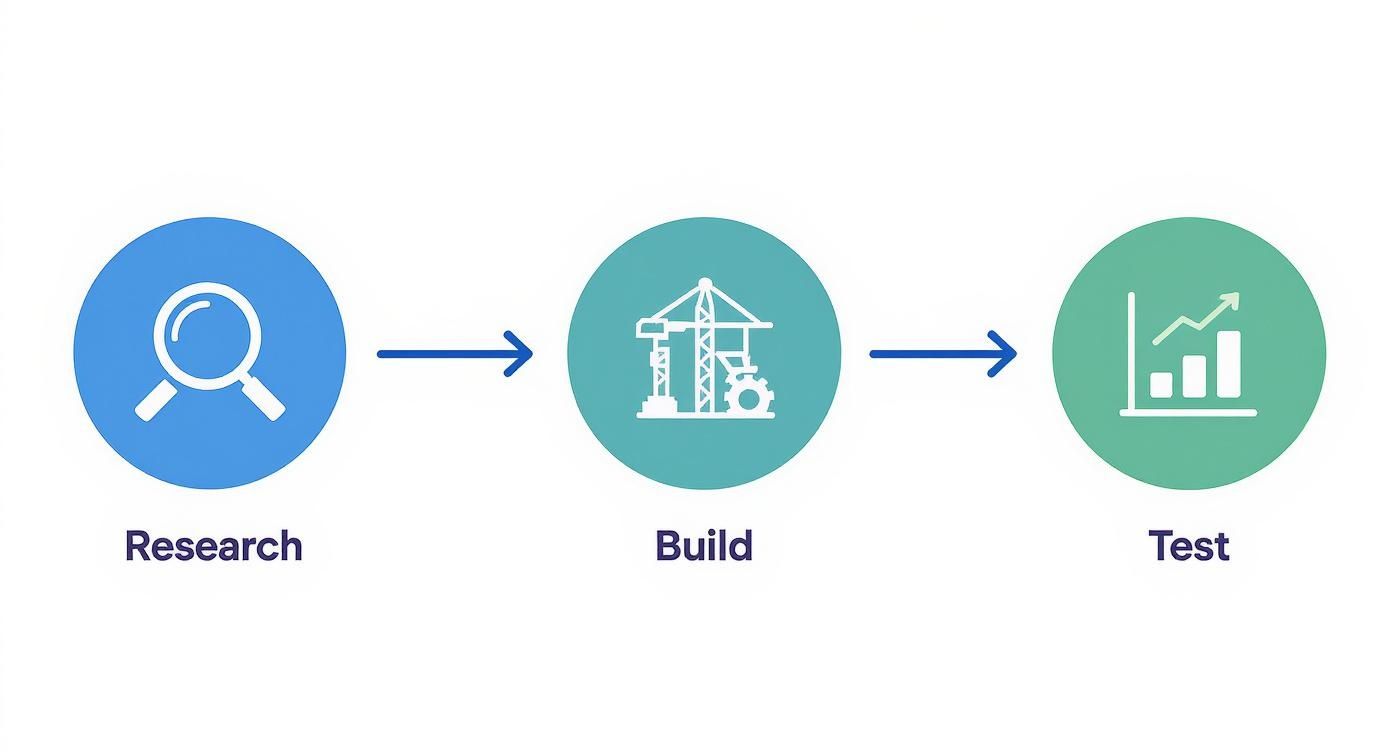
As you can see, it's a straightforward path designed to minimise risk by putting all the learning right at the start.
This method works because it forces you to face market reality from day one. Instead of just going with your gut, you're collecting real data that tells you whether your idea has legs or not. That feedback loop is everything when it comes to making smart decisions.
To see how this fits into the bigger picture of launching a successful product, check out this excellent guide on how to build digital products that succeed through validation and scaling. It covers the entire journey, from that first spark of an idea right through to scaling up.
The goal isn't to be right the first time. It's to be wrong quickly and cheaply, so you can iterate toward a solution the market will actually embrace.
This entire framework is foundational to any new venture. Of course, before you get into the nitty-gritty of AI research, make sure you've covered the basics. Our guide on how to start a business in the UK offers a solid overview of the essential legal and financial steps you’ll need to take.
Moving from a gut feeling to genuine evidence is where most great business ideas start to take shape. This is the moment you put your assumptions aside and begin thinking like a market detective. For this, we'll be using Perplexity Comet to find out what potential customers actually want. The aim here isn't just to skim the surface; it's to find a profitable gap in the market just waiting to be filled.
Forget generic Google searches. Perplexity's conversational AI lets you go much, much deeper. Think of it as a research assistant that can pull together information from thousands of sources, including niche forum discussions, detailed market reports, and raw customer reviews. This way, you’re building your idea on a foundation of real-world demand, not just wishful thinking.
For instance, a vague query like "fitness trends" is basically useless. A powerful prompt gets specific:
"Analyse discussions on Reddit's r/bodyweightfitness and r/xxfitness from the last six months. Identify the top three frustrations beginners have with starting at-home workout routines, and summarise the most common 'hacks' or workarounds they mention."
This kind of targeted question forces the AI to spot patterns in genuine conversations, digging up pain points that a standard search would completely miss.
Here’s a look at the Perplexity Comet interface, where you'll kick off your conversational research.

The clean, simple layout encourages you to ask follow-up questions, letting you drill down until you have a crystal-clear picture of your audience's problems.
Your first wave of research will probably highlight broad market trends. That's useful, but the real gold is in identifying specific, underserved groups within that market. These are the people whose needs are being completely overlooked by the bigger players. With the right prompts, Perplexity Comet is brilliant at this.
You can use it to cross-reference different data points and find unique intersections. Let's say you have an idea for sustainable packaging. A smart follow-up prompt would be:
"Based on market reports and industry blogs, which small business sectors in the UK are most vocal about needing sustainable packaging but are currently underserved by major suppliers due to high minimum order quantities?"
This prompt is effective because it does three things:
Getting this specific is how you find a niche you can truly own. The UK technology industry has hit a combined market valuation of $1.2 trillion (£886 billion), cementing its place as Europe's largest tech ecosystem. This shows just how much potential can be unlocked with rigorous niche research.
Finally, you absolutely have to understand the competitive landscape. You need to know who’s already out there serving your potential customers and, more importantly, where they’re falling short.
Don't just ask for a list of competitors. Prompt Perplexity Comet to analyse their weaknesses. If you were starting an eCommerce venture, you could ask:
"Analyse customer reviews for the top three Shopify apps for inventory management. What are the most common complaints about their user interface and customer support?"
Insights like this are what help you define your unique selling proposition. It turns market research from a simple data-gathering exercise into a strategic hunt for opportunity. If you need a hand getting your own finances in order, our specialised accounting services for eCommerce businesses can help you stay ahead of the curve.
All that deep market research you’ve pulled from Perplexity Comet gives you a pile of valuable raw material—customer complaints, market gaps, and your competitors' weakest points. But raw material isn't enough; you need to shape it into something sharp, a tool that can actually test if your idea has legs. This is where you transform those scattered insights into a focused, testable hypothesis.
Your goal is to move beyond a vague concept into a specific statement you can prove or disprove. A weak idea sounds like this: "I'm going to build a better project management tool." A strong, testable hypothesis, on the other hand, is much clearer and more direct.
A well-formed hypothesis should follow this simple structure: "We believe [a specific audience] will sign up for [our solution] because it solves [a specific problem]."
This framework forces you to get precise about who you're serving, what you're actually offering, and why anyone should care. It turns a fuzzy business idea into a scientific question you can answer with real data.
With your hypothesis framed, the next job is to pin down your Unique Selling Proposition (USP). The research you did on competitor complaints is pure gold here. What are the recurring issues people have with the tools they’re already using? Is it awful customer service, a confusing interface, or a key feature that’s frustratingly absent?
Your USP is your direct answer to those problems. For example, if your research showed that freelancers absolutely hate how complex and expensive invoicing software has become, your USP could be something like:
This USP isn't just a catchy tagline; it’s the core message that will drive all the copy on your AI-built test page. It’s the promise you're making to your ideal customer.
Every new business idea is built on a stack of assumptions. Your job is to find the single biggest assumption that, if you're wrong about it, would cause the entire idea to collapse. This is the lynchpin you absolutely have to test.
Common core assumptions often look like this:
Pinpointing this primary assumption gives your test page a crystal-clear purpose. You aren't just building a page to see what happens; you're designing an experiment to validate (or invalidate) your most critical belief. Understanding how this first step fits into the bigger picture of business growth is crucial, and exploring the essentials of technology transformation for UK businesses can offer some valuable context for scaling your idea once it's proven.

You've done the deep dive with Perplexity and distilled your research into a sharp hypothesis. Now for the exciting part: bringing it to life. We're moving from theory to a tangible asset that can gather real-world data, and the best part is you don't need to write a single line of code.
Modern AI website builders have made it ridiculously simple to spin up professional-looking landing pages in minutes. These aren't just for looks; they are built for speed and validation. The goal here isn't to build a full-blown website. It's to create a focused, single-page experience designed to do one thing very well: test your value proposition. By feeding your research-backed messaging directly into these platforms, you skip right over the traditional web development headaches and get straight to market validation.
This speed is a massive advantage. The UK technology market, currently valued at around USD 1.30 trillion, is on track to more than double by 2033. To get a piece of that pie, you need to be nimble—identifying market needs and testing product ideas quickly. AI tools are perfectly suited for this rapid-fire process.
An effective test page is brutally simple. Forget all the bells and whistles. It should be laser-focused on converting a visitor's curiosity into a measurable action, like signing up for a waitlist. Every single element must serve this one purpose.
Here are the non-negotiable elements your AI-generated page must include:
These components work together to tell a concise, powerful story. A visitor should land, immediately understand the problem, see your solution, and know exactly what to do next.
Using an AI page builder feels more like a conversation than a technical task. You provide the core inputs, and the AI handles the design heavy lifting. For instance, you could give it a prompt like this:
Create a landing page for 'InvoiceFlow,' a simple invoicing tool for UK-based freelance creatives. The headline is 'Finally, Invoicing That's as Simple as Sending an Email.' The main goal is to collect emails for a waitlist. Go for a clean, minimal design with a blue and white colour scheme.
The AI will then generate a complete page based on your instructions. From there, you can easily tweak the copy, swap out images, and adjust the layout until it perfectly matches your vision. This whole process can take less than an hour, giving you a live asset ready to put your idea to the test. To get a glimpse of how much more powerful this will become, check out our guide on ChatGPT-5's potential business use cases in the UK.
Ultimately, the power of this approach lies in its efficiency. It transforms idea validation from what used to be a lengthy, expensive project into a fast, data-driven sprint. And with AI playing an ever-bigger role in how people find things online, mastering AI search optimization is also fundamental to ensuring your new test page actually gets seen.

Getting your AI-generated test page live is a brilliant milestone, but think of it as the starting line, not the finish. The real work starts now: learning to read the story your data is telling you. It's incredibly easy to get lost in a sea of numbers, so your first job is to separate the genuine market fit signals from the distracting vanity metrics.
Total page views might look impressive on a chart, but they don't mean your idea has legs. True validation comes from tracking actions that show genuine intent. The single most important number on your test page is its conversion rate—the percentage of visitors who actually did the one thing you wanted them to, like joining your email waitlist.
This one number cuts through the noise. It tells you, in no uncertain terms, if your value proposition is hitting the mark. A low conversion rate is a clear red flag; it signals a mismatch between what you're offering and what your audience actually needs.
Beyond that headline conversion rate, you need to dig into visitor engagement. How long are people sticking around? Are they scrolling all the way to the bottom of the page? Simple analytics tools can give you this information, offering clues about how compelling your copy and offer really are.
But the real gold often comes from qualitative feedback. If you can, add a single, optional question after someone signs up, like, "What's the biggest challenge you face with [your problem area]?" This kind of direct feedback is worth more than a thousand page views.
So, let's focus on the metrics that actually matter:
Don't get seduced by high traffic numbers if nobody is converting. A hundred highly engaged visitors who sign up are infinitely more valuable than ten thousand who arrive and leave immediately. True market fit is about the depth of interest, not the breadth of exposure.
Once you've got a week or two of data under your belt, it’s time to make a call. Your results will usually point you in one of three directions: persevere, pivot, or pull the plug. Using this simple framework helps take the emotion out of it so you can make a logical next move.
London is a prime example of a competitive market, standing out as Europe’s top tech ecosystem with over 8,000 high-growth technology companies. In such a dense environment, the ability to iterate quickly is essential. Using AI-assisted research and rapid testing gives you a crucial edge to find your footing faster than the competition. You can dive deeper into the UK tech scene with Deloitte's research.
This is where understanding your core business performance becomes vital. Interpreting these early signals correctly is fundamental to building long-term financial health. For a closer look at tracking the right metrics, our guide on management accounts and business performance offers a solid framework.
Ultimately, your test page data is your first real conversation with your target market. Listen carefully. If the signals are weak, don't be afraid to go back to your research on Perplexity Comet and tweak your hypothesis. This loop of researching, building, and analysing is the very heart of finding true product-market fit.
Diving into market testing with tools like Perplexity Comet is exciting, but it's natural for a few practical questions to pop up. Here are some quick, straight-talking answers to the common ones I hear.
Honestly, the cost can be surprisingly low. Perplexity Comet has a brilliant free tier that’s more than enough for your initial deep-dive research. Most AI page builders also offer free trials or starter plans that won't break the bank.
Your biggest investment here is your time. But think about what you're saving: a potential fortune you might have spent building a full product that nobody actually wanted.
You can often get meaningful initial data for under £100. That's enough to cover a small, targeted ad campaign on social media to get your first wave of traffic to the test page. Think of it as a tiny, smart investment to de-risk a much larger one down the line.
First off, that's not a failure—it's incredibly valuable data. Getting zero sign-ups is one of the clearest signals you can possibly get. It tells you there's a definite mismatch between your idea, your messaging, and the audience you're trying to reach. It’s actually a successful test because it’s just saved you from wasting months, or even years, chasing the wrong thing.
Don't get discouraged. See it as a signpost telling you where to go next. Fire up your Perplexity research again, but this time with sharper questions:
This outcome is the perfect chance to pivot your strategy based on hard evidence, not just your gut feeling.
A test that gets zero sign-ups is a massive win. It gives you the clarity to stop, rethink, and change direction without losing serious time or money.
Forget about the calendar. Focus on getting a meaningful number of visitors instead. A good benchmark to aim for is at least 500–1,000 highly targeted visitors hitting your test page. That sample size is usually big enough to give you a statistically relevant conversion rate, so you know the results aren't just a fluke.
If you're running paid ads, you could hit that number in a week. If you're relying on organic outreach in online communities or forums, it might take a bit longer. The key isn't speed; it's gathering enough solid data to confidently decide your next move—whether that’s to push forward, pivot, or park the idea for now.
At GenTax Accountants, we turn complex financial data into clear, actionable insights for your business. Let us handle the numbers so you can focus on building something the market loves. Discover our fixed-fee accounting services at https://www.gentax.uk.
