



Generating your weekly investor updates should be a quick, painless process. The secret? Auto-generate them from your existing docs, calls, and metrics. This isn't about cutting corners; it's about turning hours of manual labour into a polished, data-rich report in just 15 minutes. It’s the key to giving your investors a consistent, insightful narrative without the weekly grind.
For UK founders, time is your most precious resource. You can't buy more of it. Yet, so many of us get stuck in the frustrating weekly ritual of piecing together investor reports by hand.
It’s a familiar story: digging through spreadsheets, pulling quotes from call transcripts, and trying to stitch a coherent narrative together from scattered meeting notes. This old-school approach isn't just inefficient—it’s a serious drag on your momentum.
This slog is even more draining in the UK's hyper-competitive startup scene. In Q1 2025 alone, a staggering 89,515 new businesses were formed, which is a 36.5% increase from the same time in 2024. With that much noise, you need slick, efficient systems to keep your investors engaged and confident. For more on the UK's startup boom, check out the data on limelightdigital.co.uk.
Those hours you spend compiling reports are hours you’re not spending on product development, talking to customers, or leading your team. It’s the classic trap of working in your business instead of on it. The real cost isn’t just your time; it’s lost opportunity and the risk of sending out inconsistent, rushed messages.
A smarter way to operate is by creating an automated workflow. Before we get into the nuts and bolts, it helps to understand what is workflow automation is all about. At its core, it’s about connecting the tools you already use to automatically synthesise information from your documents, call notes, and KPIs.
This shift isn’t just about clawing back a few hours. It’s a strategic advantage that guarantees your investors get consistent, high-quality narratives, building the confidence you need to stand out and lock in future funding.
This method delivers a polished, data-driven update without the manual headache. It's a fundamental part of the technology transformation modern startups need to adopt to stay competitive.
The difference between the old way and the new way is stark. It’s not just an upgrade; it’s a complete change in how you manage one of your most critical relationships.
This table really drives home the point. One approach is a time-sink that produces inconsistent results, while the other is a strategic tool for building investor trust.
The core benefits really stack up:
Getting your 15-minute reporting engine up and running starts with picking the right tech. The aim here isn’t just to collect a bunch of new subscriptions, but to build a smart, connected system where information flows effortlessly from where it’s created right into your final report. Think of it like putting together a small, highly specialised team, where every tool has one clear job to do.
Your foundation is a central knowledge hub. This is where all your raw notes, data points, and metrics will live before any AI gets to work. Tools like Notion or Coda are brilliant for this. They act as a flexible database and document editor rolled into one, letting you create structured pages for everything from meeting notes and call summaries to your key performance indicators (KPIs).
Next, you need a way to capture all those unstructured conversations. Your investor calls and internal strategy sessions are absolute goldmines of qualitative insight. But transcribing them by hand is a massive time-sink, which is why a dedicated service is a game-changer. Look for platforms that offer reliable AI Powered Transcription Services to turn your call recordings into clean text, giving you a solid, searchable base for your reports.
Once your knowledge hub and transcription service are sorted, the last piece is piping in your quantitative data. This is where the real automation kicks in. You need to connect the platforms where your actual business performance is being measured.
A few common connections you'll want to make include:
This infographic paints a clear picture of the workflow, showing the shift from a tangled manual mess to a fast, automated system.
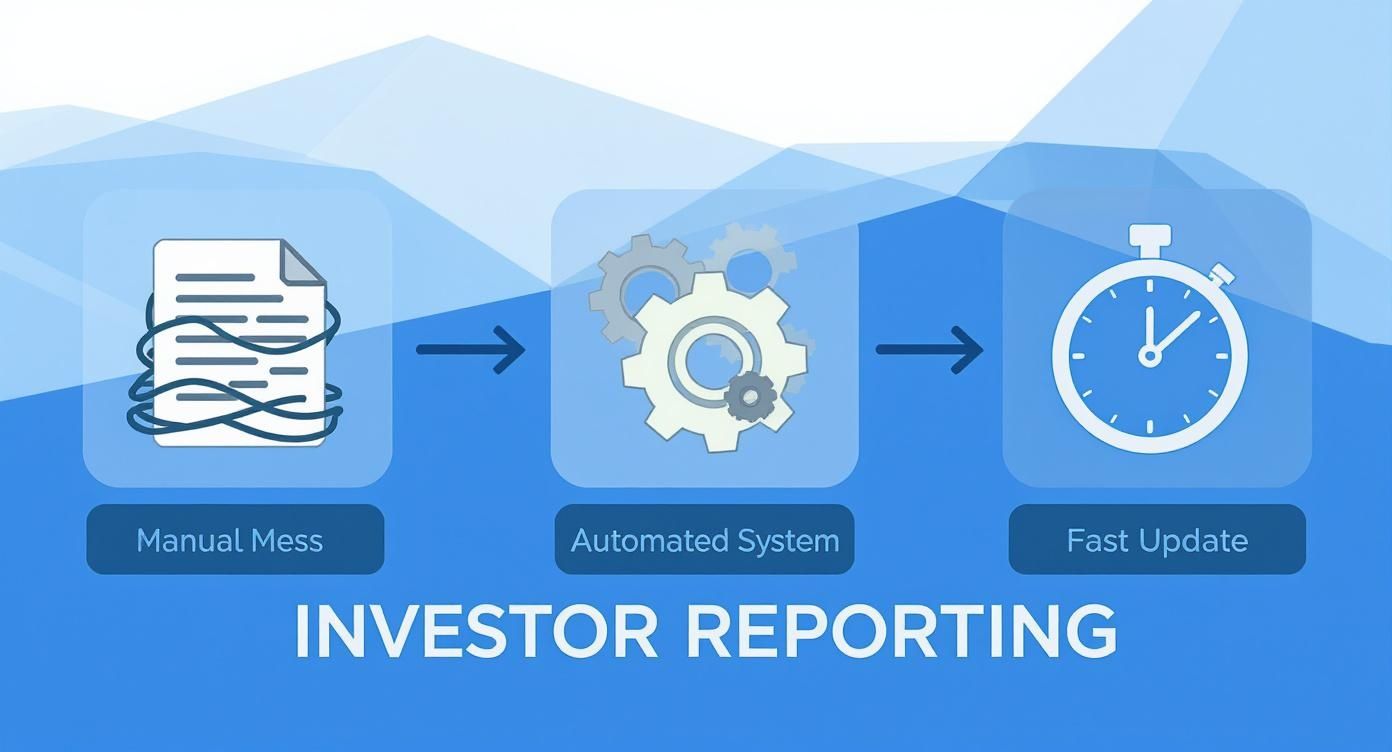
As you can see, connecting these tools is the bridge between chaotic data gathering and streamlined, rapid-fire updates.
The best part? You don't need to be a developer to connect all these different systems. This is where automation platforms like Zapier or Make come into play. These tools act as the "glue" that holds your whole tech stack together.
For instance, you could set up a simple workflow that looks like this:
The real beauty of this setup is that it all happens silently in the background. It’s constantly gathering and organising the raw materials you need to auto-generate weekly investor updates. When you finally sit down to write your report, all the essential information is already there waiting for you. This is the very core of an effective 15-minute reporting workflow.
Even the smartest automation tools are useless if they’re fed messy, inconsistent data. This is where the real groundwork is done. Before you even think about AI, you need to get your house in order to build a flawless reporting engine.
Without this discipline, you’re just automating chaos.
The whole process starts by standardising how you capture information. Think of it like creating a set of digital filing cabinets with crystal-clear labels. Every piece of data, whether it’s from a call transcript or a metrics dashboard, needs a predictable home.
This consistency is the secret sauce that makes a 15-minute workflow reliable week after week. It stops the kind of garbled, nonsensical outputs that happen when an AI tries to make sense of unstructured notes.
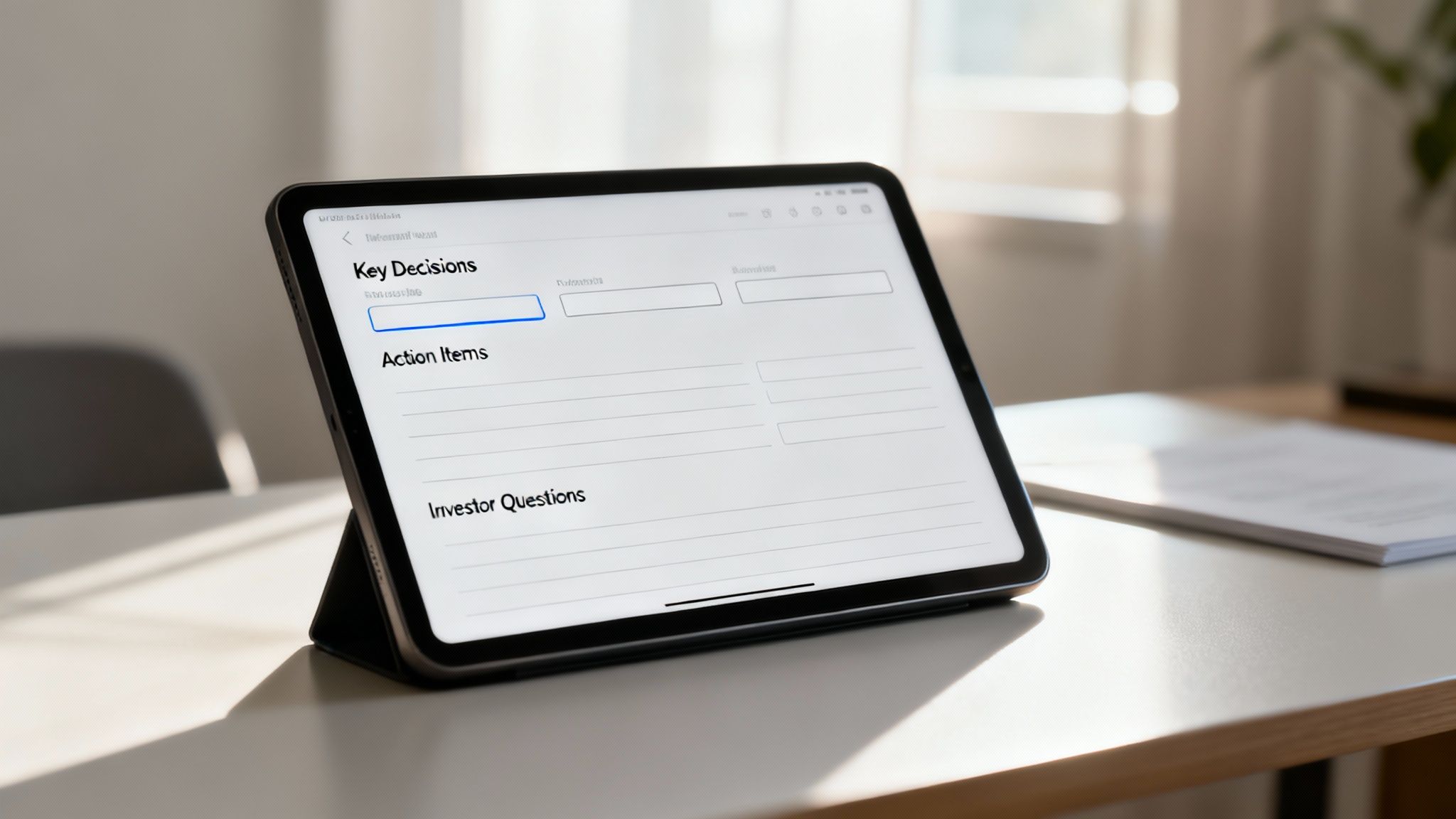
First things first: create a universal template for all your meeting notes and call summaries. Whether you use Notion or Coda, this template needs predefined fields that force you to capture information in a structured way.
Ditch the free-form wall of text. Instead, use specific headings that your AI can easily recognise and pull from. A really effective template will always include:
This structured approach instantly turns your notes from a simple record into a queryable database. When your AI scans these documents, it isn't guessing; it's pulling information from clearly labelled sections like ‘Action Items’, making sure the output is always relevant.
Now for the numbers. You need a single source of truth for all your quantitative data. Manually updating spreadsheets is a recipe for disaster – it’s slow, tedious, and riddled with human error. This is why a simple, automated dashboard is a non-negotiable.
It doesn’t need to be fancy. Just focus on the handful of metrics that genuinely matter to your investors.
This screenshot shows how an automation platform like Zapier can act as the glue between thousands of apps. It allows you to pull metrics from all your different sources into one place. By linking tools like your CRM, payment processor, and analytics platform, you create a live feed of your most important data.
Organising your data isn't just a best practice; it's the core requirement for successful automation. A structured knowledge base and a live metrics dashboard are the twin pillars that support a fast, accurate, and repeatable investor reporting process.
This dashboard becomes the primary source for every figure in your update. The AI can be instructed to pull MRR from Stripe, user sign-ups from your database, and website sessions from Google Analytics – all from one central spot.
Maintaining this data integrity is a vital part of managing your management accounts and business performance, as it ensures every stakeholder is working from the same accurate numbers. It's this disciplined approach that gives you the confidence to auto-generate weekly investor updates that are always on the money.
With your data neatly structured and your tools linked up, this is where the real magic happens. A well-crafted, reusable AI prompt is the engine of your entire automated reporting system. It’s what turns all those organised inputs into a genuinely compelling story for your investors.
The gap between a bland, generic summary and a report that actually adds value is massive. And it all comes down to the quality of your instructions. You can't just tell the AI to "write an update" and expect anything useful back. You have to be incredibly specific, giving it a role, a tone, and a clear structure to work with.
This is especially critical for UK startups competing on a global stage, where clear, consistent reporting can make or break an investment relationship. With AI adoption climbing—a huge 91% of UK companies see it as vital for innovation in 2025—using smart tools to save time on investor comms is fast becoming the norm. You can read more about what's coming in 2025 UK startup investment trends on robotmascot.co.uk.
A truly effective prompt doesn't just ask for a summary; it gives the AI a persona and spells out exactly what you need. Think of it like briefing a new team member for the first time. The more context you provide, the better the result you'll get.
Your master prompt should always contain these core building blocks:
The biggest leap you can make in your prompt engineering is telling the AI to analyse, not just regurgitate. This is how you create a narrative that gives investors the "so what?" behind the numbers. Instead of just listing facts, you want the AI to connect the dots for you.
For instance, a basic prompt might say, "Summarise our marketing notes." That’s okay, but it’s not great.
A powerful prompt, on the other hand, would say:
"Analyse the marketing notes from this week. Identify the key marketing action that correlates with the 35% spike in website traffic shown in our Google Analytics data. Explain this connection in the 'Highlights' section."
See the difference? This instruction forces the AI to perform a much higher-level task. It has to synthesise information from two different sources (your notes and your metrics) and actually draw a conclusion. This is precisely how you auto-generate weekly investor updates that feel genuinely insightful. To see how newer AI models are getting better at handling these complex instructions, check out our article on ChatGPT-5 features and UK business use cases.
By crafting a detailed master prompt like this, you’re creating a reusable asset for your business. Each week, you just run the same prompt, and it will automatically pull in the latest data, saving you hours of tedious work while producing a consistently high-quality first draft.

Automation is brilliant, but it only gets you 90% of the way there. It’s that final 10%—your personal touch—that actually cements trust and builds relationships with investors.
Think of your AI-generated draft as the perfect starting point. It’s a data-rich, well-structured summary, but it lacks the one thing your investors truly value: your insight as a founder.
This final five-minute review is non-negotiable. It's your chance to turn a good report into a great one. You’re making sure the narrative feels authentic and adding that forward-looking commentary only you can provide. Honestly, it's this human touch that makes the update resonate.
There’s a second benefit here, too. This review is your opportunity to make the whole system smarter. Every little correction you make is a chance to refine your master AI prompt for next time. If the AI misinterprets a metric or misses a key nuance, you just add a new instruction. This process continuously improves the output and shaves even more time off future reviews.
Before you hit send, just run through this quick checklist. It’s designed to be fast but thorough, zeroing in on the areas where a human eye adds the most value.
That human element is especially important right now. The UK startup ecosystem in 2025 has a distinctive 'two-speed' market, where early-stage investment is incredibly selective. As noted in a 2025 UK startup funding guide on equidam.com, while the total number of deals has dropped to its lowest since Q2 2018, investors are funnelling larger funds into startups that show real traction. A polished, insightful update helps you demonstrate exactly that.
Think of each review as a training session for your AI assistant. When you spot a recurring error, don’t just fix it in the document—update your master prompt.
Example: Let's say your AI keeps summarising internal team challenges as "lowlights." To fix this, you could add this instruction to your prompt: "When summarising meeting notes, distinguish between internal operational hurdles and external-facing business lowlights. Only include the latter in the investor update."
This iterative process is what ensures your 15-minute reporting system becomes more accurate and reliable over time. It’s also where having an expert eye can be invaluable. For founders who want to ensure their financial narrative is always investor-ready, a fractional finance director can provide the strategic input needed to perfect this process from day one.
Whenever you're building a new workflow, a few questions are bound to pop up. For founders looking to automate their weekly investor updates, I often hear the same practical concerns around security, tool compatibility, and—most importantly—authenticity.
Let's tackle those head-on. Getting this process right isn’t just about being fast; it’s about building a system that’s secure, reliable, and still sounds like you.
Security is non-negotiable, especially with investor-level information on the line. The key here is choosing your tools wisely. Stick with platforms that have robust security protocols like end-to-end encryption and customisable access permissions.
For the AI part of the puzzle, it's crucial to use reputable services like OpenAI's API or Anthropic's Claude. These platforms have clear data usage policies that confirm they do not train their public models on your private data.
Always read the terms of any tool in your stack. As a general rule, never paste sensitive trade secrets into a public, generic AI chat window. The system we've outlined here uses secure API connections, which is a standard and safe industry practice for linking software together.
This is a more common roadblock than you might think. Many founders rely on niche or specialised software for their key metrics, and these don't always show up in the app libraries for Zapier or Make.
First, check if your tool has its own native API. If it does, you can often use a custom webhook in your automation platform to pull the data you need. It requires a bit more technical setup but works brilliantly.
If there’s no API, don't worry. There's a clever workaround I call the "email bridge."
A lot of platforms let you schedule regular data exports via email, usually as a CSV file. You can just set up an automated rule to forward this email to an email parser app. This app then pulls out the relevant data and sends it straight to your central knowledge base. It’s a reliable plan B.
An automated update only feels impersonal if you let it. The goal here isn't to remove the founder's voice; it’s to get rid of the soul-crushing admin of gathering data and formatting reports. That five-minute human review we talked about earlier? That's where the magic happens.
This is your moment to inject your personality and unique perspective.
Investors appreciate timely, data-rich, and consistent updates. The bulk of the report—the metrics, the summaries, the progress against goals—actually benefits from the clarity and precision of automation. As long as you add that final, thoughtful layer of human insight, the report will feel valuable and authentic, not robotic.
Ready to transform your financial reporting and give your investors the clarity they need? The team at GenTax Accountants specialises in turning complex financial data into actionable insights for UK startups. Learn how our tech-driven accounting services can support your growth.
