



For many UK builders, the Construction Industry Scheme (CIS) is a constant headache. If you're still wrestling with manual spreadsheets and stacks of paper invoices, you're not just being inefficient—you're actively holding your business back. It's a genuine threat to your cash flow, your relationships with good subcontractors, and your standing with HMRC.

Anyone in the trade knows the monthly grind of CIS admin. It's a high-stakes, thankless cycle of repetitive tasks where one slip-up can cause a world of pain. Every month, it's the same old story: chasing down invoices, logging into the HMRC portal to verify every single subbie, and then painstakingly calculating each deduction.
This whole process is riddled with potential for human error. Picture this: your bookkeeper is rushing and misreads a subcontractor's invoice, applying a 20% deduction to the total value instead of just the labour portion. It's an easy mistake to make. But now you've underpaid a trusted plasterer by hundreds of pounds, damaging a relationship you've spent years building. The subbie is left frustrated and out of pocket, while you’re left scrambling to fix the mess and rebuild trust.
The most obvious costs are the penalties from HMRC. A simple data entry mistake on a spreadsheet means you miss the filing deadline by a single day, landing you an instant £100 late filing penalty. Let that delay slide, and the fines quickly mount up.
But the hidden costs—the ones that don't appear on any invoice—are often far worse.
Think about the sheer number of hours your team sinks into these manual tasks. Every minute spent cross-referencing spreadsheets, logging in and out of the HMRC portal, and manually creating payment statements is time not spent on what really matters: winning new contracts, managing projects on site, or improving your margins. This administrative drag is tying up your most valuable resource—your team's time and focus.
The CIS rules themselves are notoriously tricky. You're required to deduct tax from payments to subcontractors, but—and this is the crucial bit—those deductions apply only to the labour part of the invoice, leaving out materials and VAT. For instance, if a subbie invoices you £1,000 for labour and £200 for materials, you must deduct £200 (20% of the labour cost) if they're registered. Getting this wrong can lead to penalties of up to £3,000 or 100% of the deductions you owed.
The table below breaks down just how different things could be.
This table compares the traditional manual approach to key CIS administrative tasks against the benefits offered by AI-powered automation, highlighting efficiency gains and risk reduction.
As you can see, the difference isn't just about saving a bit of time; it's about fundamentally changing how your back office operates.
The fallout from poor CIS admin goes way beyond fines. When you consistently get deductions wrong, it creates friction with your most important assets: your subcontractors. Persistent payment errors, no matter how small, make your business look disorganised and can easily push reliable tradespeople towards competitors who have their act together.
In a market where good help is hard to find, your reputation for being easy to work with is gold. If your payment process is a slow, unreliable nightmare because of manual paperwork, you’ll lose the best talent. Simple as that.
Sticking with outdated manual CIS methods isn't just inefficient; it's actively costing your construction business money, damaging relationships, and limiting your potential for growth. The constant headache of compliance becomes a bottleneck that prevents you from focusing on what you do best—building.
Ultimately, the real cost of manual CIS admin is the opportunity cost. It’s the contracts you couldn't bid on because your team was buried in paperwork. It’s the growth you couldn’t chase because your back-office systems couldn't keep up. For contractors looking to move beyond just getting by and towards real, sustainable growth, sorting out these inefficiencies is the first and most critical step.
Picking the right software is probably the single most important decision you'll make when you decide to automate your CIS and contractor admin. There’s a flood of options out there, and it’s easy to get lost in a sea of marketing buzzwords. For builders in the UK, the goal isn’t just to find any AI tool; it’s to find one that fundamentally gets the unique pressures of the Construction Industry Scheme.
A generic invoicing tool just won’t cut it. You need a platform that was built from the ground up with CIS compliance at its core. That means looking past simple invoice scanning and homing in on the specific, non-negotiable features that will actually solve your biggest admin headaches.
When you're looking at different software options, don't let flashy dashboards distract you. Focus on the engine room – the features that will save you real time and keep you on the right side of HMRC. Your checklist should be all about functionality that gives you a genuine return on your investment from day one.
These are the absolute must-haves:
These three features are the bedrock of any worthwhile CIS automation tool for UK builders. Without them, you're just trading one set of manual jobs for another.
Once you've got the basics covered, a few other features separate an adequate tool from one that will genuinely make a difference to your business. As you compare your options, think about how they handle the entire workflow, from the moment an invoice lands to when you file with HMRC.
A great AI tool for CIS administration doesn't just automate a single task; it connects the entire process. It should create a seamless flow of information from the subcontractor's invoice all the way to your monthly CIS300 return, eliminating data silos and the need for manual re-entry.
Look for platforms that also offer:
Ultimately, choosing the right tool is about finding a solution that fits how your business actually works, whether you're a smaller firm managing a handful of subcontractors or a larger company with more complex payment cycles. By focusing on these essential features, you can pick a platform that not only solves your CIS admin problems but also gives you a solid foundation for more efficient, compliant, and profitable growth.
Right, let's get into the practical side of things. Setting up an automated CIS workflow isn't some black-box tech project for IT wizards; it’s actually a pretty straightforward process designed for busy builders like you.
I’ll walk you through a typical setup using a real-world AI-powered admin tool as an example. You'll see that making the switch is much easier than you probably think. This is all about connecting the dots to build a smooth, seamless process from the moment an invoice lands to the final HMRC submission.
The first move is always integration. Your new AI tool needs to become the central command centre for all your subcontractor admin. That means connecting it to the two most important platforms in your financial world: your accounting software and your HMRC account. Think of it as giving your new system a direct line to your books and your tax duties.
Connecting to software like Xero or QuickBooks is usually just a simple, authorisation-based process. You'll log into your AI platform, find the integrations menu, and pick your accounting software. A few clicks later, you’ll have given permission for the two systems to sync up, making sure every subcontractor payment and CIS deduction is perfectly mirrored in your main accounts.
Next up is securely linking the tool to your HMRC account. This is the crucial part that unlocks real-time subcontractor verification and, the big prize, one-click monthly returns. Modern AI platforms use a secure, HMRC-approved connection (an API) that keeps your data safe.
It’s a one-off setup that completely gets rid of the need to manually log into the government portal every time you need to check a subbie's status.
With the main connections sorted, your next job is to get your subcontractors into the system. Most platforms have a simple import function, letting you upload a CSV file straight from your old spreadsheets. This instantly populates the system with your list of tradespeople, along with their names, company details, and Unique Taxpayer Reference (UTR) numbers.
Once they're in, you can fine-tune the CIS settings for each subbie, but honestly, the AI handles most of the heavy lifting from here. The system will use each UTR to run an initial verification with HMRC, automatically assigning the correct deduction rate—whether that’s 0%, 20%, or 30%.
This is where the magic really happens. The best way to see the power of your new setup is to run a few real invoices through it. Grab a small batch of recent subcontractor invoices; if you can, pick ones with a mix of labour and material costs to really see the AI do its thing.
You can usually upload these invoices by forwarding them from your email or just dragging and dropping the PDF files directly into the platform. This is the trigger that kicks the AI engine into gear.
This simple workflow shows how the AI handles each invoice you upload, moving from verification to calculation all on its own.
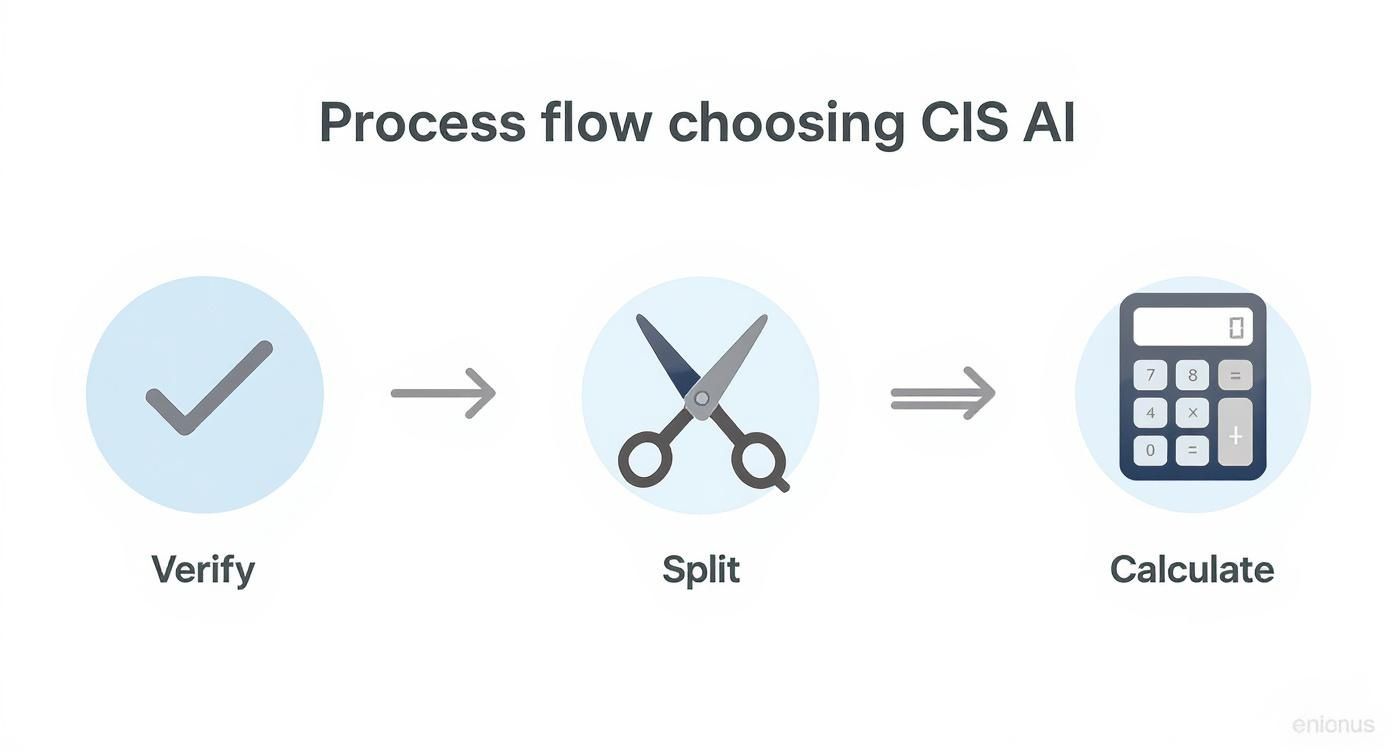
As you can see, the system systematically confirms the subbie's status, separates the costs, and applies the correct tax, all in a matter of seconds.
You'll watch as the AI reads the document, pulling out key info like the subcontractor’s name, invoice number, and date. More importantly, it analyses the line items, intelligently telling the difference between labour and materials. For example, it will recognise "Day Rate - Plastering" as labour subject to CIS, while "Plasterboard and Skim" is correctly identified as materials. If you're interested in the nuts and bolts behind this, you can explore various AI automation strategies that explain how these technologies work across different business areas.
The system then instantly checks the subbie's UTR with HMRC to confirm their current CIS status and calculates the exact deduction. The whole process takes just a few moments, and you're left with a clear summary ready for your approval. This first run is often the 'aha!' moment for builders, where the potential to save hours of manual graft becomes crystal clear. For businesses ready to overhaul their entire financial system, a full technology transformation service can map out a structured path to this kind of efficiency.
Your initial setup is a one-time investment of a few hours that pays back dividends every single month. It replaces the endless cycle of manual data entry and verification with a reliable, automated workflow that protects you from errors and frees up your time to focus on running your business.
So, you’ve got the system in place. What does it actually do day-to-day? How does a pile of subcontractor invoices magically transform into perfectly reconciled accounts? It's less magic and more like an incredibly sharp, super-efficient production line.
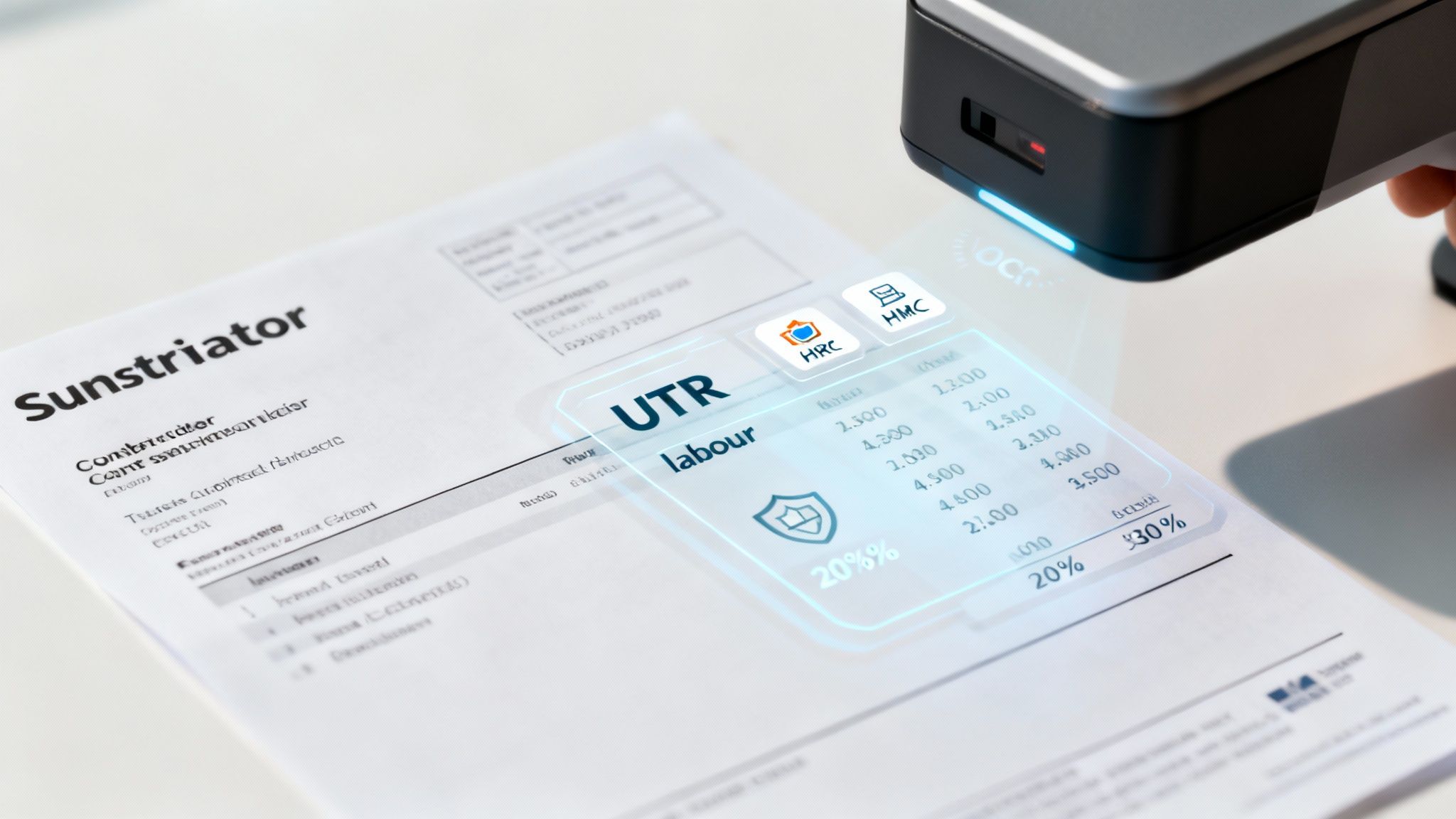
The whole thing kicks off the second an invoice lands in your inbox or gets uploaded to the system. This is where a bit of tech called Optical Character Recognition (OCR) comes in. Think of it as a digital pair of eyes that can read text from any document.
But modern AI doesn't just read; it understands. It’s not just seeing random numbers and letters. It’s identifying the invoice number, the date, who the subbie is, and critically, their Unique Taxpayer Reference (UTR) number.
Once the AI has grabbed the basic details, the real smarts begin. It immediately checks the subcontractor’s name against the list you've already got in the system. This is the trigger that starts the whole CIS workflow.
Next, it meticulously breaks down the line items on the invoice. This is a crucial step and exactly where manual processing often goes wrong. The system is trained to tell the difference between various costs based on descriptions, keywords, and how the invoice is laid out.
With everything neatly categorised, the system has all it needs to get the calculation right, every single time.
Imagine you get an invoice from your go-to plasterer, "ABC Plastering." It looks something like this:
Here’s how the AI handles it in a few seconds, with zero human input:
This whole process eliminates guesswork and kills the risk of human error. Even better, it creates a perfect digital audit trail for every single transaction. In an industry where penalties for incorrect CIS returns can run into thousands, that’s not just a time-saver; it’s a competitive advantage. Studies show that proper automation can slash invoice processing time by over 50%, improving cash flow for everyone involved.
Understanding the nuts and bolts of how to automate invoice processing is the first step towards building a system that truly works on autopilot.
This intelligent workflow doesn't just save time; it fundamentally changes your role. You stop being a data-entry clerk and become an overseer, simply reviewing and approving calculations that the AI has already nailed.
For many builders, this automation slots right into their existing financial software. If you're just starting out, picking the right accounting package from the get-go is vital. We’ve put together a detailed guide on the best cloud accounting software for startups to help you build your financial systems on a solid, efficient foundation.
Filing your monthly CIS return is the last, unavoidable hurdle in the compliance cycle. For countless builders, the run-up to the 19th of the month is a mad dash – a frantic scramble through spreadsheets, paper invoices, and payment records. It’s stressful. But automating this process turns a dreaded task into a simple, two-minute job.
The real magic of a smart, AI-driven system is that it’s working for you all month long, quietly in the background. Every time you process a subcontractor's invoice, the platform is methodically logging every detail. It builds a perfect, real-time record of each payment made and every deduction calculated, creating an unshakeable audit trail.
Because this reconciliation happens continuously, there’s no last-minute panic when the filing deadline looms. No more manually compiling data or cross-referencing different systems. The heavy lifting has already been done, one invoice at a time.
Instead of piecing together a report from scratch, the software simply presents you with a pre-populated CIS300 monthly return. All the information HMRC needs is right there, accurately categorised and ready for you.
This pre-filled return will have everything you need, including:
Your job transforms from data entry clerk to final reviewer. All you need to do is give the summary a quick once-over to make sure it looks right, then click ‘submit’. It really is that straightforward.
The secret is the direct integration between your accounting platform and HMRC. It creates a secure, seamless link that allows for instant submission of your monthly return without ever having to leave the software. This saves hours and practically eliminates the risk of manual filing errors.
The fallout from missing the CIS return deadline is swift and painful. HMRC slaps you with an automatic £100 penalty for being just one day late, and those fines escalate quickly the longer you delay. Manual processes, relying on human memory and someone being available, make it dangerously easy to miss these critical dates.
Automation takes this risk off the table completely. Because the return is essentially ready to go at any point during the month, you can file it well ahead of the deadline. Many platforms even ping you with automated reminders, making sure compliance is never an afterthought.
This proactive approach doesn’t just save you from costly fines; it helps you maintain a clean compliance record with HMRC, which is invaluable for any growing construction business. For a better sense of how this fits with your other responsibilities, our guide on payroll services for small businesses in the UK provides great context on managing all your payment obligations.
By turning your monthly CIS admin into a reliable, automated function, you free up your time and mental energy to focus on what you actually do best—running projects and growing your business.
Making the jump to automation can feel like a big step, especially if you're used to wrangling spreadsheets and relying on a trusty calculator. It's only natural to have a few questions. Let's tackle some of the most common queries we hear from UK builders about bringing in AI to handle their CIS admin.
Honestly, the switch is usually a lot smoother than most people think. Modern accounting tools are built for builders and office managers, not IT wizards. You don't need to be a tech genius. Most platforms will walk you through the setup.
You can typically import your existing subcontractor lists straight from a spreadsheet. The initial legwork, like connecting your bank and HMRC accounts, might take an afternoon. But the time you get back every single month on data entry and reconciliation pays for that small upfront effort almost immediately.
Look at it this way: it’s about investing a few hours just once to claw back dozens of hours every month. That’s more time to focus on your projects instead of chasing paperwork.
Yes, and this is where it really shines. Good systems use something called Optical Character Recognition (OCR) and machine learning to scan and actually 'read' the line items on an invoice.
The AI is trained to spot the difference between labour costs (which get CIS deductions) and things like materials, VAT, or other costs that don't. This automatic splitting is far more accurate and consistent than trying to do it by eye, which massively cuts the risk of making a wrong deduction and getting a headache from HMRC down the line.
This is all done through a secure, official link to HMRC's own systems, known as an API (Application Programming Interface). Think of it as a direct, approved channel of communication.
When you process an invoice for a subbie, the software instantly pings HMRC with their UTR number. It gets an immediate response confirming their current status—whether they're on gross payment (0%), the standard rate (20%), or the higher rate (30%). This completely gets rid of manual lookups and means you’re always using the correct, up-to-the-minute deduction rate.
While the tech is clever, it isn’t magic. If you get a really messy, handwritten invoice or one in a totally unique format, the system might flag it for a quick human check.
But here's the smart part: the AI learns. Every time you confirm a line item from a particular subcontractor, the system remembers. This means it gets more and more accurate with your regular subbies over time. It’s designed to handle the vast majority of your invoices on autopilot and only ask for your help when it genuinely needs it.
Ready to stop wrestling with CIS spreadsheets and get your time back? The team at GenTax Accountants specialises in helping UK builders implement the right technology to automate their contractor admin, ensuring compliance and boosting efficiency. Find out how we can help your business at https://www.gentax.uk.
