



Think of professional accounting services for a small business as your financial navigation system. They're what turn a sea of complex numbers into a clear, reliable roadmap for growth. Instead of just guessing, you get an expert co-pilot to help you steer the company towards profitability, all while avoiding the costly mistakes that can sink a business.

Imagine trying to navigate a ship across the ocean with nothing more than a compass and a gut feeling. You might eventually get there, but you’re missing the detailed charts, weather forecasts, and expert crew that ensure a safe and efficient journey. For a small business owner, that’s exactly what running your finances without professional support looks like.
Bringing in a professional accountant isn't just another line item on your expense sheet—it’s a strategic investment in clarity, compliance, and growth. This partnership frees you up, as the captain, to focus on steering the business forward, making confident decisions backed by accurate, real-time data.
A lot of business owners see accounting as a necessary evil, just another box to tick for HMRC. And while compliance is absolutely non-negotiable, the real value is in turning that raw financial data into actionable intelligence.
A great accountant doesn’t just tell you what you owe in taxes. They help you understand the story your numbers are telling.
This kind of proactive guidance helps you spot the hidden financial icebergs that can sink a promising business before it even gets going.
Today’s economic climate really drives home the need for expert financial guidance. Recent research has shown just how much pressure UK businesses are under, revealing that 54% of small and medium-sized businesses (SMBs) feared they would collapse if hit with another unexpected surge in costs. Despite this, a surprising 62% of these businesses said they don't use a professional accountant to manage their finances, creating a huge support gap. You can read more about these findings on Dext.com.
Partnering with an accounting service isn't just about outsourcing a task; it's like installing a financial early-warning system that provides stability in a volatile market.
This support is crucial for all sorts of business structures. Taking a look at who we help can clarify how specialised services fit your unique situation. Ultimately, it’s about transforming numbers from a source of stress into your most powerful tool for sustainable success, giving you the confidence to build a resilient and thriving business.
Dipping your toe into the world of accounting services for small business can feel like you’re suddenly expected to speak a new language. You’ll hear terms like 'ledgers', 'accruals', and 'reconciliation' thrown around, and it's easy to feel a bit lost.
But don't worry. The core services you actually need are much simpler than they sound. They build on each other logically to give you a clear, complete picture of your company's financial health.
Think of it like building a house. You can't just start putting up walls without first laying a solid foundation. In accounting, that foundation is bookkeeping.
At its heart, bookkeeping is simply the act of recording every single financial transaction your business makes. Every sale, every supplier payment, every expense—it all gets logged meticulously. It’s the daily diary of your business’s financial life, making sure absolutely nothing is missed.
Imagine you're running a café. Your bookkeeping is the detailed list of every coffee bean you buy, every flat white you sell, and every wage you pay your baristas. Without this fundamental record-keeping, you're flying blind, with no real idea of what's coming in or going out. It's the essential groundwork for everything else.
The sheer scale of this service reflects its importance. The UK bookkeeping industry is on track to hit £6.8 billion in revenue in 2025, a figure largely driven by the 5.5 million SMEs that are the backbone of our economy. Many of these businesses choose to outsource this crucial task so they can focus on what they do best, which just goes to show how vital it is.
Once your bookkeeping is in order, you can move on to the next level: management accounts. If bookkeeping is the list of ingredients for your café, management accounts are the reports that tell you which dishes are actually making you money.
These are regular reports—usually monthly or quarterly—that summarise your financial performance and give you a clear snapshot of your business's health.
They typically include:
This is where raw data transforms into useful information. Instead of a long, confusing list of transactions, you get a clear, concise report that helps you make smarter decisions. To get the most out of these, it's worth learning how to read company financial statements.
Finally, we get to the service everyone immediately thinks of when they hear "accountant": year-end accounts and tax returns. This is the annual process of finalising all your financial records for the year and submitting them to the authorities—namely, Companies House and HMRC.
Getting this right is non-negotiable for staying compliant and avoiding some hefty penalties.
While bookkeeping and management accounts are for your eyes only—helping you guide strategy and make decisions—year-end accounts are formal, public-facing documents. They are a legal requirement that summarises your business's entire financial year. Your accountant uses these finalised accounts to calculate how much tax you owe (like Corporation Tax) and files all the necessary returns for you.
Think of it as the grand finale. Your daily bookkeeping and monthly management reports are the rehearsals. They ensure your year-end performance is accurate, compliant, and as stress-free as possible.
These three core services—bookkeeping, management accounts, and year-end filings—are designed to work together as a seamless system. You can explore our approach to accurate bookkeeping services to see how we build this essential foundation. By understanding how they connect, you’re in a much better position to figure out what level of support your business needs not just to survive, but to truly thrive.
It's helpful to split these services into two camps: the essentials you need for compliance, and the strategic services that help you grow. The first group keeps you out of trouble, while the second actively pushes your business forward.
Here’s a simple breakdown:
Understanding this distinction is key. You start with the essentials to build a stable base, then layer on the growth-oriented services as you look to scale and optimise your operations. An effective accountant helps with both.
Once your day-to-day accounting is ticking along nicely, you can start using your finances to actively push for growth. This is the point where you move beyond simple compliance and start tapping into specialised accounting services for a small business—your toolkit for scaling up. Think of it as layering in the right expertise at just the right time.
This diagram shows how the core accounting services build on one another, from daily bookkeeping all the way to your annual compliance duties.
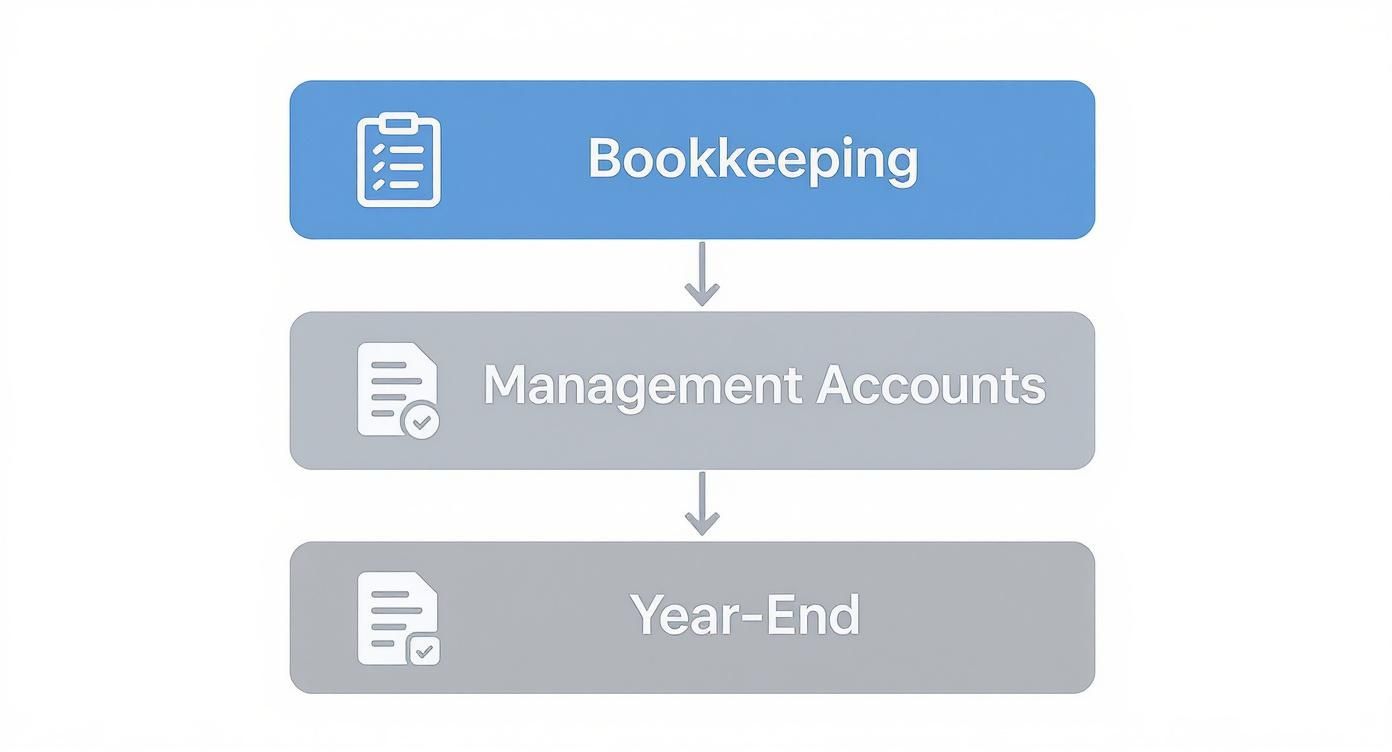
As you can see, a solid bookkeeping foundation is non-negotiable. Without it, you can't generate meaningful management reports or file accurate year-end accounts. Everything flows from there.
As your team grows, managing payroll quickly becomes one of your most critical—and surprisingly complex—jobs. It’s so much more than just sending out salaries. You’re navigating the intricate rules of PAYE (Pay As You Earn), National Insurance contributions, and workplace pension auto-enrolment.
Get this wrong, and you’re looking at serious penalties from HMRC. Just as damaging, you could erode the trust you’ve built with your employees. Professional payroll services take this entire headache away.
They make sure that:
Handing this over removes a massive administrative weight, freeing you up to focus on leading your team instead of getting lost in spreadsheets and calculations.
The moment your business's taxable turnover crosses the government’s threshold (currently £90,000), you must register for Value Added Tax (VAT). This introduces a whole new layer of compliance: collecting VAT on your sales and submitting quarterly returns to HMRC.
VAT can feel like a minefield. You need to know which of your sales are subject to VAT, what VAT you can reclaim on your business purchases, and how to submit everything correctly through Making Tax Digital (MTD) software.
An accountant completely demystifies this process. They handle the calculations, ensure you reclaim every penny of eligible input tax, and file your VAT returns accurately and on schedule. This simple step prevents costly errors and late submission penalties down the line.
As your ambitions grow, you’ll start needing high-level strategic financial advice—the kind a Chief Financial Officer (CFO) would provide. But for most small businesses, hiring a full-time, six-figure executive just isn’t on the cards. This is where a Virtual Finance Director (VFD) changes the game.
A VFD, sometimes called a fractional FD, gives you CFO-level insights and guidance on a part-time, flexible basis. This service bridges the gap between your day-to-day accountant and a full-time financial executive, giving you top-tier strategic advice that actually fits your budget.
A VFD focuses on the bigger picture, helping you with:
This strategic input transforms your financial data from a backward-looking record into a powerful, forward-looking tool for making smarter decisions. If you're curious about this powerful option, you can explore the benefits of a fractional finance director and see how it could give your business the strategic edge it needs to scale successfully.
Let's get straight to it. One of the very first questions any business owner asks is, "So, what's this actually going to cost me?" It's a crucial question. Understanding how accountants price their services is key to finding a partner that not only fits your budget but feels like a real investment in your company’s future.
This isn’t about hunting for the cheapest deal. It’s about finding the best value.
Thankfully, the world of accounting has moved on. The old, unpredictable model of hourly billing is fading out, making way for transparent, predictable structures that are better for everyone involved.
Traditionally, accountants billed by the hour. You'd work with them all month, and then a surprise bill would land on your desk based on how much time they clocked. This approach often created a weird tension, making you think twice before picking up the phone with a quick question, purely for fear of "being on the clock."
Modern, tech-savvy firms have flipped this on its head by embracing a much better model: the fixed-fee monthly subscription. For small businesses, this is a genuine game-changer. You pay one, predictable amount each month for a clearly defined set of services. That predictability is brilliant for budgeting and managing your cash flow.
A fixed-fee model changes the whole dynamic. It turns a transactional relationship into a proper partnership. You feel free to communicate openly and ask questions without worrying about an unexpected bill, which always leads to better advice and fewer costly mistakes down the line.
To get a feel for how different firms package their services, you can explore pricing models for accounting services from various providers.
So, what actually determines the price you'll pay? It's not just a number plucked out of thin air. The cost is usually tied to a few key factors that reflect the amount of work and expertise your business needs.
Business Complexity: A solo freelance consultant has far simpler needs than a limited company with five employees, stock to manage, and multiple online sales channels. The more moving parts in your business, the more work is involved.
Transaction Volume: How many sales and purchases are you processing each month? A café with 500 monthly transactions is naturally going to need more bookkeeping time than a consultant who issues 50 invoices.
Service Scope: Are you just looking for the bare minimum to keep HMRC happy at the year-end? Or do you need the full works, including monthly bookkeeping, VAT returns, payroll for your team, and strategic financial advice? The more support you need, the higher the investment.
Level of Strategic Input: A basic compliance package is one thing. A service that includes regular performance reviews, cash flow forecasting, and proactive tax planning from a senior accountant or Virtual FD is something else entirely and will be priced accordingly.
Deciding between hourly billing and a fixed-fee subscription comes down to what you value most: flexibility for one-off tasks or predictability for ongoing support. Let's break down the pros and cons.
Ultimately, the fixed-fee model aligns the accountant's goals with yours—helping your business run efficiently and grow—rather than just clocking up hours.
Understanding these elements helps you see where the value truly lies. You're not just paying for tasks to be ticked off a list; you're investing in peace of mind, expert guidance, and the strategic insights that will help your business thrive.
You can learn more about how we bundle these elements by reviewing our comprehensive accounting services. Asking the right questions around these factors will help you find a transparent pricing structure that aligns perfectly with your business goals.

Picking an accountant is one of the biggest decisions you'll make as a business owner. This isn't just about hiring someone to file your taxes once a year; it’s about finding a strategic co-pilot who will be with you for the entire journey. Get it right, and they won't just keep you compliant—they'll actively help you grow.
The stakes are high. As of 2025, the UK is home to around 5.45 million small businesses, forming the backbone of our economy. While an impressive 92.3% make it through their first year, that number plummets to just 39.4% by year five. That stat alone shows just how tough the environment is, and why expert guidance is so critical. You can discover more insights about the UK business landscape to understand these challenges better.
With so much on the line, a rushed decision can be incredibly costly. You need to look past the price tag and really dig into their expertise, their approach, and whether they truly align with where you want to take your business.
Every business is different, and a good accountant gets that. They should understand the unique financial quirks of your sector. An accountant who's brilliant for a construction firm might be lost with an e-commerce brand that needs to understand payment gateways, stock management, and international VAT.
When an accountant has experience in your industry, they already speak your language. They know the common pitfalls, the hidden opportunities, and the specific tax rules that apply to you. This kind of specialised knowledge can save you a fortune in the long run, not to mention a whole lot of stress.
Here's a scary thought: in the UK, technically anyone can call themselves an 'accountant'. That’s why checking for professional qualifications is absolutely non-negotiable. Look for credentials from recognised professional bodies, which ensures they are held to high ethical standards and are up-to-date with the latest regulations.
Key UK accounting bodies to look out for include:
Seeing a membership logo from a reputable body like ACCA gives you peace of mind. It's proof of quality, ongoing training, and professional conduct.
Modern accounting runs on technology. Your accountant must be comfortable and fluent with cloud accounting software like Xero, QuickBooks, or FreeAgent. This isn't just a "nice-to-have" anymore; it's essential for efficiency, accuracy, and getting real-time insight into your finances.
A tech-forward firm uses software to automate the boring stuff, like data entry, which frees up their time to focus on what really matters: giving you valuable, strategic advice.
An accountant who still works with spreadsheets and shoeboxes full of receipts is stuck in the past. You need a partner who uses technology to make your life easier and your business smarter.
When you have your initial meetings, don’t hold back. Treat it like an interview for a critical role in your business, because that's exactly what it is.
Come armed with a list of questions to see if they're the right fit:
Finding the right accounting partner is a decision that will pay dividends for years to come. Take your time, do your homework, and choose someone who is as invested in your success as you are.
Every business owner has questions when it comes to managing the money side of things. It’s completely normal. To help you get a clearer picture, here are some straightforward answers to the most common queries we hear day in, day out.
So many founders ask if their business is "big enough" to need an accountant. But honestly, it’s less about your size and more about your ambition and the complexity you’re dealing with. A good rule of thumb? Hire one as soon as your finances start to feel like a burden, or when you realise your time is better spent actually running the business.
There are a few key moments when it becomes a no-brainer:
The best time to bring in professional accounting services for a small business is before you’re in a tight spot. Getting ahead of the game with proactive advice is always more valuable than calling for help when something’s already gone wrong.
This one trips a lot of people up, but the distinction is actually quite simple. Imagine you're building a house. Your bookkeeper is the skilled tradesperson on the ground, carefully laying every single brick. Your accountant is the architect who designed the master blueprint and ensures the whole structure is sound, safe, and fit for purpose.
A bookkeeper meticulously records the daily financial transactions—every sale, purchase, and payment. An accountant then takes that beautifully organised data and uses it for high-level analysis, strategic tax planning, and big-picture advice.
In short, your bookkeeper keeps your financial diary perfectly up to date. Your accountant reads that diary and helps you write the next chapter. Both roles are vital, but they work at different levels.
Cloud accounting platforms like Xero or QuickBooks have completely transformed how small businesses manage their finances. The days of wrestling with clunky spreadsheets or drowning in a shoebox full of receipts are over. Now, everything lives in one secure, online hub that you can access from anywhere.
This gives both you and your accountant a live, real-time view of your company's financial health. You can check your cash flow on your phone, send an invoice from a coffee shop, or snap a photo of a receipt the second you get it.
For your accountant, it means less time wasted on tedious data entry and more time focused on what really matters: giving you sharp, valuable advice based on information that's just minutes old, not months out of date. It’s a massive step forward.
Before diving in, it helps to have a bit of background knowledge. Taking a look at some expert tax advice for small businesses will give you a better feel for the landscape. This little bit of prep work means you'll be able to get so much more value from your new accounting partner.
Ready to turn your finances from a source of stress into your greatest asset for growth? At GenTax Accountants, we combine expert knowledge with powerful technology to provide the clarity and support your business deserves. Get in touch with us today for a free consultation and discover how our dedicated accounting services can help you thrive.
