



Hiring an accountant for your small business in the UK isn't just another box to tick – it's one of the most important decisions you'll ever make. An accountant does far more than just your taxes; think of them as a strategic partner, a co-pilot providing the financial foresight you need to survive and grow in today’s tough economic climate.
Running a small business is a constant balancing act. One minute you’re managing day-to-day operations, the next you’re chasing new business, all while trying to keep an eye on the competition. It’s easy to let the complexities of UK tax law and financial management slide down the priority list, but honestly, that’s often what separates the businesses that make it from those that don’t.
Too many owners see their accountant as an annual expense for tax season. But their real value is unlocked when they become a trusted advisor. They’re the one who can actually make sense of your financial data, helping you make smart, informed decisions on everything from pricing and payroll to expansion and investment.
Of course, a good accountant makes sure your business stays on top of its regulatory compliance obligations, saving you from HMRC headaches and potential penalties. But their real magic lies beyond the basics.
They can help you:
The reality is, a shocking number of UK SMEs are trying to figure this all out alone. There are around 5.49 million SMEs in the UK, but a recent survey revealed that only 38% work with an external accountant.
This is a huge risk, especially when you hear that 54% of business owners say another major cost increase could force them to close, and 46% have recently struggled with cash flow. These are the very problems an accountant is trained to solve.
Your accountant should be the first person you call when making a big business decision, not just when your tax return is due. They provide the objective, data-driven perspective needed to turn ambitious goals into achievable realities.
This proactive partnership is what separates businesses that just scrape by from those that truly thrive. Whether you're a contractor, a growing agency, or an eCommerce store, understanding who we help can clarify the specific value an accountant brings to your unique situation.
Every business is different, and so are its accounting needs. A freelance designer working as a sole trader simply won't need the same support as a growing eCommerce shop set up as a limited company. Getting this right from the start is the key to finding an expert who fits your budget and your goals, without paying for services you don’t actually use.
Think of your business structure as the starting point. It dictates the bare minimum you need to do to stay on the right side of HMRC and Companies House. Once you’ve nailed that down, you’ll have a clear 'shopping list' of must-have services to take to potential accountants.
This flowchart can help you visualise if getting professional help is the right move, especially when you start feeling the pinch from cash flow pressures or rising costs.

As you can see, worries about cash flow and the fear of spiralling costs are often the main triggers that convince business owners it’s time to call in a professional.
A good accountant should be able to provide the specific services your business needs to stay compliant. Below is a quick comparison of the essentials for different UK business structures.
This table shows the baseline compliance tasks, but your actual needs will depend on your industry, turnover, and growth plans. Now, let’s dig into what this means in practice.
If you're a sole trader, your financial world pretty much revolves around one thing: the annual Self Assessment tax return. Your main priority is finding an accountant who can accurately tot up your profits, identify every single allowable expense, and get that return filed with HMRC on time.
It might sound simple, but a savvy accountant makes a huge difference. They know exactly what you can claim for – from mileage and use-of-home costs to professional software subscriptions – making sure you don't pay a penny more in tax than you have to.
Running a limited company? The paperwork and responsibilities ramp up significantly. You’re not just dealing with HMRC anymore; you have to keep Companies House happy, too.
An accountant for a limited company will be managing a much bigger checklist:
To get a feel for what’s involved, you can take a closer look at the annual accounts services we offer.
Beyond the standard structures, some business types have their own unique headaches. Contractors, for instance, especially those trying to navigate the minefield of IR35 legislation, absolutely need an accountant who lives and breathes this stuff. They can provide critical advice on your employment status for tax purposes.
eCommerce businesses have a completely different set of challenges. An accountant with real experience in this space will understand the fiddly details of:
Choosing an accountant is about finding someone who gets your business. A generalist can file a tax return, but a specialist who understands your industry's quirks can offer strategic advice that genuinely helps you grow. This is what turns an accountant from a necessary cost into a valuable partner. They need to handle where you are today, and be ready for where you want to be tomorrow.
Figuring out how accountants for small businesses in the UK structure their fees is a massive step towards managing your budget and avoiding any nasty surprises down the line. Let's be honest, cost is a huge anxiety for any owner, but picking the right pricing model can turn your accounting from a painful expense into a predictable, high-value investment.
Let’s break down the most common ways firms charge for their work.
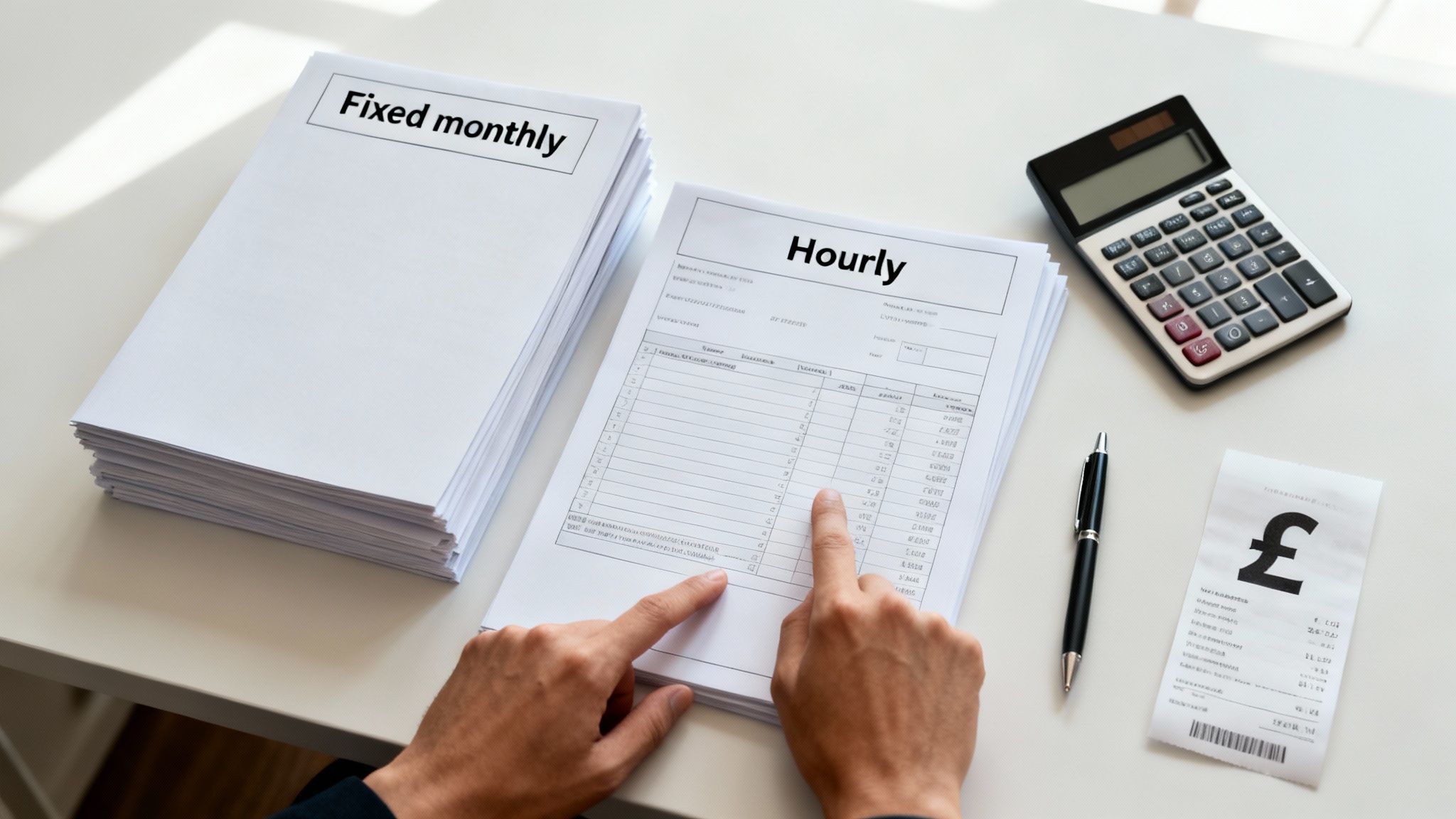
You’ll mainly come across two models: fixed monthly fees and the traditional hourly rate. Each has its own pros and cons, making them a better fit for different types of businesses and stages of growth. Knowing the difference is the first step to making a smart financial decision for your company.
A fixed monthly fee is exactly what it sounds like. You agree on a clear scope of work—things like your annual accounts, VAT returns, and payroll—and you pay the same amount every single month. This model has become incredibly popular with small businesses for one simple reason: predictability.
For a startup or any business on a tight budget, knowing exactly what your accounting will cost is a game-changer. It makes managing your cash flow so much easier and gets rid of that nagging fear of a huge, unexpected bill landing on your desk.
This model also encourages a better relationship with your accountant. You’re far less likely to hesitate before picking up the phone with a quick question when you know you’re not being billed for every minute.
The only catch? You have to be crystal clear on what’s included. If you find yourself regularly needing help with things outside the initial agreement, these will usually be charged as extras.
The classic model is charging by the hour for any work done. It offers flexibility and can actually be more cost-effective if your needs are minimal or just pop up now and then.
A great example is a sole trader who only needs a hand with their year-end Self Assessment. Paying an hourly rate for a few hours of work is often far more economical than a monthly retainer they don't really need.
The big drawback here is the lack of certainty. A complicated HMRC enquiry or a messy set of books can make costs spiral, and fast. It completely throws your budget out the window. This model can also discourage communication, as you find yourself worrying about being "on the clock" for every email or phone call.
The best pricing model really comes down to your business needs and whether you want a partner or a service provider. A fixed fee fosters an ongoing relationship where advice is part of the package. Hourly billing treats accounting as a task-based service you dip into when required.
Ultimately, you’re looking for a structure that gives you real value. Don't just fixate on the price tag; look at what's actually included. A slightly higher fixed fee that covers unlimited advice and strategic planning could save you a fortune in the long run.
Take a look at the different accounting services on offer and see how they can be bundled into a cost-effective package that genuinely supports where you want your business to go.
In today's world, an accountant still drowning in spreadsheets and paper ledgers can seriously hold your business back. The best accountants for small UK businesses are the ones who embrace technology – not just to be efficient, but to give you a crystal-clear, real-time picture of your financial health.
Honestly, your accountant's tech stack is just as important as their qualifications.
A modern firm absolutely must be skilled with leading cloud accounting platforms. This isn't just a nice-to-have; it's a fundamental requirement. Without it, you're constantly looking in the rearview mirror, making crucial decisions based on old, outdated information.
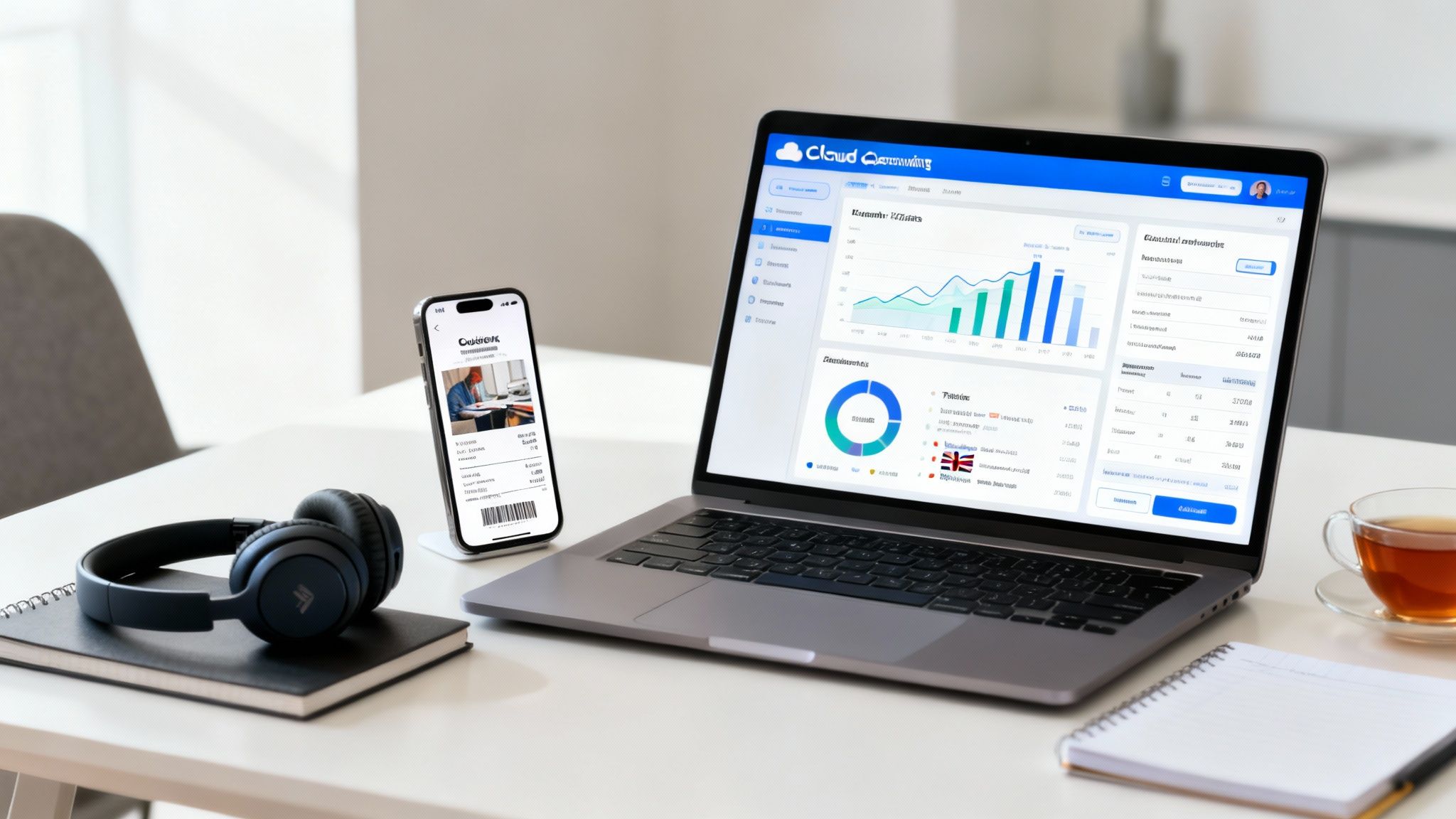
This kind of software gives you a live dashboard of your business's performance, accessible anytime, anywhere. It’s the difference between guessing and knowing.
Being comfortable with platforms like Xero or QuickBooks is just the starting point. The really great, tech-savvy firms go further. They use a whole suite of integrated tools to automate the tedious, time-consuming tasks that used to eat up an accountant's day.
This is where you, the business owner, see the real value.
Think about tools that automate things like:
This move towards automation is a game-changer. Market surveys show that bookkeeping and payroll services still make up nearly 30% of a typical UK accountancy firm's workload. By automating these jobs, your accountant frees up their time to focus on what really matters: giving you strategic advice to help you grow.
An accountant who invests in technology is investing in their ability to serve you better. They are shifting their focus from being a data processor to a strategic advisor, which is exactly the kind of partner a modern small business needs.
When you're interviewing a potential accountant, don't be shy about digging into their tech. Their answers will tell you a lot about how efficient and forward-thinking they really are.
Here are a few sharp questions to get you started:
Finding a partner who is as comfortable with technology as you are is vital. It’s the foundation for building a streamlined, efficient, and scalable business.
Hiring an accountant isn’t just about finding a number-cruncher. Think of it as an interview where you’re in the driving seat, looking for a genuine partner for your business. To get it right, you need to dig deeper than just their fees.
The best questions will reveal their experience, how they communicate, and whether they’ll be a proactive advisor or just a reactive bookkeeper. Your aim here is to find someone you can really trust for the long haul. A great place to kick things off is by getting a feel for their experience with businesses just like yours.
Start by asking about their client base. Do they already work with other eCommerce brands, creative agencies, or contractors in your sector? An accountant who already gets the specific challenges you face—from VAT on digital services to the minefield of IR35—is worth their weight in gold.
Here are a few essential questions to see if they’re the right fit:
The demand for solid financial guidance is definitely on the rise. Recent data shows that 68% of accountants reported clients needed more support with financial management, while 81% grew their client lists in the last year. This just goes to show how crucial it is to find a proper strategic advisor, not just a form-filler.
Knowing what questions to ask is only half the battle; you also need to know the warning signs. The interview process can quickly tell you if an accountant isn't going to be a good fit. When you're looking for accountants for small business UK, keep a sharp eye out for these red flags.
An unwillingness to be totally transparent on pricing is a huge warning sign. If they can't clearly explain their fee structure or what’s included, walk away. Hidden costs and surprise bills are the last things you need when you're trying to manage a budget.
Other deal-breakers to watch out for include:
Ultimately, vetting a professional service provider follows the same principles, no matter the industry. The kind of rigorous checks discussed in guides to finding the best IT support for small businesses in the UK—where you evaluate features, pricing, and suitability—apply just as much here. Do your homework, and you can find a partner you can truly rely on.
Right, let's get into the questions I hear all the time from business owners just starting their search for an accountant. I've kept the answers practical and straight to the point, so you can move forward with confidence.
It’s a common mix-up, but their roles are quite distinct.
A bookkeeper is all about the day-to-day. They’re the ones meticulously recording every single financial transaction—every sale, every purchase, every payment. Their job is to keep your financial records organised and accurate, which creates the foundation for everything that follows.
An accountant takes that organised data and uses it to see the bigger picture. They'll prepare your formal financial statements, handle the more complex tax returns like Corporation Tax, and offer strategic advice on things like cash flow, tax planning, and genuine business growth.
Think of it this way: a bookkeeper records your financial past with precision. An accountant helps you interpret that past to successfully plan your financial future.
Plenty of founders start off doing their own books, and that's absolutely fine. The real trigger for hiring a professional usually comes when your business structure changes or things just get too complex to handle alone.
You’ve hit a key moment to bring in an expert when you:
Another massive sign? When the time you spend on admin is actively pulling you away from the work that actually makes you money. If you find yourself losing sleep over compliance instead of focusing on your customers, it’s your cue to find a pro.
Honestly, not anymore. While having someone local is great if you genuinely value regular face-to-face meetings, modern tech has made geography pretty much irrelevant for most businesses.
Thanks to cloud accounting software and video calls, a fantastic accountant can be based anywhere in the UK. In fact, a remote accountant might even be a specialist in your specific industry—like eCommerce or creative agencies—offering a depth of expertise that a local generalist just can’t match. It all comes down to what you value more: in-person chats or niche expertise and digital efficiency.
This one is critical. The term 'accountant' isn't legally protected in the UK, which means anyone can technically call themselves one. That’s why checking their credentials is so important for your own protection.
You need to look for membership in a recognised professional body. The most respected ones are:
Being a member of one of these bodies guarantees they follow a strict code of ethics and are committed to keeping their skills up to date. It’s the peace of mind you need to know your business finances are in safe, competent hands.
Ready to get the expert financial support your business deserves? At GenTax Accountants, we combine tech-savvy solutions with dedicated support to help you grow. Get in touch today for a free consultation.
